
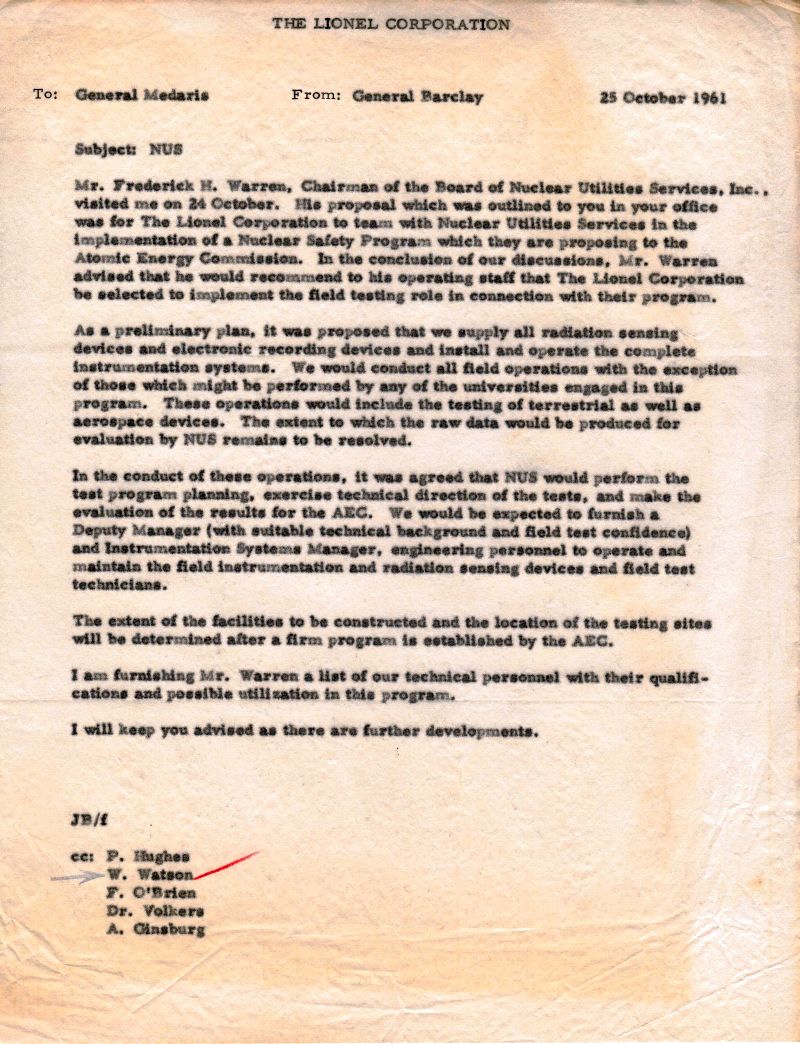


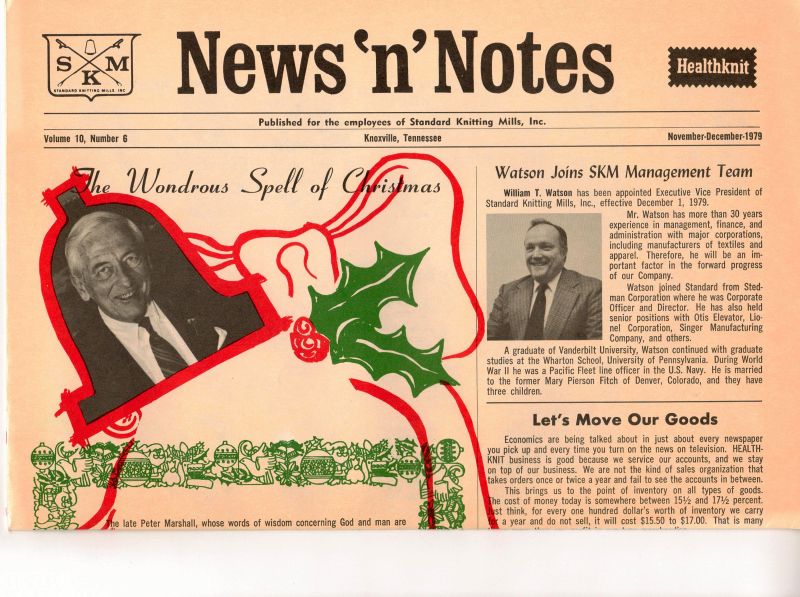
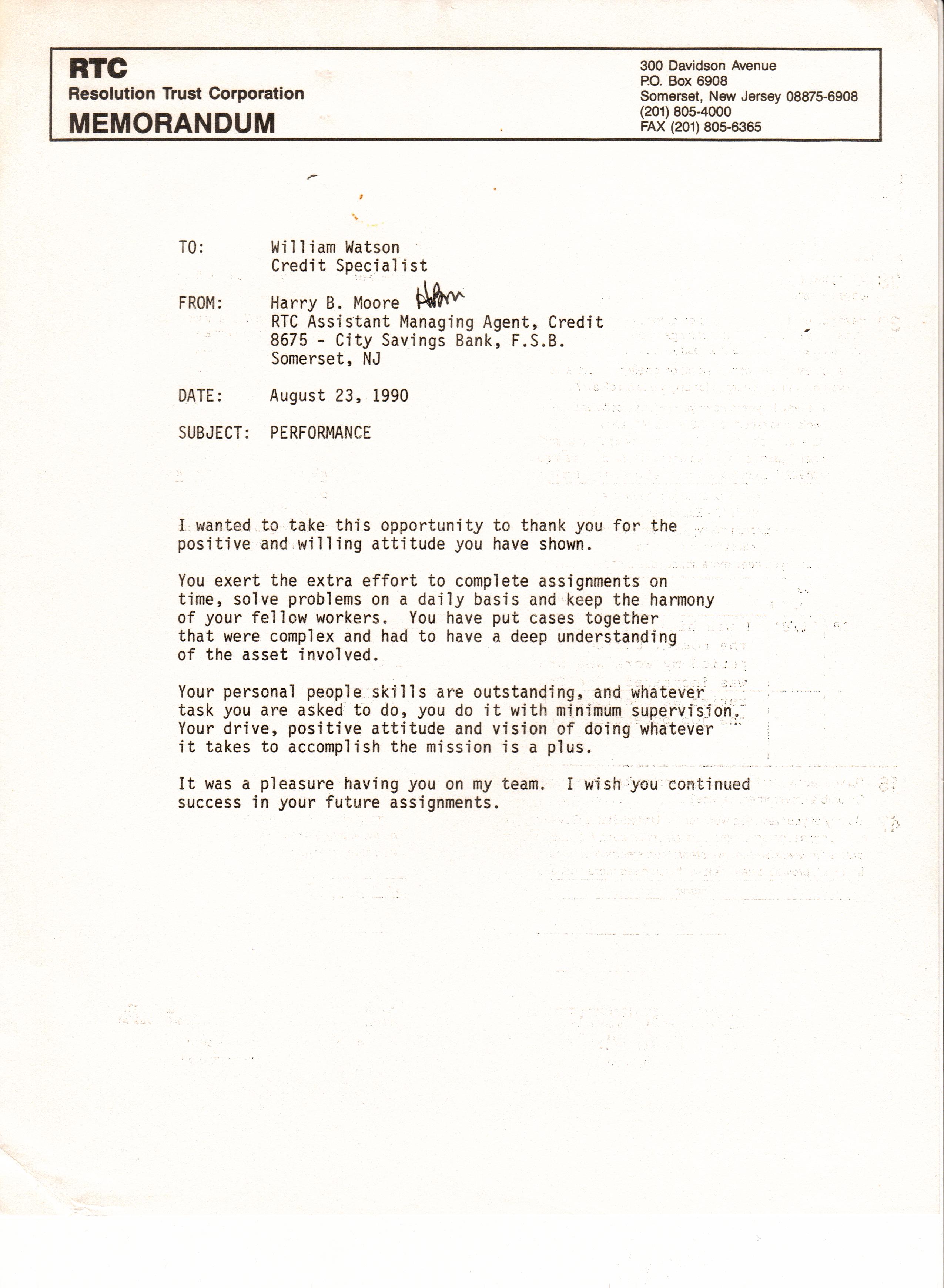
As I Recall Draft by Willam Taylor Watson III "Bill"
Copyright 1995 all rights reserved
Adapted for the internet by George Fitch Watson copyright 2015 all rights reserved
Preface
My children have importuned me over many years to write down my recollections of people, events or my feelings at certain times in the past. I dismissed them at first as casual interest of a passing nature which would soon be forgotten. I also felt that it required more ego than I possessed to burden others with my thoughts and reactions. My first reaction to anyone's memoirs is one of thinking that they want to draw attention to themselves.
The persistence of my family have given more credibility to their seeming desire.
Then too, I have pondered the fact that I regret not having queried my grandparents, parents, uncles, aunts, cousins and others about just this kind of thing. How great it would be, I thought, if I could hear what soldiers in various wars actually said and did - particularly those related to me. And so the theme runs through other thoughts - why not find the scoundrels who anteceded us and hear their version of events - how they felt at the time. What was everyday life like to my ancestors? If I wondered, might not those who followed me also be curious?
"The years teach much that the days never know" was true when first written and is true today. I have lived long enough to know that historians write what they remember or what they want us to remember. This often gives a different view - "different spin" we say - than that held by some and often may even differ from the facts.
Thus I became persuaded and my ego grew enough to believe that someone might want to see the world turn as I see it - perhaps "As I saw it" would be more accurate to the reader.
This is my "spin".
William Taylor Watson III Knoxville, Tennessee 1995
As I Recall
I was born on October 20, 1922 (so they tell me). I don't remember anything about the event but they tell me it happened in a front bedroom upstairs at 2311 Elliston Place in Nashville, Tennessee. That would have been my maternal grandparents' house. It later became Mom's & Dad's house and we lived there for a while before World War II (WWII) and again later. (We moved to 3705? Richland Avenue in Nashville and lived there for a while during WW II while my sister and her children lived with us. Her first husband, Fred Rogers, was a pilot in the Army Air Force and was killed in the South Pacific Theater during WWII.)
Dad's Family
Dad was born on July 19, 1892 in Memphis and died July 14,1969. Mom was born on May 20, 1896 and died on August 8, 1980. Mom and Dad were married in Bon Air, Tennessee on August, 24, 1919. I believe he was still in the army, having been an artillery officer in Europe in World War I. In October 1994, my wife (Perry), my daughter (Mary), son George and I visited Samur, France. It is one of the places Dad trained to be an artillery officer. He was in charge of a battery of three 75mm cannon in WWI battles at the Meuse-Argonne and Chateau-Thierry.
(GFW note: His obituary shows he served in the Mexican Border Campaign with Co. I, First Tennessee Infantry Regiment then 115th Field Artillary in World War 1 and became a lieutenant at Saumur Artillery School in Saumur France. Then he served with the 18th Artillery of the Third Division and in the Army of Occupation and the end of the war.)
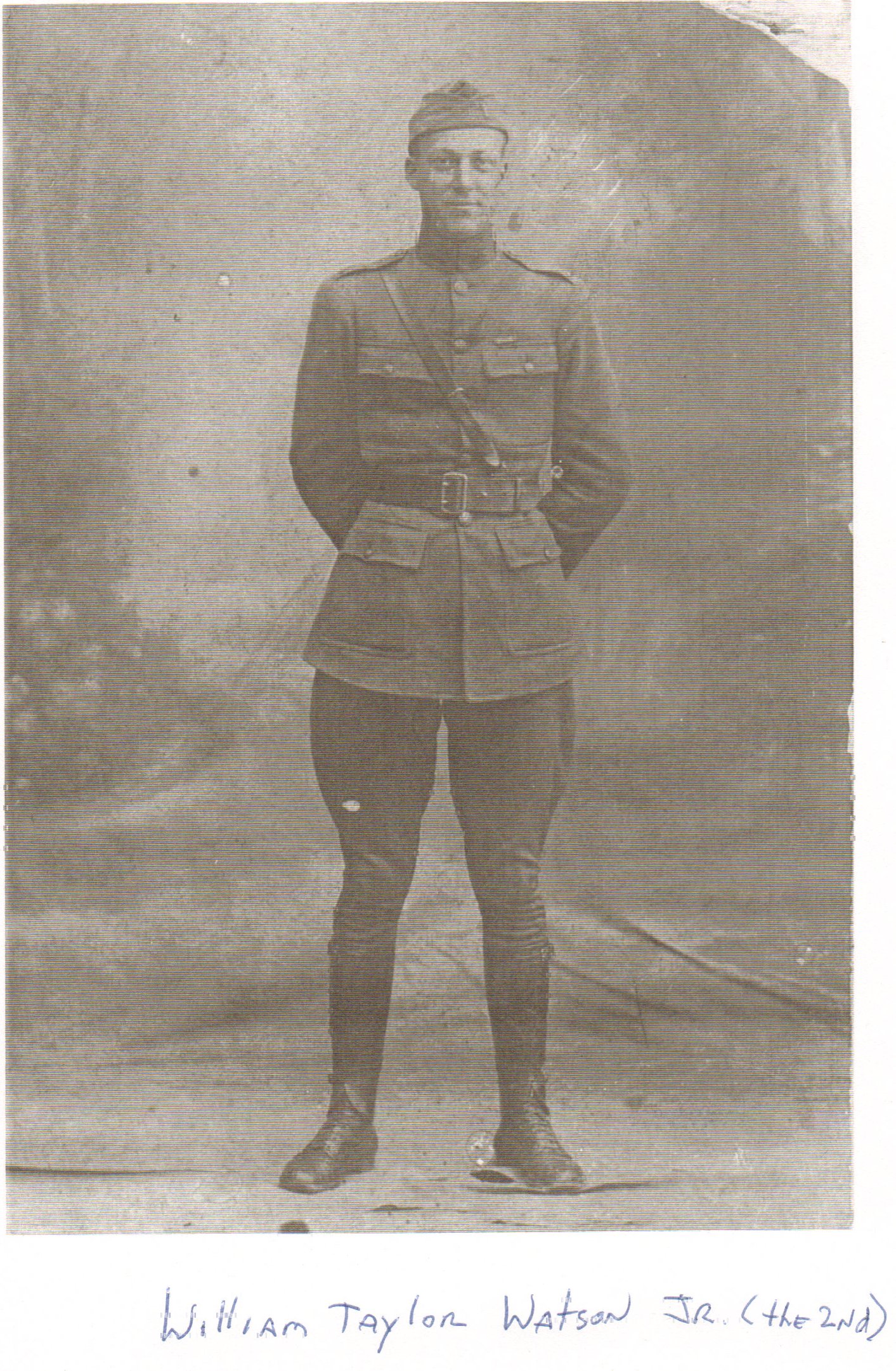
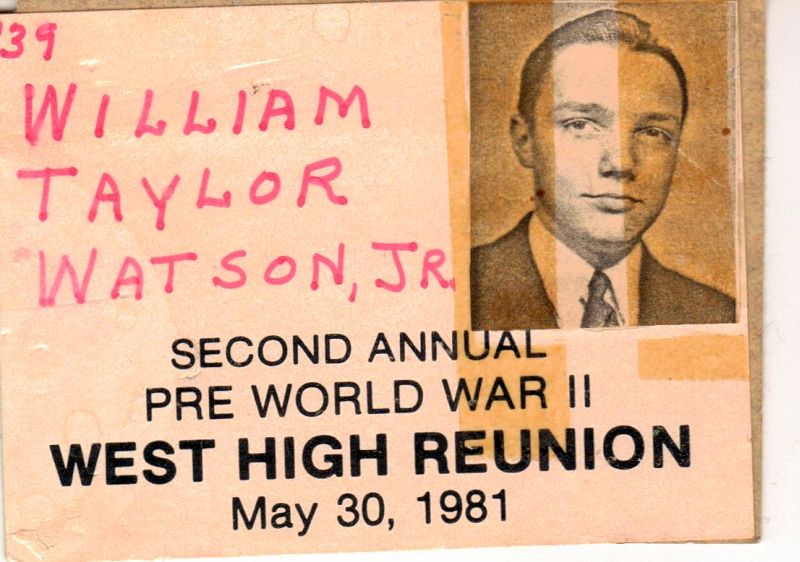
William Taylor Watson Jr photo in his World War (One) uniform closeup
Dad's family were Memphians. His Dad, the first William Taylor Watson, was born May 18, 1850 in Mississippi and died on June 20,1920. He was one of several children. He was a professor and, I think, was Headmaster at Memphis University School (MUS) in Memphis. It was and is a very prominent college prep school. I believe Grandad taught Latin, Math and Penmanship (which was important in those days).

William Taylor Watson Sr the 1st
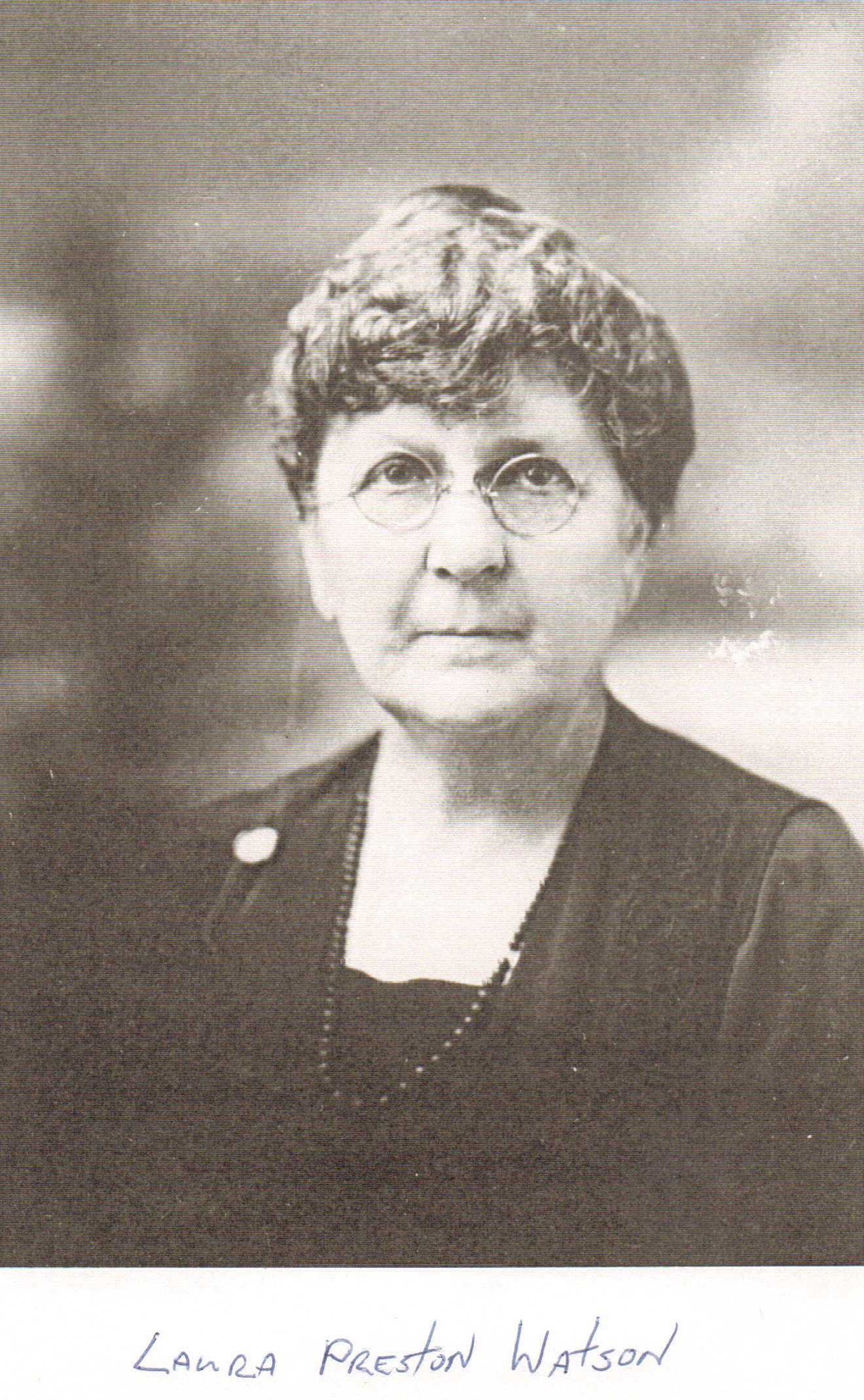
Laura Preston Watson
My nephew, Bobby Watson, attended MUS when his father, my brother Bobby, was a Vice President of Union Planters Bank in Memphis.
Grandad played the violin and was given a violin by a man who played it in a famous symphony orchestra in Europe (Vienna I think). We still have the violin. It was altered to attach a longer handle because the man who gave it to Grandad was too big to use a normal one.
My paternal Grandmother was born Laura Francis Preston in Lebanon Tennessee on April 10, 1861 and passed away on May 11, 1942. She was tall and a handsome woman. Even in old age she stood erectly and had a gracious dignity about her. We called her "Granny".
When I was small Granny would sit by my bed and read to me. I used to watch Granny talk because I wanted to see her chin wiggle. She had developed what I call a "wattle" which jiggled as she read me stories. It fascinated me. (Now I have a wattle.)
Granny was always dressed in black - in mourning for her deceased husband. I never saw her in any color. She wore pinz-nez glasses which were on a cord attached to a pin. If she took them off, the elastic retracted into the pin and helped hold the glasses on her chest.
When Granny visited us, she often walked to the grocery on West End Avenue - about 5 or 6 blocks away from our house on Belcourt - and walked back with a bag of groceries. In those days we also had a grocery which delivered. They even put the groceries on the kitchen counter. They would telephone every morning and ask Mom what we wanted and it would be delivered that day. Mom would talk to the grocery man, ask him what they had specials on, what he thought was good, etc. One of the four owners of the grocery lived next door to us. He was well liked. His name was Roy Green. Later he entered politics and ran for mayor of Nashville.
In later years Granny sold her house and spent part of each year with each of her four remaining children (Grace having died in the 1919 flu epidemic). That sounded good at first, but was hard on her because she had always had her own house and now she had none and had to move every 3-4 months. She also lost a lot of privacy and her lifelong friends because some of us lived in other cities. When with us, she shared a room with Sis and they shared a small closet.
I remember saying a bad word in Granny's presence. She took me by the ear and marched me to the bathroom and washed my mouth out with soap. I didn't say bad words again in her presence. I still can taste the soap when I think about it.
When I was very young, perhaps one or two, I was very ill - had pneumonia. This was before we had wonder drugs to protect us against this ailment. The doctor thought I was about dead and would expire shortly. He told the family they could go in and be with me for my last minutes or hours. I am told that Granny went in, picked me up and poured bourbon down my throat. It is reported that I immediately perked up and soon recovered.
Granny was one of those strong, moral Southern women who hated yankees. She remembered what they did to the South after the civil war. She never spoke of Northerners without hate in her voice.
I was always told that we were related on Dad's side of the family to Andrew Johnson and Zachary Taylor. My middle name is Taylor, presumably in his memory.
Grandad Watson and Granny had five children of which Dad was the third and was the oldest boy. Willette was born August 17, 1887, Grace was born on July 28, 1889, Dad was born on July 19, 1892, Anastasia (Auntie to us) was born on August 16, 1894 and Herbert Wyatt Preston Watson (Uncle Pres) was born on May 28, 1896.
Aunt Willette married Albert Lavallette Duval (Uncle Allie to us). They had a daughter, Willette, whom we all called "Baby". She had a son named Tom White who lived for years in Memphis and worked for the government - think the city- but who has disappeared. He didn't show for his mother's funeral. It was rumored that he might have been in trouble and did not wish to be arrested. I heard that he had been arrested several times for driving under the influence of alcohol and didn't show up in court for the last one.
Grace married William Little and they had two sons. One was William who graduated from West Point and had a career as an army officer. He attained the rank of Colonel as I recall it. I think he and his family lived near Washington, DC., perhaps Arlington, Virginia. I never met him. The other son was John Little, called Jack, who graduated from the Naval Academy and became a naval officer. He visited us in Nashville one time. He was killed at Pearl Harbor on December 7, 1941. He was a Lt(jg) on the USS Utah, a battleship which was sunk that morning. I saw his name inscribed on the Pearl Harbor Memorial when I was in Honolulu in August, 1995. Grace and her husband both died from influenza during the 1918 epidemic which killed many people in the USA. Jack was the only one of that group whom I ever met.
Anastasia, "Auntie" to us, married G. Kemp Strickland (Uncle Strick) on September 20, 1920. They had no children and she frequently said how much she and Uncle Strick appreciated Mom and Dad letting them share their children with them. Auntie often visited and went with us on trips. She was full of fun and we had many laughs. Uncle Strick was a bank examiner (for the FDIC I think) and was an impressive, handsome man. He was very likable. He loved to play golf and thought Memphis was the greatest place in the world. He died in 1975 and she in 1986. When she died, she left her possessions to us (three brothers and sister).
Uncle Pres married a beautiful woman, Isabel Beasley. They had two children, Ethel and Petie. They lived in Montgomery, Alabama as far back as I remember. We used to visit Granny in Memphis. She had a house on Goodbar. Uncle Allie and Aunt Willette lived with her. I recall driving to Memphis. We'd drive for hours through swamp-like land near the Tennessee River and cross it on a ferry. There was no bridge then! I recall how frightened we kids were when we heard that one of the ferries had sunk or that a car went into the river trying to get on or off the ferry. I now doubt the tales but was frightened then.
There were two ferries. One would be on the East shore and the other on the West shore. They'd cast off at the same time and pass each other in the middle. A typical ferry might carry mule drawn wagons, a bus and cars. It didn't have a great capacity.
While at Granny's, Aunt Willette and Uncle Allie would take us to the Memphis Zoo. At night Aunt Willette would help me undress for bed while Auntie would help Crockett. I recall that they made it a race to see who could finish first. Pretty clever, eh?
One year when we went to Memphis, Crockett and I were at Auntie's apartment building and went exploring through the garages. We found an old car - it was antique even then - and proceeded to play on it. The owners discovered us and, while we did no damage, we got a good whipping for invading someone's property without permission.
One year, Sis and I rode the bus with Dad from Memphis to Nashville. The driver stopped in a small town to go to the bathroom. After he got off, Dad said "I think I'll jump off and buy a pack of cigarettes." He did and then the driver came out, started the bus and began to drive away. By this time, Sis and i were crying and another passenger told the driver that one of his passengers had stepped off. He waited and Dad got back on board.
Uncle Pres was a salesman type - very congenial and often hosted us at his beach house in Laguna Beach, Florida. We had many good times there and later rented it from Aunt Isabel for many summer vacations after Uncle Pres died of a heart attack in November of 1962. Laguna Beach is West of Panama City, Florida on the Gulf and has a beautiful beach. His house was just across the road from the beach. We could leave the house, cross the road and a sand dune and be on the beach. The house had a screen porch along the front side facing the ocean. There were two hammocks and several sofas and chairs there to lounge in and see the Gulf. The front rooms of the house had large windows which looked out onto the porch. One could sit in the front room and see out to sea across the porch. Many happy summers were spent there by our family.
All of Dad's family were very good looking, fine people.
Dad graduated from MUS. He was an excellent student and won a track scholarship to attend the University of Virginia. Unfortunately, Grandad Watson became ill and Dad had to go to work to help support the family. He never went to college but I never heard him complain. Dad was a very bright person. He was an excellent bridge player, could remember Latin idioms. When I was in high school - he often helped me when I was "stuck" on a translation. (I took two years of Latin in high school). He cared about his family and built his life around them.
When he started work, the cotton business was very important in Memphis. They spoke of "King Cotton" to indicate that it was primary in southern agriculture. He started there and stayed in cotton all his life. His last job was with Werthan Bag Company in Nashville. He was responsible to buy the cotton for Werthan to be ginned and spun into yarn for cloth manufacture. The cloth was made into bags for sugar, etc. Part of his position duties entailed "classing" cotton - estimating the length of fibers in a bale of cotton and the quality and cleanliness of the cotton.
He was in charge of the ginning operations. This was done at cotton gins in Murfreesboro, Tennessee and Smyrna, Tennessee. He had to visit the gins on a regular basis and sometimes took me with him. Less regularly, he also took my brother Crockett who was two and a half years younger than I. At that age, the age difference was a lot. I remember going with Dad to supervise the building of a new gin in Murfreesboro and to expand the one in Smyrna.
Farmers would drive their cotton wagons , pulled by a mule, to the gin. The wagons were wooden and had sides which I think were perhaps four feet high so that they could put a lot of cotton in them. As you know, cotton was picked by hand, placed in burlap bags by the pickers who dragged the bag behind them from cotton plant to cotton plant. They waited until the cotton boll burst open in the sun and tried to pick the cotton "clean" - that is, to not pick any of the boll or other trash - just the cotton itself.
They then emptied the bags of cotton into the wagon which was brought to the cotton field. When full, the wagon was driven to the gin. There it was weighed, the cotton was sucked out through a big pipe which I think might have been about a foot in diameter. It was placed in storage bins until ready for ginning. When the wagon was empty, it was weighed again and the empty weight was subtracted from the full weight to determine the weight of the cotton. The farmer was paid by weight and quality according to market prices which fluctuated with weather and market conditions.
Cotton was ginned to clean it as much as could be done and compressed into bales for shipment to cotton mills. The bales were wrapped in burlap and held together with steel bands wrapped around them in several places.
When Martin Luther King was buried in Atlanta - I was there and saw the funeral parade-, his coffin was carried in one of those cotton wagons and pulled by a mule.
A highlight of the trip for me would be to play in the cotton storage bins. Crockett and I would have cotton fights (throwing cotton at each other) or jump from the rafters into a storage bin. Of course that wasn't what we were supposed to do. That would get the cotton dirty. Another highlight would be to walk to the railroad track which was nearby. Cotton gins were on sidings because the cotton would be shipped by railroad from the gin. We'd sit by the track or walk on the rails until a train came into view. Trains then were pulled by coal fired steam engines. They made a lot of smoke and chugged loudly. We could see the engine come from a long distance down the tracks. I was surprized at how much the engine and cars swayed from side to side as they approached. The tracks held them in a generally straight line but one could see the coacches and engine sway from side to side. Often we'd place a small rock or a penny on the track and let the engine crush it. They'd whistle for every crossroad. I think it may have been a long whistle sound then two short and another long one: "Whoooo, Whoo-whoo, Whoooo". All trains on the lines we saw then were steam powered. There would be an engine followed by a coal car or tender. The tender carried coal and water. The water was used to make steam. The coal was used to make the fire which turned water into steam. Most engines I saw were hand fired. That means that the coal had to be shoveled into the furnace in the engine. A fireman was on board to do that. The RR Engineer sat on a seat on one side of the engine and looked out a window to see down the tracks. He often stuck his head out the window to look. He operated teh engine by means of a long metal arm I call a throttle. He also could apply brakes and used sand when necessary to help stop the train. The reason for the sand was that the rails were smooth and train wheels tende to slide along them even after the brakes were put on - which stopped the turning of the wheels. The sand provided friction between the rail and the wheel. There were boxes of sand hanging from the locomotive from which the sand was dropped on the track. I became fascinated with railroads and often dreamed of the places the train had been and where it was going. Being a railroad engineer seemed like one of the best of all jobs to me. Maybe being a fireman or a cowboy might be just as tempting but no better.
In those days (1930s) we had an economic depression and jobs were scarce. The trains would have hoboes on them getting a free ride to another town to seek a job. There also were settlements around town of people we called gypsies. They probably were people who didn't have jobs and who had to live where they could find shelter. When young, we were cautioned that gypsies stole little children and we should avoid them.
There were also people who lived on the city dump. They built shelter from old boxes and pieces of tin. They would scavenge the leavings from the garbage trrucks that dumped and find enough of whatever they sought to mmake do. I recall seeing several such shacks on the Nashville dump.
Dad also had to travel around Tennessee, Kentucky, Alabama, Mississippi to get an idea of how much cotton would be available and what the crop was like. Volume affected the price. Bankers all over the state would call Dad to get his opinion as to the cotton market because they were asked to lend money to growers and cotton processors. Dad was one of the primary experts in that field.
He had great skill at looking at a cotton field and estimating the yield. He could also take a sample of cotton and form an opinion as to its quality and worth. Every now and then he'd go to the mill and class cotton. He'd get a sample of the cotton in a bale by pulling some off from at least two sides. He could pull some of the fibers between his fingers and estimate the length of the fiber within a thirty-second of an inch. I sometimes measured the fibers and never found him to be wrong in his estimate. During the day we'd have lunch with Dad and some businessmen at a local eatery. These would be little country places where they might sell a ham sandwich or have a blue plate special. Sometimes Dad would buy us a box of Mallomars or a Moon Pie - both were great treats to us. A Nehi Orange or a Coke (called Cokie Cola by some) would help quench our thirst.
There was no air conditioning in those days. People had fans in their hands and businesses had electric ceiling fans to move the air or electric oscillating fans on a table or stand. Screens were everywhere so that any breeze could come through and to keep out the flies - which were plentiful. We had flypaper hung on walls or in strips from the ceiling. Flypaper had something in it (such as honey) to attract flies. It also had glue. When a fly came for the feast, he was stuck forever. Of course we also used fly swatters.
There were no interstate highways. The best roads would be paved with asphalt but many were tar and gravel or plain dirt roads. Hot tar was put down on the graded land and gravel spread over it. The tar caused the gravel to stick in place. In summertime the tar would get hot in the sun and bubble. It was fun to go around and burst the bubbles with one's shoes. Of course the tar might stick to the shoes and require carbon tetrachloride to remove it. The roads were sort of humpbacked. They were slightly higher in the middle than on either side so that rain would run off. There was very little shoulder and only two lanes - one each way. The roads often ran on top of ridges and continually curved - some of them sharp curves. Tennessee had no speed limit. There were no signs indicating a safe speed for curves. Inevitably, someone would place crosses at the sharp curves to memorialize the people who had died there trying to go too fast for the curve. If you came around a blind curve, which frequently happened, you might come upon a Negro man on his cotton wagon taking up your side of the road. If it was night, he might have a small lantern behind his wagon so it could be seen - but these were hard to see. If one got behind one of these wagons in two way traffic a lot of time could be lost. There was very little straightaway and a lot of up and down. Every main highway went through every county seat and the traffic had to pass through every stop sign and traffic light and wend its way around the square in the center of town which contained a courthouse and a statue of a confederate soldier. Farmers would have their wagons parked around the courthouse to do business selling their produce or doing other things. Bib overalls were the usual attire for these people.
Dad liked to be with his family. We often played games at the dining room table - Parchesi, Monopoly, Checkers, Chess and others. Mom and Dad often had parties at which people came over to play contract bridge. We built a lighted badminton court in the backyard of our house on Belcourt and on the side yards of Elliston Place and Richland. Many hours of family fun were had there both day and night. My athletic prowess extended only to badminton where I was champion of the neighborhood.
Dad and Mom loved to garden. At Belcourt and Elliston Place they had all of the available space which wasn't in grass put into gardens. Beautiful! So many flowering trees and plants. There was a Redbud tree just outside my window and it was beatiful in the Spring of each year. So many varieties of flowers. Iris, which was the state flower and a favorite in Nashville (they had Iris festivals) were prominent, but many other varieties existed. We had Butterfly Bushes in the front yard and, yes, they did attract butterflies. Monarchs were plentiful as were others. One year I planted vegetables and raised a good sized watermelon.
Dad also played golf as did Mom. They played together some as did the family. We played on a public course in percy Warner Park in the early years and on more fancy public courses later. Dad had a group of men with whom he played regularly.
There was no TV. We went to the movies, listened to the radio, read, walked or played games. Sometimes, if it was hot, we'd go for a ride in the car. There was always an argument among the four of us children as to who sat by the window last time and therefore wasn't entitled to sit there this time. Again, no A/C - just open windows to cool us off. Occasionally we'd stop by an ice cream parlor and have a cone. The favorite was Lily's on Hillsboro Road where one could get three dips for a nickel.
You have heard how brother Crockett and I used to climb out on the roof at Belcourt. We often did it to cool off. We took the precaution to take off all our clothes before doing it - else the pajamas we wore would show dirt from the roof. The dirt was covered by the Pjs when we put them back on upon returning inside.
"Our" car was actually a company car. The first car we had was in Nashville. It was a two door Model "A" Ford - black, of course, with cream colored wire wheels and a front and rear seat. Later we had a rumble seat car - I don't know what make it was. I remember riding to school in the rumble seat many times - even in cold weather. Then a two door Chevvy with a full back seat. That's what we had until WW II as I recall it. Prior to Nashville, Dad was always picked up by someone who drove him to & from work. In Nashville, the situation reversed; Dad picked up several people and took them to and from work. One of those people was a Mr. Galbraith. He had ten of the prettiest daughters I ever saw. He was also one of the first Roman Catholics I knew as such.
Dad was a faithful member of our church and of the American Legion. The Legion was composed of WW I veterans and participated in veterans affairs and politics. Dad was also a member of the"Forty and Eight" which was reserved for those veterans who actually served in France. WW I was important to Americans. A large War Memorial Building was erected in Nashville in front of the state capitol and housed many artifacts from WW I. In the basement there was a large, scale model of a battlefield in France with trenches and barbed wire and miniature soldiers. I spent hours there as a boy thinking about what it must have been like to be in a war.
Whenever there was an important Legion event, Mom and Dad attended although Dad shunned the spotlight, preferring to let others enjoy that. I recall the dedication of a statue at the corner of Elliston Place and West End Avenue which was placed in honor of fallen WW I military personnel. Dad marched in the military parade in his civilian American Legion uniform and I was there when the rifle salutes were fired. Boy, they hurt my ears.
Later, there was a statue dedicated in Percy Warner Park and Dad joined the marchers who paraded in that event.
On occasion, Dad would write what I call doggerel. It was poetry which rhymed and had good meter but was not intended to be of consequence. I don't know that any of it was preserved and there wasn't a lot of it but he had a knack for getting a point across in verse.
Dad was a scholar, a soldier, a gentleman, a Christian and an excellent businessman at his chosen line of work. Best of all, he was a loving family man. I was and proud to be "Bill Watson's son"
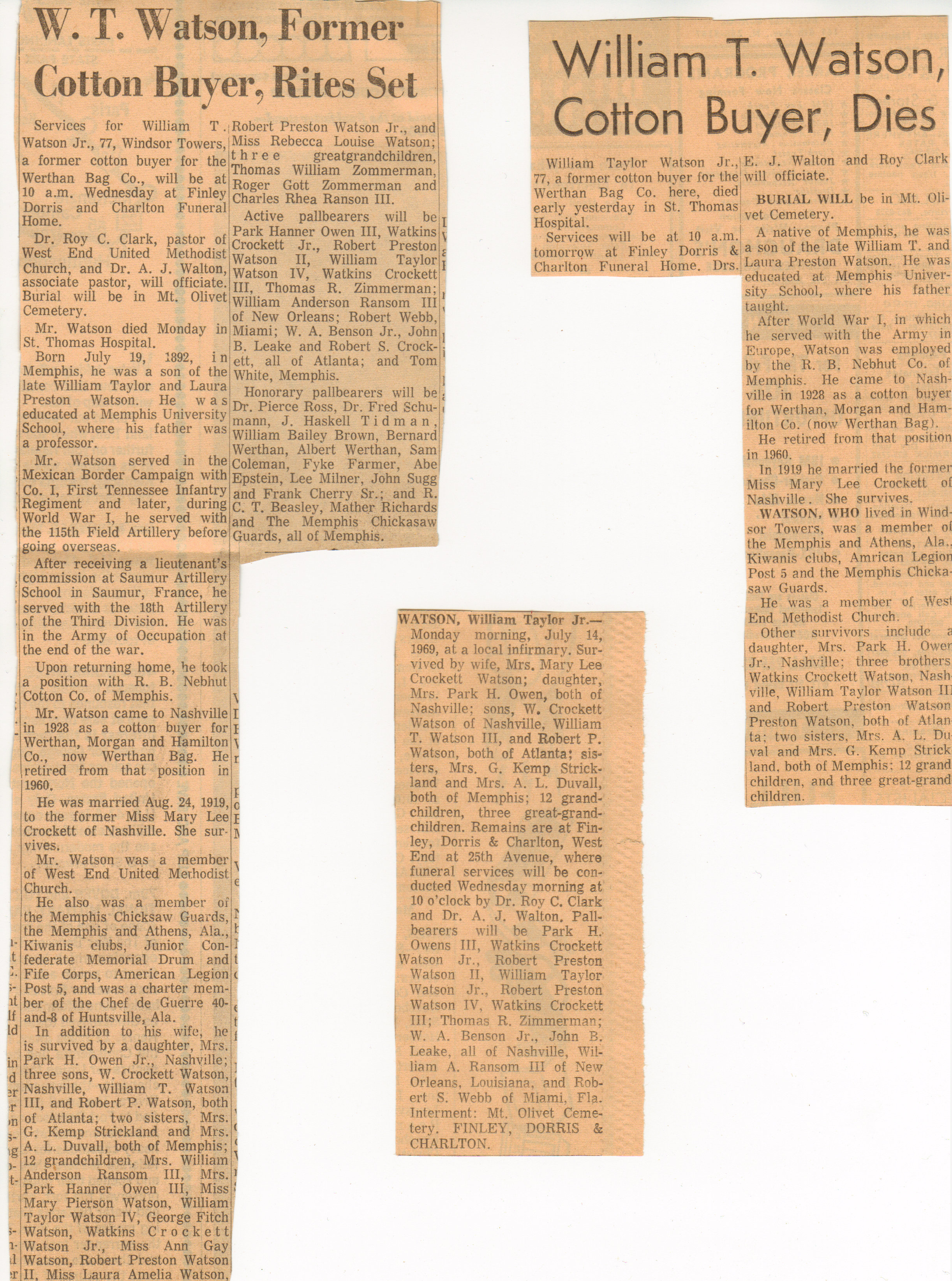
William Taylor Watson Jr obituaries
Mom's Family
Mom's side of the family was composed of a sister and two brothers as well as her parents and herself.
Mom's sister was Emma Mai Crockett. She married a man named Paul Thompson and they had one child named Emma Mai. Aunt Emma Mai had a tough marriage. Uncle Paul was not a good provider and was always trying to find a way to get rich quickly. I recall that he was mixing something on the stove top one night and I asked him what it was. He said he was developing a substitute for rubber. I mentally flinched because I knew that large chemical companies were spending millions doing the same thing in sophisticated lab settings and had not been successful. He ran a gas station for an off grade brand for a while. He got into some trouble with the law and embarrassed Grandad by asking him to testify as to his high moral character - which Grandad was reluctant to do. Ultimately he disappeared into Louisiana. Aunt Emma Mai was very loyal to him but finally obtained a divorce. Many years later, she later married again to a friend of Dad's, Bob Owen and moved to Jackson, Tennessee. She lived there until she died.
Her daughter, Emma Mai, married William "Bill" Ewing. He was an enlisted man in the army when she met him. He became president of an insurance company subsidiary of a large insurance company - I think Metropolitan. His father was the legal counsel for Metropolitan. Bill had his offices in Austria. Later they moved to New York and New Jersey. We used to visit them at their home in White House, New Jersey. They had a nice home on the banks of a river and we had nice strolls nearby. We always felt extra safe there. The reason being that one of their next door neighbors was a Mafia Don and nobody came near who didn't belong.
Emma Mai (my cousin) wrote articles for the Nashville papers and many articles for the New York Times. She also wrote for big women's magazines - that is , the magazines were big, not the women. Active in the Junior League, she held high national office there and in other organizations. The Junior League is a very highly respected and socially elite group of young women wherever it exists. One has to be invited to join and must do a lot of volunteer charity work to earn membership. All of Mom's family, including "Sis" belonged. Emma Mai has always been a very elegant looking lady with gracious manners. You know her and her two sons Bill and Frank. Frank is married and lives in Jackson, Tennessee. Bill lives outside Atlanta where he and his wife Eva own an environmental company which is doing very well and growing. They have a daughter whose father was Eva's previous husband and they are expecting another child as of October, 1995.
Mom's older brother was Watkins Crockett Jr. He was not older than Mom, just the older of the two boys. He was a fine, handsome person. He graduated from Vanderbilt Engineering School. He spent his career with General Electric and had an executive position with them in Nashville. He was a golfer as was Grandad. They belonged to two country clubs in Nashville. One was Richland Country Club and the other was Belle Meade Country Club. Uncle Watt married Mary Padgett and they had two children, Watt III and Mary. Aunt Mary was a tall, black haired beauty. Both of their children also were good looking and black of hair. Young Watt has been an insurance agent with New York Life and we have bought insurance from him. Young Watt married Ann Kirkpatrick and they were divorced after she gave everything up for religion. He has married again.
The younger brother was Robert Penn Crockett. Uncle Bobby graduated from Vanderbilt Engineering School and worked for GE for a long time but left to become a stock broker. Later he returned to GE and moved to Atlanta where he stayed until retirement. He married Gertrude "Trudy" Treaner. I believe the wedding was at Scarrit College. My brother Bob was scheduled to be the ring bearer for the wedding but was very young and shy and begged off at the last minute. Trudy and Bobby had two children: Little Trudy and Robert Penn Crockett III. He was nicknamed "Penn". Trudy married a banker named George Wade Jr. and they lived in Columbus, Georgia until they were divorced. He has remarried she has not. Trudy moved back to Atlanta They had a daughter, "Cissy", whose wedding we attended in New England a couple of years ago. Penn moved to California (Sacramento?) where he is in the hospital business. I think that at one time he was in insurance and we bought a policy from him. (Or was that Petie Watson?)
Young Trudy told me recently of her excitement when, as a teenager (and a very cute one she was), brother Crockett and I had doted on her and made her feel great. Apparently she thought we were handsome and men of the world and she was flattered by teh attention we gave her.
Aunt Trudy and Uncle Bobby were very sociable. By that I mean they were hospitable and friendly. They had a small place on Lake Allatoona outside of Atlanta and we had an open invitation to visit there. They tried to get us to join but we belonged to the Capital City Club in Atlanta and spent our spare time there. I had a canoe which I gave to Uncle Bob for use at the lake in the 1980s.
I think Bobby Crockett had the best personality of anyone I have known. He just passed away in his sleep this Summer (1995). Always smiling and laughing. He was fun to be around. Aunt Trudy was the organizer of many get togethers, They were always entertaining and had many friends. They were active in the Episcopal Church (Saint Phillips Cathedral where we belonged in Atlanta) and other organizations. They had us stay with them while we were looking for a house in Atlanta. They kept some of our furniture for us when we moved away. They had us visit their square dance group and invited us to join.
Uncle Bobby denies the two tales I'm about to tell but they ring true. One day Bobby was trimming a tree in his yard and wanted to saw off a fairly large branch. There was not a good place to stand so he sat on the limb he was sawing - expecting to get off before he sawed it through, As you may have guessed, he mis-estimated the time to get off the limb and it broke while he was still on it. He actually sawed off the limb on which he was sitting.
The other tale also involves trimming trees. He was to "top" a tree, meaning he was to saw off the upper part of the trunk of the tree. To make it easier to saw, he put a strap around the tree trunk and himself. That way both hands could be free to aid in sawing. When he finally cut through the trunk and the top fell off, the tree bounced back and forth and the trunk hit him on the forehead each time it swung back. This was because he was strapped to the trunk and couldn't get away. Finally the tree stopped moving and Bobby ended up with a bruised forehead.
Mom grew up in Nashville primarily. When she was young they lived in a large two story house on Harding Road. It had two large white columns in front and faced what was the Richland Golf Course. Later that part of the golf course became the grounds for West End High School.
Her maiden name was Mary Lee Crockett. I don't know for whom she was named. Lee was a very popular name in the South (Civil War General, you know - big stuff in the South). She was born there on May 20, 1898. Her father was Watkins Crockett and her mother was Mattie Sue Benson Crockett .
_____________________________________________________________
GFW note: What is the relationshiip to David "Davy Crockett of the Alamo?
Gabriel Gustave de Crocketagne m. Mademoiselle de Saix of France
Antoine de Saussure Peronette de Crocketagne (changed to Crockett in Ireland) 1643-1735 m Lousie de Saix 1648-
Joseph Louis Crockett 1761-1748 in Ireland m Sarah Gilbert Stewart 1680-1776
William David Crockett 1709-1777 m Elizabeth Boulay
Now the Line splits
Anthony Crockett 1756-1836 DAR # A027934 | David "The Elder" Crockett 1728-1776 m Elizabeth Hedge
Overton Washington Crockett 1791-1864 m Evalina Augusta Smith 1800-1861 | John Crockett 1753-1834 m Rebecca Hawkins
Robert Payne Crockett 1828-1900 | David "Davy" Crockett 1786-1836 ***
Watkins Crockett Sr 1868 -1953 m Mattie Cain Benson 1871 - 1940
Mary Lee Crockett m William Taylor Watson Jr
William Taylor Watson III
Col Anthony Crockett served in the Revolutionary war and was the source for Mary Lee Crockett's acceptance into the Daughter sof the American Revolltion Birth: Nov. 19, 1756 Prince Edward County Virginia, USA Death: Dec. 6, 1838 Frankfort Franklin County Kentucky, USA
A Revolutionary Patriot, Col. Crockett was the son of Irish immigrants. As a child he was given into service with his cousin Samuel Crockett when his parents died. At the age of 20, he entered the Continental Army as a private in Capt. Posey's company. Two years later he was promoted to Lt. and served in the Virginia troops under Col. George Rogers Clarke. He fought under Clarke in several of Clarke's engagement during the war. After the war, Crockett remained in service and helped to defend several towns in the West eventually settling in Kentucky. As a citizen of Franklin County, he served as a representative for Kentucky in the Virginia State Legislature then the Kentucky Legislature after it was granted statehood. For thirty years he was sargent at arms for the Kentucky Senate. With the war of 1812, Crockett raised a volunteer unit and commanded troops in several battles including the battle of the Thames where he was cited for personal bravery. He was married to Mary Robertson with whom he had 11 children. Crockett was reburied here from another location by some of his descendants.
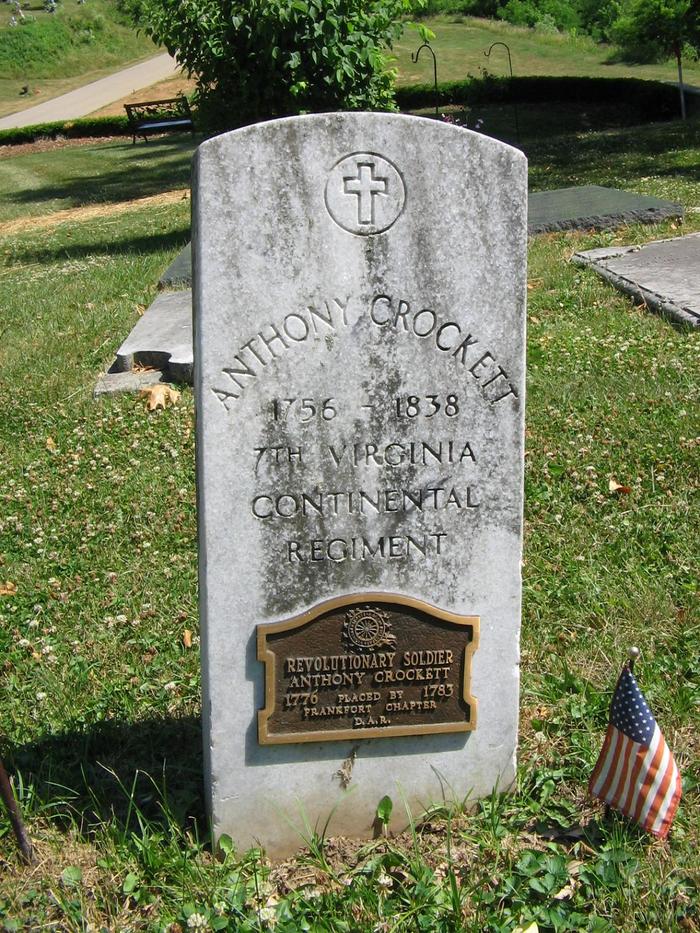
Col Anthony Crockett gravestone 7th Virginia Continental Regiment DAR
_____________________________________________________________
Mary Lee Crockett and her parents lived for a while in Pelham Manor, New York. Grandad was President of a bank in New Rochelle, New York. (Do I have the towns backward?).
Watkins Crockett Sr testimony about the Van Norden Trust of New York 1910
Watkins Crockett Sr Vindicates Cummins Van Norden Trust in New York 1910
Later, J. P. Morgan took over the bank and asked Grandad to stay on and join his team but he refused and returned to Nashville. In 1927 (I think) Grandad became the first president of a new bank in Nashville called the Third National Bank.
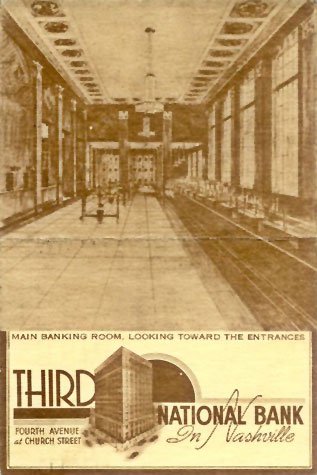
He held that position for ten or more years. He became Vice-Chairman in 1937 or so and held that position until he retired. Under his leadership as president the bank grew to be a very large bank for a city the size of Nashville. They now have branches in Knoxville and elsewhere. A few years ago the bank was merged with the Trust Company of Georgia which became SunTrust Bank. The name Third National Bank still is used in the Fall of 1995 but will soon disappear as all of the merged banks will carry the name SunTrust
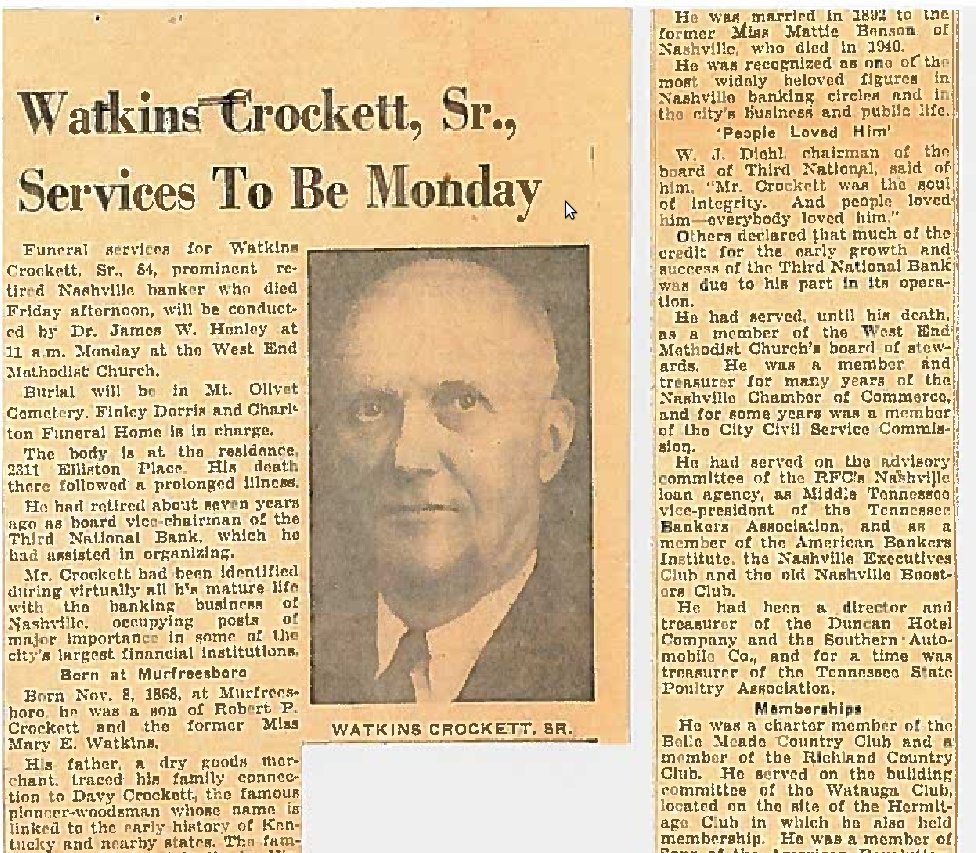
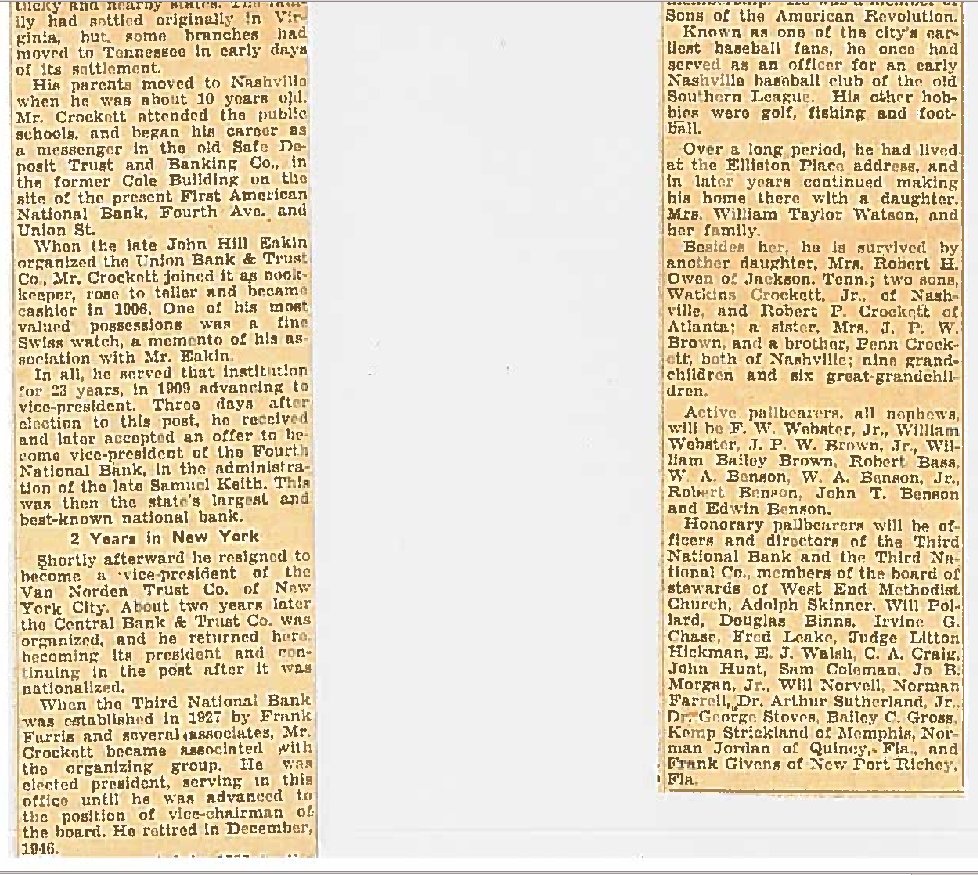
Watkins Crockett Sr Obituary
During the economic depression of the 1930s, banks were authorized to issue their own money. The Third National issued its currency and Grandad's name was on it as was his signature.
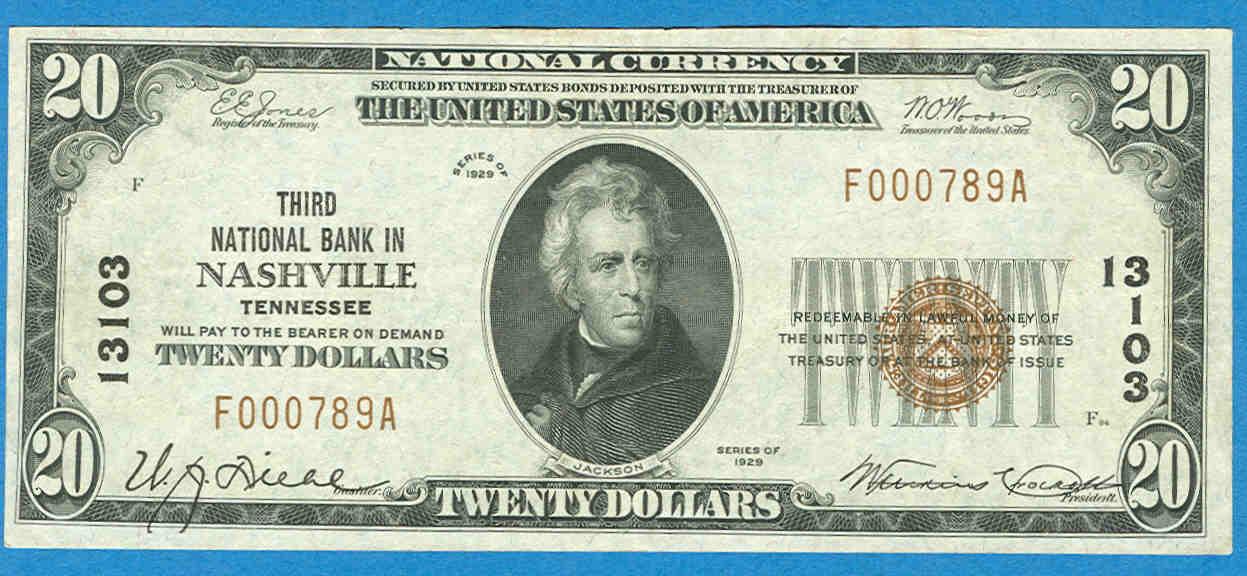
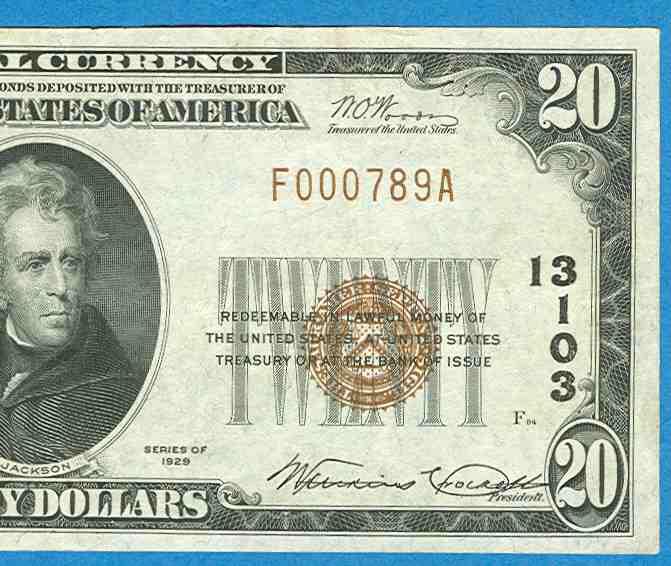 That money was called Script. Each of their children was given a framed piece of script. Mom had hers for many years. I think one of Sis's children probably has it now.
Grandad Crockett became a victim of Parkinson's disease and lived many years thereafter, the last years he was bedridden and had nurses 24 hours per day. Grandmother Crockett had died much earlier of a heart attack. Both of them had very large funerals. I recall being in a car for Grandmother's funeral and looking back at the cars in the cortege. The line stretched out for a mile and her passing was prominently noted in the newspapers. In her own name she had been very active in social and charity work. In addition, she was the wife of a prominent banker.
As mentioned, she was very active in a number of charitable and social organizations but was hampered by deafness. She had a battery operated microphone on her chest, which helped. She also had a speaking tube about 3 - 4 ft. long. She put one end in her ear and, to communicate with her, one spoke into the other end of the tube. It was difficult but possible.
Grandad and I would sometimes go to a baseball game together. The Nashville Vols were a minor league team which played its home games at Sulphur Dell in North Nashville - near Werthan Bag Corporation where Dad worked.
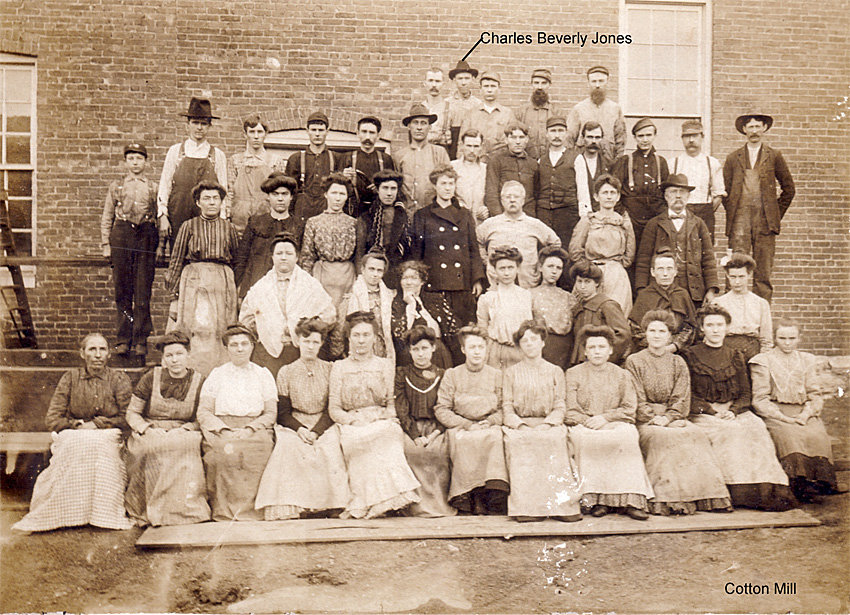
Werthan bag company around 1900
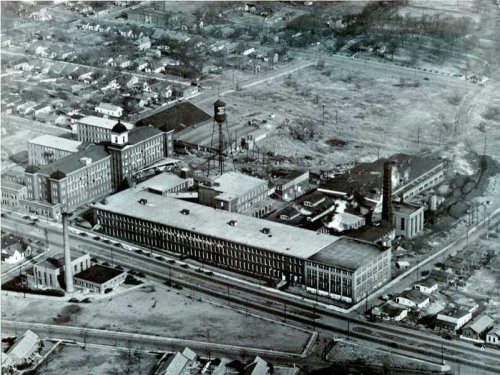
Werthan Bag Company
https://historicnashville.wordpress.com/2009/04/21/werthan-bag-company/
http://www.werthan.com/wpihistory.htm
We often drove to Sulphur Dell Park to fill gallon jugs with sulphur water from a spring there. . Grandad and Grandmother thought it was good for them. It has a funny taste and smell due to the sulphur.
Grandmother Crockett had my favorite maid, Julia Carney. She was my special person and, I am proud to say, I was hers. She looked just like the Mammy drawings we see and cared a lot for us. She was a fine, upstanding person who "took care of her white folks" and didn't want them to behave like "po white trash". Julie Pie as we called her, always told me I should be president of the United States and for years I considered a career in politics.
Grandmother was famous for some of her recipes and they were widely acclaimed. They have been reproduced in many recipe books, sometimes with attribution, sometimes not. It was always a treat to eat at her table. We've often talked of canning some of her products and selling them. Creamed peas and carrots, baked sweet potatoes with marshmallows on top, baked apples with walnuts, coconut cake roll, beaten biscuits, mustard relish and many others come to mind. We did can them but ate them ourselves or gave them as gifts instead of selling them. Eating was a big event in her house and was always properly served by the butler. Everyone had a sterling silver napkin ring and we ate on linen.
She also was a poet and composed some very excellent verses. I wish I had copies of them now. Perhaps cousin Emma Mai has copies. Grandma had them published, I think. She founded a school for the deaf and visited public schools to supervise administration of hearing tests to school children. I recall her visiting my class at Cavert Junior High School in Nashville while we were taking the test for deafness.
Grandmother and Grandfather Crockett were short people. He was bald, she was dark haired. An interesting sidelight on that: While traveling in Florida or Georgia (Neither of them ever learned to drive. Ethridge, their chauffeur, drove them on trips), they had trouble at an inn because the desk clerk thought Grandmother might be Jewish because she was so dark. In those days there was a sign on hotel counters saying "Selected clientele". That meant that no Jewish people would be accommodated if they asked for a room. Negroes knew better than to ask. Not very democratic. My other grandparents were tall people. Dad was 5'10 1/2" tall and Mom was a little over five feet.
When Grandmother Crockett died there were editorials in the Nashville papers about her passing. The funeral cortege was many blocks long. I think it was my first family funeral. We all met at her house: uncles, aunts, cousins, etc. the night before and the night of the funeral. The casket was not kept at the funeral home but at the residence of the deceased. We all met and it was both somber and joyous. Somber for the obvious reason, joyous because the family got together. They loved, respected and missed her but they also liked each other's company. It was hard for me to swing from sadness to levity at that age but much joking and laughing took place whenever those people got together no matter how serious the occasion.
Another recollection which sticks out in my mind was the sound of the bell at Mt. Olivet Cemetery which always began to toll as a cortege entered through the gates. "Going Home" was the theme and Mom would hum it. I still choke up a bit as I think of that hymn and the family funerals at which I have heard it played. Then the graveside service seemed always to occur when it rained. We always waited until the dirt was put into the grave and the funeral pall was placed on top of the grave. Many people don't do that.
Mom's ancestors are reputed to include Mary, Queen of Scots, and Rob Roy. We are also related to Davy Crockett (his grandfather is one of our ancestors), Daniel Webster and William Penn. They neglected to tell me about the horse thieves. We did have a relative named William J. "Bill" Cummins who went to prison for a while. They say there was a large crowd of friends and admirers which met him when he was released. He was a very popular man, I am told. Cummins Station is a large railroad depot in Nashville which was owned by the family. He married Emma Mai Benson, Grandmother Crockett's sister.
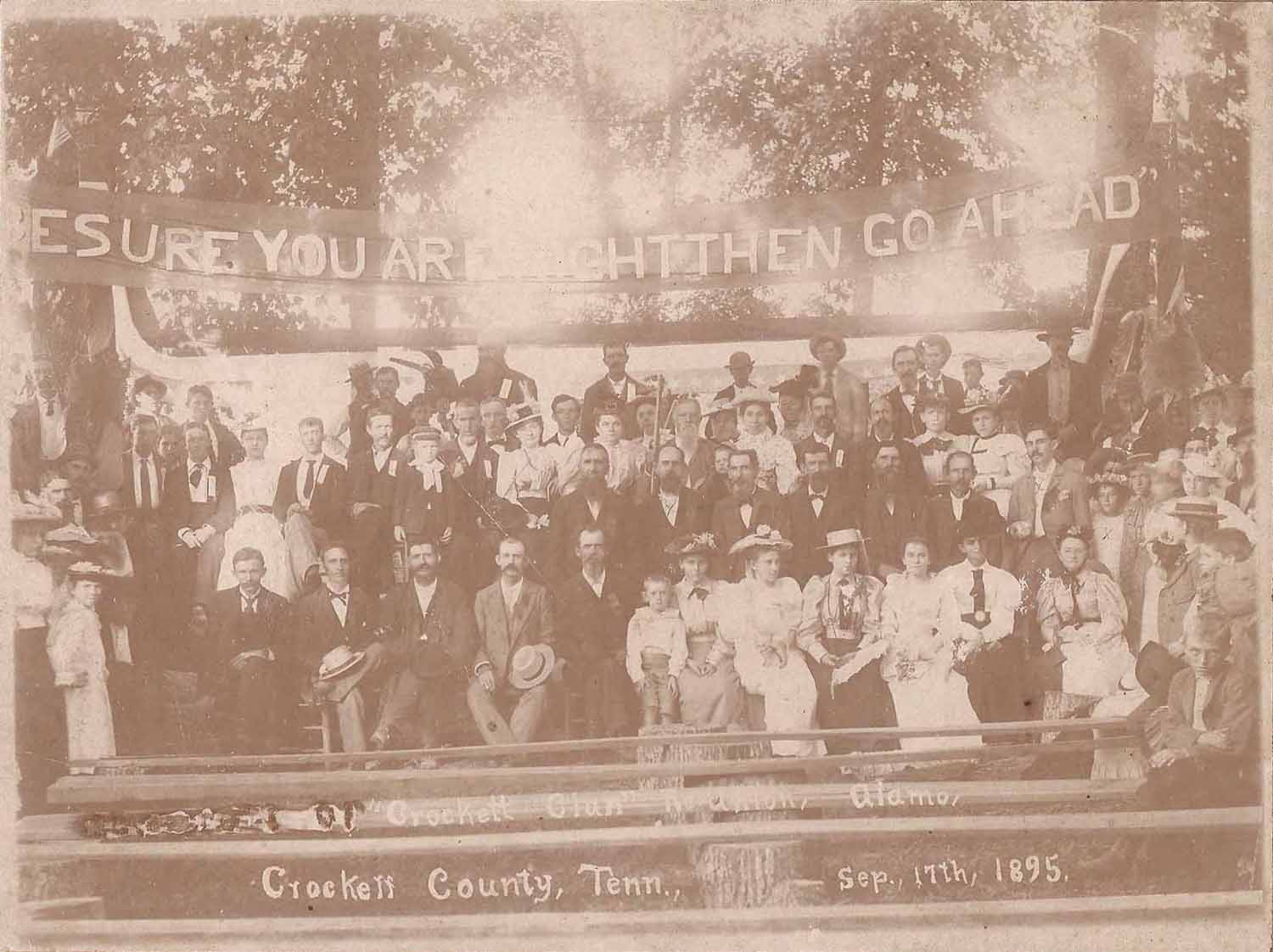
Crockett family clan gathering in Spet 17th, 1895 in Crockett county
"Be Sure you Are Right Then Go Ahead"
"Re Union , Alamo
Grandad had a brother named Penn Crockett (that ties to William Penn for whom Pennsylvania is named). He had a sister named Annie who married John P. W. Brown. John Brown was head of the Tennessee Electric Power Company which supplied electricity to a large area.
We used to go visit them with lots of cousins, etc. at a large lodge owned by the power company at Rock Island, Tennessee. Lots of ladies spent the summer there with their children. TVA took over the lodge when they took over electric power distribution in this area and the lodge no longer exists.
One summer, while staying there, some of us children decided to walk around the lake. We neglected to tell any grownups and were gone for an hour or two. When we returned the ladies were in a frenzy - thinking we'd all fallen into the lake and drowned. We hadn't. I received a switching for that escapade. Grandmother Crockett had a sister named Emma Mai who married into the Cummins family, Bill Cummins (the same one mentioned earlier). They had a beautiful white two story mansion on Harding Road. It has been torn down for many years. It was called "Rose Lawn" and stood back from the road on a large plot of land. It had white columns across the front and was landscaped magnificently. It was featured in a book entitled "the Hundred Most Beautiful Houses in America". It deserved it.
We called Emma Mai Cummins "Big Grandma" for some reason. She had a child named Mary Sue who married Fred Leake and they had children named Shirley, Emmy, Teddy and Jack. The boys went to Princeton as did their father. I'm not sure of the relationship of Fannie Farmer. She came from that side. She might have been a sister of Fred Leake. She married Fyke farmer, a Nashville lawyer who became head of an international organization for peace and became very famous. Very fine people. When I lived in New York I introduced their daughter, Mary Sue Farmer to her husband to be.
There also was a Lena Cummins who was a child of Emma Mai Cummins and who married Lee Adams and had a child.
The Cummins family owned a company which manufactured a breath saver called Breethem. If you had too many drinks or ate onions or garlic you might suck on a few of them to freshen your breath. Cousin Lena's picture was on the front of the little box in which they were sold.
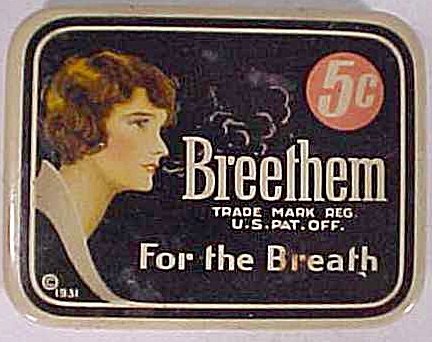
Cousin Lena's picture
The Cummins family owned a company which manufactured a breath saver called Breathem
Mom attended Ward's Seminary in Nashville - later to become Ward Belmont College. She did all the things a bank presidents daughter should do. Volunteer work, debut, etc.
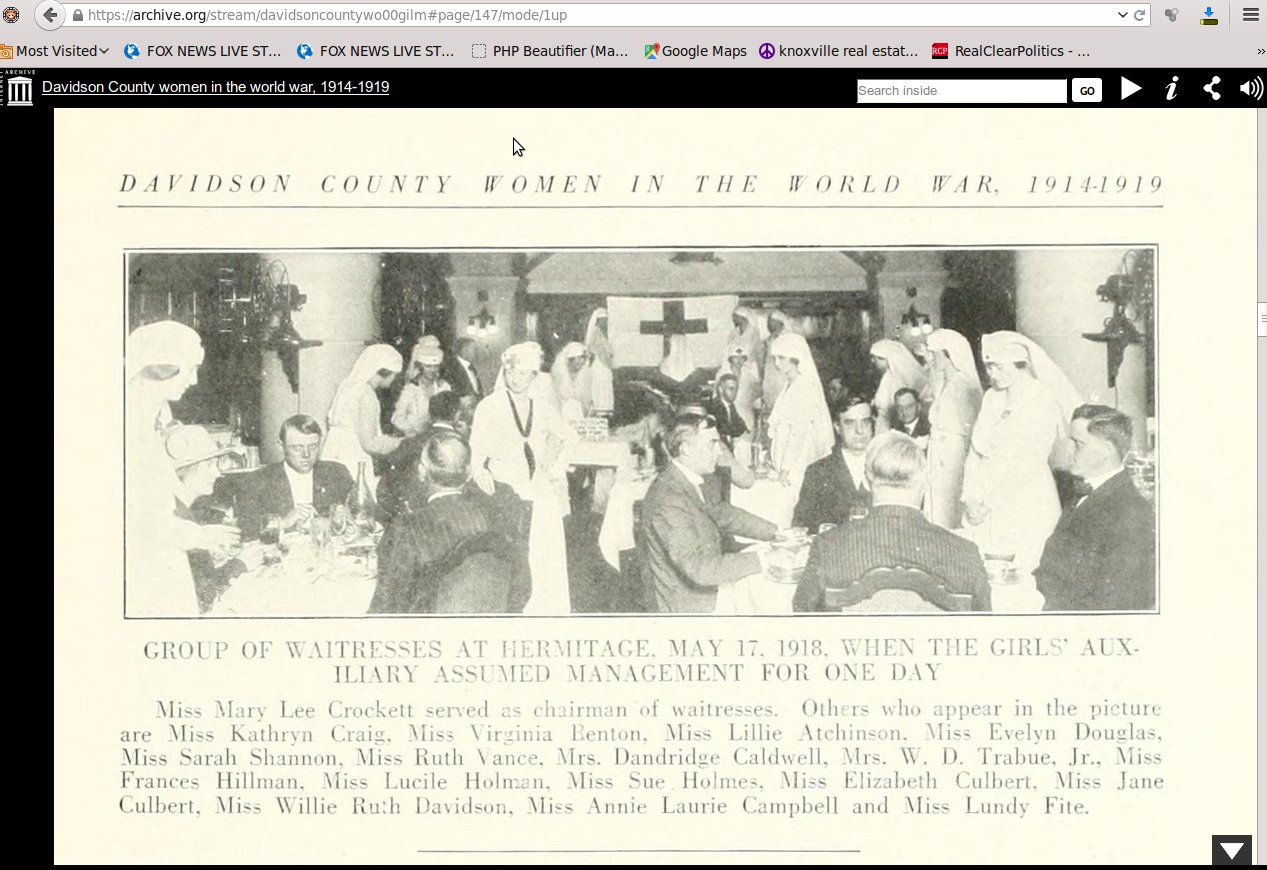
davidson county women in the world war miss mary lee crockett as chairman of the waitresses close up page 146 or there about
.
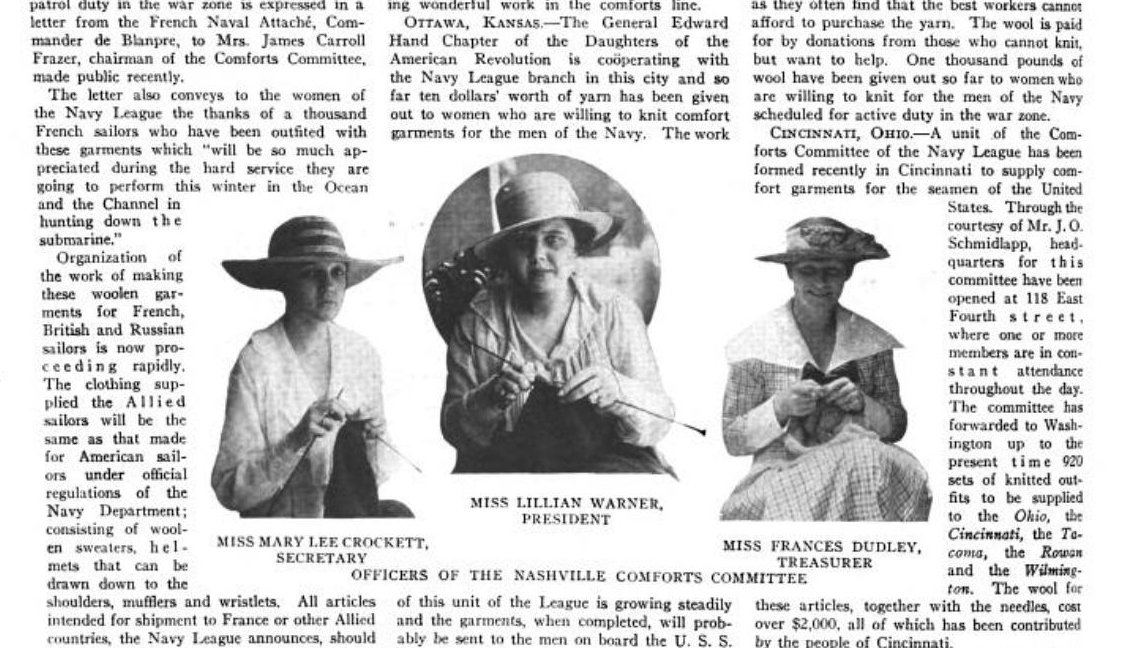
mary lee crockett officer ofthe nashville comforts committee Sept 1917
.
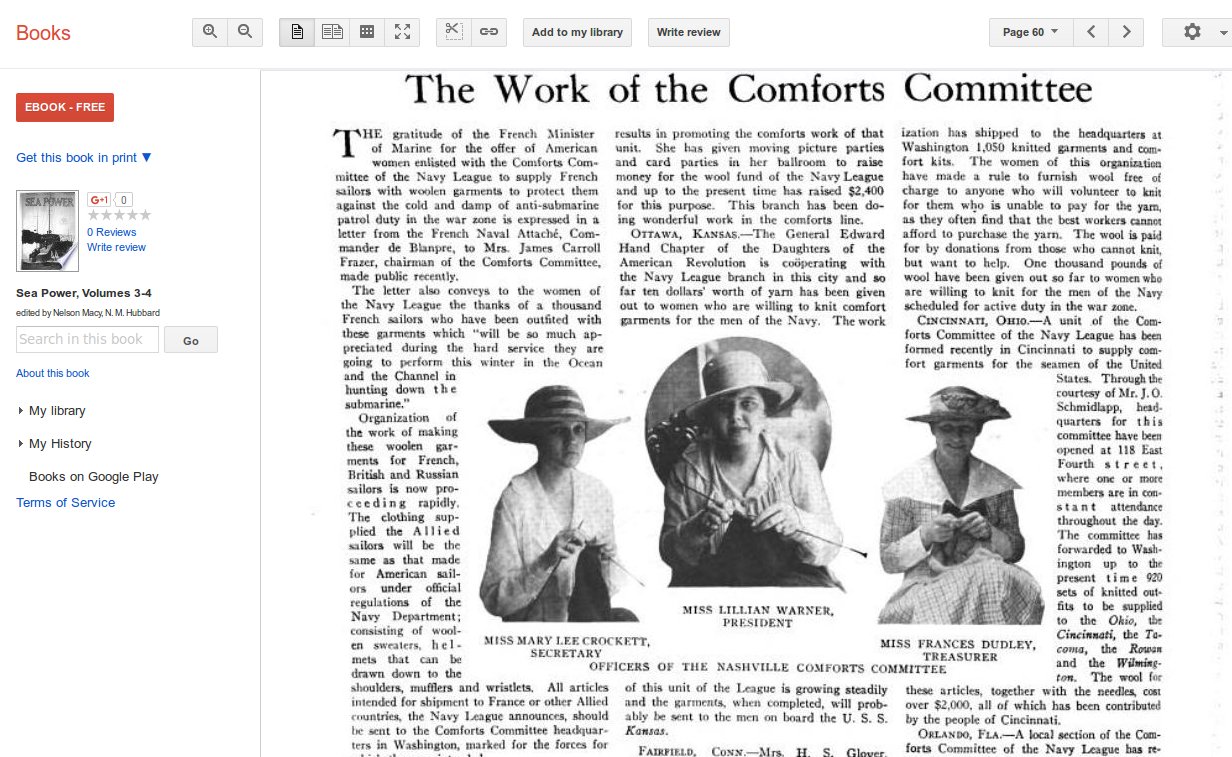
seapowermagazinevolumes3dash4 mary lee crockett comforts committee Sept 1917
.
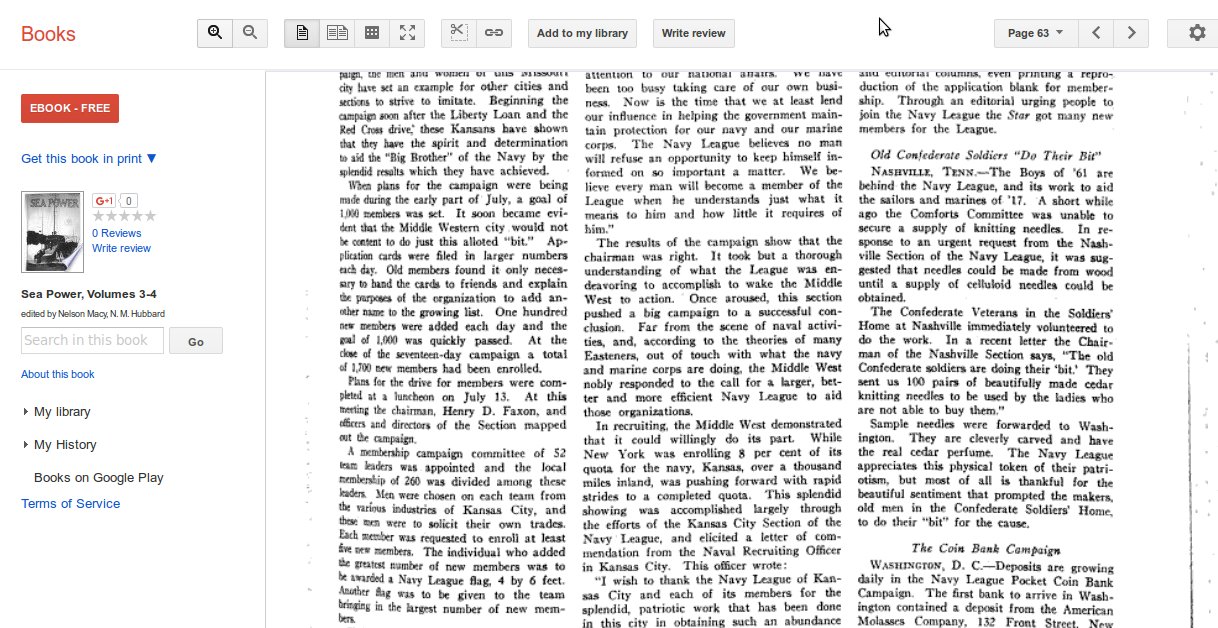
seapower magazine volumes 3dash4 confederate soldiers do their bit Sept 1917
Grandad was head of a bank in New York for a while. While in New York State, Mother was an actress in the movies. She made a movie with Francis X. Bushman (George Watson note This apparently would have bee around 1910 based on her father's tenure as President of the Van Norden Trust in New York then) who was a leading screen idol at the time. "His lavish acting salary enabled him to build a home on Hollywood Boulevard, which he later donated to Sid Graumann, whose famous Chinese Theater now occupies the spot." http://www.timesledger.com/stories/2014/4/queensline_all_2014_01_24_q.html
Francis_X._Bushman_filmography#1911
Youtube compilation of stills from Francis X. Bushman movies. Perhaps Mary Lee Crockett is in one!
There were movie studios in Westchester County then. Mom was a beautiful and lively lady. I have been told by several of her contemporaries, without a query from me, that she was one of the most beautiful people they had ever seen and that she could have become a famous movie star if she had so wished. They say that when she walked down Fifth Avenue in New York that people stopped and turned around to get a better look at her beauty.
Mom had many talents. She could read music and played the piano for us. Many hours were spent as a family singing old familiar songs and new ones too. Crockett developed an ability to play the piano too. Mom spent a lot of time sewing. She darned our socks, repaired clothes and made clothes. She'd buy a pattern and some cloth. Then she'd pin the pattern to the cloth and cut out pieces of material. These she would baste together until things were just right and she'd then do the final sewing and take out the basting stitches. She and Sis wore many outfits which they made themselves. Another way to deal with the economic recession of the 1930s.
She also knit and crocheted. We all wore beautiful cable stitch sweaters and argyle socks she knit for us. I have some as keepsakes today. She knit herself many dresses. That's in addition to the ones she sewed. Mom was a natural executive. She was president of every organization she ever joined from PTA to social and patriotic groups. I recall that, when she was President of the Tennessee American Legion Auxiliary, she took Mary Lee and me (I don't think Crockett went - probably too small- and brother Bobby wasn't yet even a gleam in Dad's eye) to Knoxville with her for the state convention. We stayed at the Andrew Johnson Hotel which is still standing - only now it is an office building. We rode the Tennessee Central Railroad between the cities. I have only the vaguest memory of that occasion which probably took place in the late 1920s.

The south facade of the Andrew Johnson Building, viewed from the Gay Street Bridge, in Knoxville, Tennessee, USA. The Plaza Tower (First Tennessee Plaza) and Riverview Tower (BB&T) rise behind the Andrew Johnson Building. The Blount Mansion visitor's center is visible at the base of the building.
They asked Mom to be national president of the Auxiliary but she declined because she had three small children at home. Again, Bobby hadn't been born.
You are probably not aware of the power and social acceptance of the American Legion in those days. It was begun as an organization of veterans of the First World War. The American Legion Auxiliary was the companion organization for wives of veterans. The president of the Legion was powerful politically because the veterans often voted alike. They had their own magazine and had organizations in every town, many with clubhouses and frequent activities. They had a sub group called the "Forty and Eight" consisting of veterans who had gone overseas and served. The name came from the French railroad coaches which held forty men or eight horses. Their state and national conventions were big news and drew top business and political leaders. The National president of the Legion became the Republican presidential nominee in the 1940s.
The Legion still exists but is much less noticed today and lacks the social cachet and political power it once had.
Mom was very prominent socially though she was not rich. Any announcement about our family received top billing in the society section.
Despite all her abilities, Mom was a person liked by everyone. My girlfriends, Sis's boyfriends, everybody took to her and called her MOM. She gave of herself to everything and everyone. She was fun! Most of all she loved her family. She used to lament the fact that we didn't all live close by. She wrote without fail every week to each of her children. She used to say that she didn't want to interfere with our lives but that she wished she lived on a hill and that each of her children lived on another hill within sight of hers so she could see us and be with us when possible. Like many sons, I think of my Mother as a saint.
I wish I had let my parents know more of how I love them. Not that I didn't write, call and visit. It's just that one can't ever do as much for ones parents as they do for us.
Mom and Dad's Crew
Mom and Dad were always family people. Dad was not the joiner Mother was and had no executive aspirations. He would shy from public speaking. They had lots of friends and often had the maid stay after dinner to baby sit us while they went out for dinner, to play bridge, go to the movies, attend parties, dances, etc.
You have heard about an incident which occurred one Christmas. Mom and Dad were out and Maggie, the maid, was watching over the four of us children. We talked her into lighting a candle in the front window. As you have heard, the curtains caught fire and fell on the family ottoman and started it burning. Flames were starting to shoot across the ceiling. Brother Bob was small and was in a stroller beyond the ottoman and near the window. I was afraid he'd be hurt so I jumped over the burning ottoman and pulled him out of his stroller and across to a place away from the flames. Fortunately, we got the fire out quickly and a neighbor came by and calmed us all down.
Dad would call out "It's seven o'clock, time to get up" and we'd all arise and prepare for work or school. Of course I would have been up earlier to start the furnace and maybe the fire in the living room fireplace but would have gone back to bed for as few winks before seven. Mornings were a rush. baths were taken the night befoer and dressing and eating breakfast had to be done rapidly. Dad drove us to school. We'd be at school before 8 AM because Dad would be at the office by eight. He often picked us up at school if we stayed late to play tennis, etc.
Supper was at 6PM. Dad left work between 5 PM and 5:30 PM, took his riders to their homes and was home in time for supper. Some days the maid stayed through dinner and served it. Other times we helped Mom in the kitchen. We had no dishwashers. We used a large pan of soapy water and we all dried and put away. It was a family affair. The maid usually got to our house after breakfast, cleaned the kitchen, made beds, cleaned house, prepared meals. We had several of whom I was fond. First was Maggie, a large Negro woman who worked hard. (All of the servants in the South were Negro. When I went North I encountered the first White servants I knew). There was another Maggie who was smaller and had a husband named Ed. He worked in the yard. These people were paid little (we were paid little more) and had to obtain transportation to & from work. Ed and Maggie went off to Detroit to live before WW II. There they could earn a lot more in a factory than they could in the South. The maid came in the morning and left after fixing dinner unless she was asked to stay later. She came in on Thursdays briefly. Sundays she'd leave after the noon meal.
An embarrassing moment occurred one time. One of the sayings in those days was "That's mighty White of you" meaning that was very good of you. Without thinking I thanked one of the maids at dinner by saying that. My Mother and Father were furious with me and I had to apologize. I did sincerely because it was athoughtless error, not a mean statement. I don't think I've used that phrase again.
We drove to Sunday School every Sunday at West End Methodist Church. When we moved to Nashville, the church was on the Northeast corner of Broadway and 18th Street I think. It was a red brick building which later burned and was replaced by a new Sewanee stone structure at 23rd and West End Avenue - where it stands today. For many years only the Sunday school wing was built and we held church services on the Vanderbilt campus across the street. Vanderbilt was originally a school with close ties to the Methodist Church. It still has a Divinity School.
Some of us kids would occasionally be asked to deliver advertising circulars for the grocery owned in part by our next door neighbor on Belcourt. That entailed taking a stack of circulars to a neighborhood and putting one on every front porch. For that we got anywhere from 25 cents to 40 cents. Cokes cost a nickel, as did regular sized candy bars, so we profited from the arrangement. I could ride the street car to town for seven cents, go to a movie for a dime and ride home for another seven cents. So, for a quarter I could go to town, see a movie, come home and have a penny left over from that quarter. That penny would buy me a small Baby Ruth or other candy bar. If I wanted to take public transportation which stopped a little nearer home, I could ride the bus for ten cents each way.
My earliest recollections are of Murfreesboro, Tennessee where we lived twice before I started school. One of those times we lived on a corner of a residential street in a white clapboard house with a front porch. I was very young, probably one or two years old. Mom was always amazed at some of the things I could recollect from a young age. I recall crawling on the floor there and dropping things through a hole in the floor. Mom lost a diamond ring there and thinks I dropped it through the hole. Could be.
I also remember that my sister learned to skate inside the house there and that I was too small to do that. I was allowed to hold on to a broom handle while someone else would slowly pull me on skates Sis lent me.
Huntsville, Alabama was our home later. Crockett was born there on May 24, 1925. I wasn't yet three years old. I recall seeing Charles Lindberg's plane "The Spirit of Saint Louis" fly over our house. That must have been 1926 or 1927 (the year he flew the Atlantic). We lived in a small house with a small front porch and a smaller back porch. There was a garage and chicken coop behind the house. We didn't keep chickens but the smell lingered from a prior owner's chickens. I recall we sat up one night looking out the back window watching a neighbor's house burn down. We could feel the heat and hoses were used to cool off the outside of our house and to douse sparks which flew over. Very scary and exciting to a little boy.
Also, another boy and I were playing on the sidewalk in front of his house and we found a bullet. We proceeded to pound it with a rock to hear the noise it would make. It finally went off with a loud bang and every front door on the street opened and all the ladies ran out to see what happened. Although he wasn't hit, the other child was screaming and I was wondering whether I would get a switching. I did.
I recall standing on the front porch and peeing over the side onto the driveway to hear it splash and watch the rivulets run. Unfortunately for me, Mom also heard it splash and I got another switching. Mother told me years later that the neighbors worried because we children received so many switchings. They were afraid we'd have warped personalities. I leave it to the reader to judge the outcome. Be kind.
For Christmas one year (in Huntsville) I got an Indian Suit and headdress. I really enjoyed running around doing a war dance and whooping like I thought an Indian should. I was teased by the boys there because Mom bought me a pair of rompers which were pink. No self respecting four year old he-man like me would want to wear pink pants.
We played a game called Red Rover and another called Snap the Whip. In Red Rover each side lines up opposite the other and one side has all its members lock arms and call out "Red Rover Red Rover let (they'd insert a name of one of the opponents here) come over". That named person then ran as hard as he could into the other line, trying to break the armlock between any two opponents. If he was successful, he got to pick one of his opponents to take back and join his team. If unsuccessful, he had to join the other team. I remember that I was smaller than the others and almost never could break through the opponents line. But I enjoyed playing with the big boys. In Crack the Whip, it seems I was always on the end of the whip and was thrown to the ground because I wasn't large enough nor strong enough to hold on with both hands. Again, I was the smallest of the group. I enjoyed it. We moved to Nashville in 1928, I think. We lived at the Sulgrave Apartments on West End Avenue. They were located on the South side of the street and were between Murphy road and Fairfax Avenue. They were very nice for their time but were replaced by more modern apartments later - called the Continental I think. They were three story brick apartments and socially very desirable. A number of prominent Nashvillians lived there. We had an apartment on the top floor on one end with windows on three sides. We had a foyer, living room, dining room, kitchen, butler's pantry, enclosed sun porch on the end (facing south), three bedrooms and a bath. The apartments had large grounds and a long semicircular driveway near the avenue. It had stone entrance columns at each end opening on to West End Avenue. There was a large circular drive which led off of the oval. It ran all the way up past the apartment buildings to an old mansion. Presumably the Sulgraves lived there. Across the oval from our apartment was a sandpile where I spent a lot of time.
A book about historic Nashville in this time

I started school that fall (just before my sixth birthday) at John B. Ransom Elementary School. I attended Ransom until we moved to 2813 Belcourt Street at which time I entered the third grade at Cavert School. While at Ransom I became ill my first or second year and missed a lot of school. I finally had to have a mastoidectomy because continual infections had reached one of my ear bones. If you don't like to hear young children scream in pain and terror, you wouldn't have wanted to watch as my parents held me down so the doctor could lance my ear with his knife so that the infected area could drain. I think those weeks of suffering and waking in pain at night were the cause of my fear of the dark which persisted until I was twelve or so.
I was placed in Vanderbilt Hospital by Dr. Henry Nelson for the mastoid operation. Some time during the morning on which I was to be operated upon they wheeled a boy into my room and said he had just had an operation like the one I was to have. Amazingly, they had operated on the wrong boy! Needless to say, I was out of that hospital in short order and operated on in the Protestant Hospital which was at the corner of 21st Avenue and Church Street. Its name has been changed since then.
I recall Mom and Dad discussing the 1928 Presidential elections in our living room. Mom favored Al Smith and Dad favored Herbert Hoover - who won. Because we were on the top floor, we had a bright apartment even though the grounds were planted with trees. My first memories of Christmas are from there. I truly believed in Santa Claus.
I recall that, in the early years, my sister was responsible to see that I arrived safely and on time at school. One day after I was on my own, I was walking alone and crossing Fairfax Avenue when two ladies were in a car and didn't see me until it was too late. Their car knocked me down but only my ego was hurt and I wanted them to go away and leave me alone. They would have none of it and marched me to the nearest house and talked the lady there into letting us go in to call someone. After a little conversation they decided I seemed to be all right and they left and I went home. I don't think I told Mom for many years and she was very upset although it was then in the dim past.
At that time there were street cars on West End Avenue. I think one line (#3 cars) ran all the way out West End Avenue and Belle Meade Boulevard almost to Percy Warner Park. Another, #4, ran only to the city limits which were then just beyond our apartment building at Fairfax Avenue. West End Avenue narrowed there to two lanes. The streetcar was important. It was the way many of the servants who didn't live on their employer's property got to work. At that time all servants in the South were Negro. There were no white servants in the South.
White people also rode the streetcars and buses. Then, there were signs on public vehicles in the South which read "This section reserved for White people" Or "This section reserved for colored people". People obeyed the signs. Whites filled the bus from the front and Negroes from the rear. Movie houses had separate entrances and seating sections for Negroes if they had seats for them at all. They usually entered from an alley and sat in the third balcony, while White people entered from the front of the building and occupied the first floor and balcony.
There were separate drinking fountains, bathrooms, waiting rooms, schools and eating establishments for white and colored.
Negroes also waited for whites to get on and off of public transportation before doing so themselves. Negro servants addressed white people as Mr or Miss and said Sir and Mam out of respect, no matter what their age discrepancy. I was embarrassed at the age of ten or less to have Negro servants call me "Mr. Billy" and say "Sir" to me. There were very few of what were called "uppity niggers". Very embarrassing to a sensitive white person to see the discrimination. Yet it was not feasible for one or a small group to stop it. They'd be ostracized by zealots and be subject to attack. No one dared change until the federal law changed.
Many people who felt they had no feelin of discrimination in them sincerely believed that separate but equal was fair. In schools in eating places, etc.
A different time! The Tennessee Central Railroad had a viaduct across the street just west of Fairfax Avenue. The road (West End Avenue) narrowed to two lanes west of there. Trains, both passenger and freight, ran on the railroad line and there was a small wooden station house at West End Avenue. That RR is gone now and a leg of the interstate system runs where the RR used to run. It was fun hearing and seeing the trains. The track ran alongside the road leading from West End to my school.
While we lived there, a fire station was built at the viaduct and West End Avenue. I spent many hours there. Richland Country Club was a block further out from the viaduct. We moved to a house in 1931 or so. Mom and Dad bought a house at 2813 Belcourt Street which was about 8 - 10 blocks from our apartment and just as close to downtown. Brother Bob was coming or had come when we moved. They paid $6,500.00 for the house. I think Dad made two or tree hundred dollars per month - which was not bad in those days.
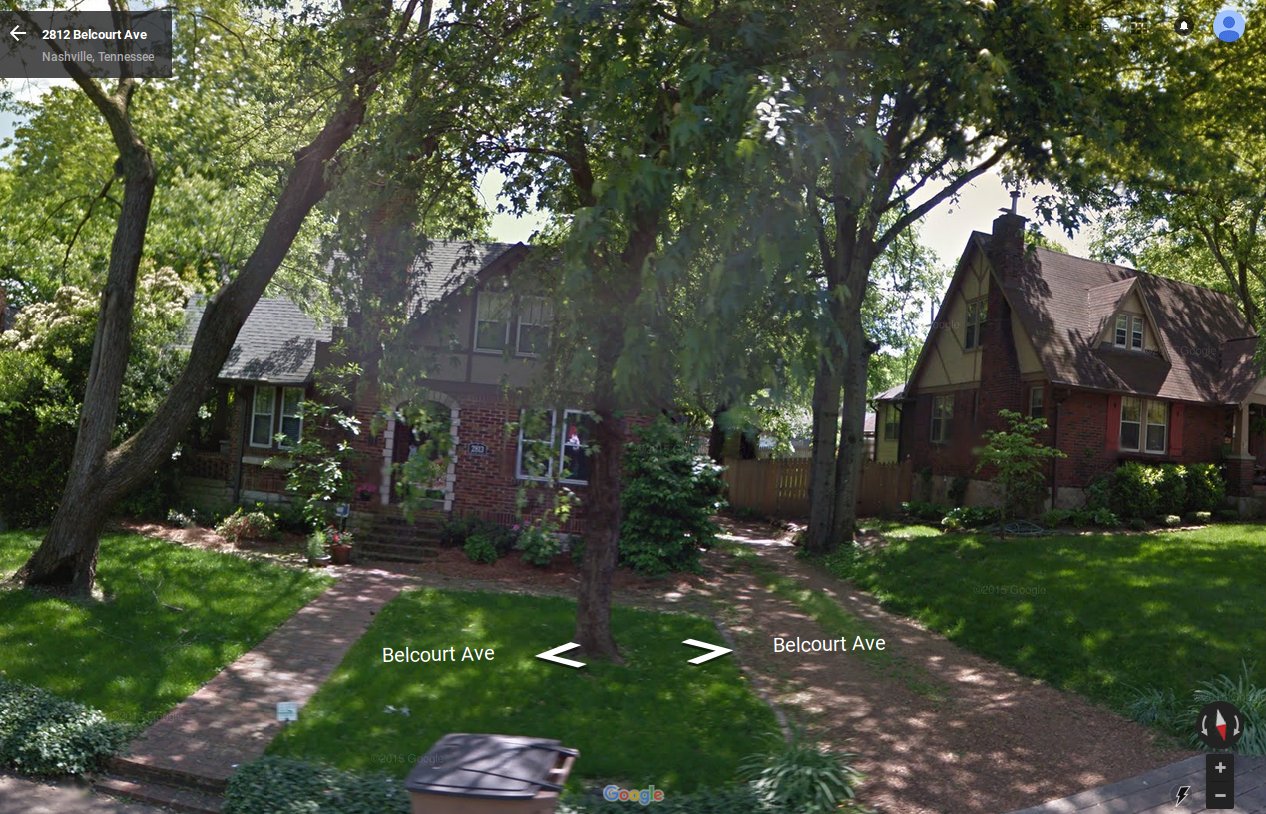
2813 Belcourt Street, Nashville,TN as of 2015 from Google streetview
It was a small two story brick house. It had a very small front porch, partially sheltered from the wind, a living room, dining room, small breakfast room, kitchen, open side porch (where we spent many hours), small enclosed back porch, two bedrooms and a bath down stairs and two bedrooms upstairs. It had a paved basement with a coal fired furnace. Later Mom and Dad added a bath upstairs and another bedroom upstairs.
That's where I grew up.
When we moved to Belcourt, I began attending Cavert School at the third grade level. I went to summer school every year and that put me ahead of my natural grade. It also made me the smallest boy in the class every year. When I entered college I was 16 years old, still wore braces on my teeth and was not a fully developed young man. That had many disadvantages.
As a boy, I was too small to make any athletic teams although we played a lot of baseball in our neighborhood. I became a catcher and caught without a mask until Mom realized what was happening and bought me one. I learned a lot about pitching and how to get batters to strike out or hit a bad ball while catching.
I was active and liked to walk. I'd walk to town or to the Belmont Theater where movies were shown. It was at the corner of Hillsboro Road and Blakemore, a couple of miles from home. Saturday mornings they had serials. These were stories which continued from one week to the next for 12 or 15 weeks. They'd typically be cowboy movies and there was always a critical event at the end of each episode the outcome of which wasn't disclosed. "Come back next week to see the next thrilling episode" would be the way the serial would end. I don't think I ever saw more than tree episodes of a serial.
Sometimes I would go alone to the Belmont Theater at night. I remember seeing "Frankenstein" there and walking home in the dark. There were sidewalks and there were streetlights at every corner but I was never certain I'd make it to the next light. i had to talk myself into bravery for the walk.
Regular movies were preceded by a newsreel and a comedy film. Don't misunderstand, the news and comedies were separate flicks - the news only seems comic. All were black and white, color came later. We had no TV then, so movie newsreel were the only way we saw events of the world other than still photos in newspapers and magazines. They were very impressive.
One movie house in Nashville had vaudeville when I was young. It was the Princess Theater on Church Street. Mom and Dad didn't attend it and I only learned about it from seeing ads. They had travelling vaudeville acts. Each week they'd change. Some were good, most mediocre or bad. Still, lots of people attended. One feature of the Princess was the sale of candy at intermission. The master of ceremonies would hawk the candy citing its good taste and cheap price. The big sales point was that they gave away prizes in "each and every " box of candy. Most were valueless trinkets and the candy wasn't great. They'd have ushers go up and down the aisles selling and saying something like "there goes another wrist watch" meaning another person had a wrist watch in their box of candy. I never saw a wrist watch come out of such a box but it sounded as if every third or fourth person won a wrist watch. An early introduction to con artists.
I joined the Boy Scouts at West End Methodist Church and enjoyed going to their meetings. We'd play games for a while, then have serious sessions when we were working on projects such as merit badges. I went to Camp Boxwell for two weeks each of two summers and had a great time. I learned to paddle a canoe, took a 14 mile hike and enjoyed many other things in scouts. I am a big believer in that organization. I passed enough merit badges to become a Life Scout but never got the rating because we became active in other things and I stopped attending. A mistake. (GFW note: Camp Boxwell still exists! http://www.virtualboxwell.org/primer/pt_boxwell.php )
In those days people went to work or to shop downtown. There might be a dime store, a florist, a restaurant, a drive in, a small clothing store or a drug store - maybe a corner grocery in the neighborhood - but the real shopping was done downtown. Big department stores were all downtown. Most banks didn't have branches. One usually journeyed downtown to do business, to go to the dentist or doctor, for entertainment or a meal out. There were no malls. Many families had no car. We only had the company car which Dad brought home.
Doctors made house calls for the sick. That became passe in the 1960s or thereabout.
We had vendors come door to door. The Fuller Brush Man sold all sorts of brushes. We got our first encyclopedia from a door to door salesman. A man who called himself the "market man" would drive a truck to our neighborhood. He'd carry an assortment of fresh vegetables and the ladies would go out and see what he had each day. We didn't have refrigerators. We used ice boxes. These had a place to store a block of ice and space to place milk, eggs, vegetables and meat which were to be kept cool. Each day, the iceman would come by and leave a block of ice if you wanted one. We used a square sign marked with 25, 50, 75 and 100. If the sign was placed in a front window of the house with one of the numbers right side up, the iceman would use his icepick and chip off the right amount of ice. He'd lift it with a pair of tongs and bring it through the back door and put it in the icebox. That's why they say that every man has his wife but only the iceman has his pick.
We kids would crowd around the icewagon and ask for chips of ice which fell off as the iceman used his pick to carve out a block of ice from a larger one.
The milkman would come early every morning selling milk, cream, butter and cheese. We had glass bottles then. They were usually quart size for milk and pint for cream. Milk wasn't homogenized then and the cream would rise to the top of the bottle and the milk would go to the bottom. (Hence the saying "The cream always rises to the top"). He would carry a metal wire container to the front door of our house. It contained a variety of his products and, depending on the note you left him, he'd leave one, two quarts of milk and a pint of cream. We washed the bottles and put them out for the milkman to pick up the next day. In the winter, the milk would freeze in the bottles left on the front porch. This would result in the milk expanding and raising the cardboard insert used for a cap about an inch or two. Thus the milk bottle would have a hat.
The mailman came twice a day in those days. He walked from house to house carrying a large leather bag slung over his shoulder. Letters were 3 cents to out of town locales, 2 cents if within the city. Postcards were 1 cent. Airmail was six cents. Special Delivery was a dime and a special truck brought it to the door.
The vendor we most looked for was the ice cream man. He would come in the afternoon and all of the children would stop whatever they were doing and run in to ask their mothers to let them have a popsicle or ice cream cup. They cost 5 cents. We couldn't have them every day but maybe once per week in the summer. Another way to be refreshed in Summertime was to turn on the water sprinkler and put on a bathing suit and run through the sprinkler. fun!
In Winter, one of my jobs was to fire the furnace. We had a coal fired furnace. A coal truck would bring a ton of coal and it would be shoveled into a coal bin in our basement through a basement window. It was my job to see that the furnace had coal in it and that the fire kept burning. I had to learn how to start a fire and get the coal to burn - not as easy as it sounds. I had to "bank" it at night when everyone went to bed. That involved piling the coal in a corner of the furnace and turning the damper (air control) down so that the fire stayed lit but burned slowly during the night. Sometimes the fire would go out while I was at school or during the night and I had to start a new one using paper , kindling and small pieces of coal and later larger pieces. I had to arise about an hour before everyone else and go to the basement and get the fire started again so the house would be warm when everyone else arose. That alarm clock always went off when I was deep in sleep and the house was cold and it was really cold in that basement in the winter! I learned how to do it all and became very proficient.
I developed skill at furnace management and earned my allowance of a dollar a week doing that and mowing the yard. I also took our push mower around the neighborhood and mowed lawns for 25 cents per lawn. These were quarter acre lots with houses. i became very proficient at mowing and caring for the mower - sharpening, oiling, adjusting the blades, etc.
As a young boy I loved to climb trees or hike in the woods on the hill where we lived. Our hill had a city water reservoir under it and a caretaker, Mr. Wetterau, who stayed in a small shack at the foot of the reservoir. I'd hike up to his shack and talk with him. He spent a lot of time whittling fishing floats. He had thousands of them. He'd give us one every now and then. I never went fishing, so it didn't do anything but take up space in a drawer.
From the top of the reservoir we could see the city in all directions. There were wooded areas in which we could pretend we were woodsmen like Daniel Boone. In summertime we went barefoot part of the time (can you believe it?) and were proud to be the first whose feet toughened enough to walk in the woods without shoes. Sometimes we'd take off our shirts. One year we took off all our clothes (bib overalls) and ran in the woods without them, completely nude. That year I got poison ivy all over my body. You cannot conceive of the trouble (itching and pain) resulting from poison ivy everywhere and I do mean everywhere. If one moved an arm or leg it would break open some blisters and that required wiping clean and applying medicine so the sores wouldn't breed other sores as they were wont to do.
Climbing trees was a favorite sport. We had giant oaks behind us in a field and I would climb to the top and stand in a fork of a branch and hold on to the two branches and swing back and forth on those two branches as hard as I could while imitating Tarzan's yodel. I was very good at that. Mom could attest as she could see me from the kitchen window 60-70 feet in the air, playing Tarzan while her heart was in her mouth. One young neighbor did fall from a lower level and break his back. I never felt in danger.
We built a treehouse about 30 feet up and fixed the steps (wooden sticks nailed to the tree) so that one had to be an acrobat and fairly tall to climb up. This kept girls and smaller boys out.
Hackberry trees were prevalent. They provided berries which could be used in a peashooter. The peashooter would be a hollow tube of wood perhaps six inches long and probably made of bamboo. A good marksman could hold a number of berries in his mouth and blow them one at a time in rapid succession against real and imagined enemies.
We also learned how to make rubber guns. These were pieces of wood on which we'd stretched a rubber band made from a piece of tire innertube. One could pull off the back end of the rubber band and release the rubber band to fly off at a target. A repeater could be made by having notches on the "barrel" of the gun so that bands could be released from each notch sequentially. If one tied a piece of cord under the rubber bands properly, he could pull on the cord and release several rubber bands in rapid sequence.
Cap pistols were a popular toy for boys. Single shot or repeater, the noise they made when the trigger was pulled gave a realistic feeling to the gun battles we had.
Our basement on Belcourt was semi-finished. The foundation was of stone and concrete with brick above that. Because the house was on the side of a hill, the foundation extended two or three feet above ground level on the high side and six or eight feet on the low side. We could enter the basement from the stairs leading from the kitchen or from an outside door on the downside of the hill. The flooring for the first floor was placed on the foundation and about half of the basement space was paved in concrete and the rest left as a dirt crawl space.
That meant that the basement was a great place to dig roads for toy cars and trucks. I fashioned roads climbing from the concrete floor up the side of the dirt to the ground level, built bridges across "valleys" and had a great time playing in the basement.
The field behind our house was full of rocks containing fossils. They were so ordinary that we thought nothing of seeing a piece of stone with a fish skeleton in it. We'd also find indian relics such as arrowheads.
Our backyard was a mess when we moved in. There was a natural drainage in rainy weather across our neighbors yard across our driveway just behind the house.and into the next yard. Another runoff came from the same direction and ran across our yard behind our two car garage which was ten or fifteen feet behind the house. Thirdly, a sometime creek ran across the lower rear corner of our yard from the lot behind ours.
Mom and Dad spent hours making our back yard into three levels from side to side. They also dug a ditch along our property border on the uphill side which ran all the way to the rear property line and along the rear property line down to the lower rear corner of the property. This stopped the runoffs from eroding our property and formed the basis for what became a beautiful garden of flowers on the upper level behind the garage, a play area as the center level from the house to the rear property line and another grass area on the lower level with flower beds along the property line.
They built a patio made of Sewanee Stone in the middle level at the back end of the property. We had chairs and a glider there and I sometimes slept there in the summer. The lower level in the back corner just below the patio had a fish pond in the former creekbed. The middle level had a badminton court between the house and the patio.
I recall that the pond froze over one winter and we lost our fish. Another time, a friend came by with a BB gun. I borrowed it and aimed at a fish in teh pond, making certain to take into account the distortion caused by the water surface. I fired the gun and much to my srprize and chagrin the fish came to the top, dead by BB shot. I really felt bad. I had not expected to hit the fish.
We installed lights in the back yard and played badminton many nights. I even climbed on the roof of the garage and built a seat so that Crockett and I could sit up there and watch the badminton games when we weren't playing. We reached the "stadium" by climbing on the garage door and hoisting ourselves to the roof. Ultimately this caused the garage door to come apart and it had to be repaired.
Dad usually drove us to school. We loved riding in the rumble seat unless it rained. We walked home. We took our lunch to school. Probably a meat sandwich and a sandwich with jelly in it. We had something called "sandwich spread" which was mayonnaise and pickle pieces. Maybe we had an apple. We'd buy milk at school. A half pint cost a nickel, I think. The school day began in an assembly hall. All grades were there. We'd disperse to our rooms after a prayer and pledge of allegiance. We often had singing. That's where I learned "America the Beautiful" and other songs. We'd sing Stephen Foster songs and other well known ditties. I remember that one of the teachers played the piano for our songs and also played a tune while we went to and coming from class. Sometimes there'd be crescendo to the music. One day I couldn't resist the urge to shout in time with the last note of the song. The Assembly teacher (Miss Maria Cage, I think) said "Billy did you hear someone shout just then?"
I turned red.
If we were too noisy, especially as we aged (may I say that about 8-10 year old boys?), there was more effort to discipline us. Little boys just need a word, sometimes pointed, to bring them in line. Older ones are more obstreperous and need more stringent treatment. I recall making too much noise, as lively kids will, and being sent to the Principal's office. He was named McKee (we called him Monkee but not to his face) as I recall it and a stern word or admonition from him would do much to calm down an over exuberant pupil. One time, I guess I was a repeat offender, he held my hand by the fingers with my palm up and used a ruler to slap me on the palm about three times. Tears of embarrassment came to my eyes and I was ashamed of myself for misbehaving. It didn't take much discipline to control our ebullient natures. All of the children were essentially good. That's a sharp contrast with today when there seems to be little restraint and no "corporal" punishment.
I think we went to school half a day in the early grades, then until 2 PM as we advanced. Finally, in Junior High (7th,8th & 9th grades) we stayed until 3 PM. Classes were 45 minutes in earlier grades and went for a full hour later.
Grade school and Jr. Hi subjects might include Spelling, Writing (penmanship), Arithmetic, History, Civics, Art (drawing), Manual Training, Music (I took some violin lessons but never liked it and couldn't stand the squeak of the bow on the strings).
All courses were: memorize and drill. Spelling provided lists of words each day, arithmetic consisted of problems in adding, subtracting, dividing, multiplying, ratio and proportion. No computers or adding machines. Learn the multiplication tables and drill. History consisted of lists of dates and lists of causes and results (Name the 13 direct causes of the Civil War. What were the six indirect causes? Name the US Presidents in order. State the things that happened in the term of Andrew Jackson.) Art consisted of copying a drawing made by the teacher on the blackboard, cutting out paper to make a valentine, etc. Manual training was working in a woodworking shop. I made a trellis for roses, a bookholder of wood. We had to measure, mark and saw the wood to shape. Then sandpaper and assemble pieces and put on a finish (paint or stain and varnish). Not very good work but Mom feigned pleasure at receiving them. The trellis was put to use in the yard. The Bookholder was used in the house for years.
We had recess about 11 AM or 12 Noon. There would be shifts so the cafeteria wasn't crowded. Parents helped operate the cafeteria - I remember Mom being on duty at Ransom School. We normally carried a sandwich or two to school and bought milk at lunchtime. The fact that Mom was on duty meant I could ask for an extra something and she'd laugh and get her purse to pay for it.
After eating there was usually time to go outside and play. There was always a "one eyed cat" baseball game going on when I finished lunch and people who joined had to start in the outfield and work through positions until it was their turn to bat. I never got through all the positions before Monkee would ring the five minute warning bell to tell us to stop and start toward the school building. Later I learned that the ones who got to bat were boys who didn't go to the cafeteria to eat - they went directly to the baseball field.
When I first started at Cavert (third grade) I sat in the front seat of a row of boy's because I was the smallest. Next to me was a pretty girl named Jean Bracey at the head of a girl's row. All of the boys were "in love" with Jean (at the age of nine!). We had tablets and on the outside of the back we would put our initials. Then below that we would put a large plus sign and place the letters l, o, v, and e around the sign. Below that we'd put JB for Jean. Every boy in the class had his initials plus Jean. Jean wrote on hers LL plus JB. LL stood for Lee Lavender, one of the boys. Later, She had a tablet that said BW plus JB. I had moved up to the top! As the early years went by I began to sell magazines for pocket money. There were three big publishers who had young boys selling door to door. They were Curtis Publishing (Saturday Evening Post, Ladies Home Journal and another magazine the name of which I don't remember); Colliers? (Colliers, Womans Home Companion and American Magazine); Liberty? (Liberty, a farm magazine-the name escapes me). I'd get the magazines from a man who'd bring them around or they'd come express mail to my home. Colliers, Liberty and The Saturday Evening Post were weekly publications and sold for 5 cents. I got to keep 1 and 1/2 cents of that. The other magazines were mostly monthly and sold for 25 cents each and I got a larger portion of that.
I also got certificates in proportion to my sales. These could be redeemed for prizes. I spent hours pouring over the prize catalogs and redeemed certificates for prizes.
One summer, a neighbor boy and I opened a cold drink stand at the corner of Belcourt and Natchez Trace Boulevard. We nailed a piece of wood to a telephone pole on the corner, attached a wide plank to the top of that piece of wood and place a 2 x 4 under the other end of the plank. This served as a counter. We bought a large galvanized tub, filled it with ice and covered it with some cloth to limit the sun's melting force. Then we'd buy a case or two of soft drinks. Coca Cola was popular as were Nehi beverages such as grape, chocolate, Orange and others. Colored men who worked at nearby houses, salesmen driving by, bus drivers (the Sunset Park bus stopped at our corner), ladies waiting for the bus - all these people and more would want to quench their thirst for a nickel per bottle. A favorite was the Double Cola because it was twice the size of the others. I once saw a big Negro man swallow a Double Cola in what appeared to be one gulp and ask for another.
None of these ventures made me rich but they kept me busy and taught me some rudiments of salesmanship and business.
I don't know how old I was when I got my bicycle. It was second hand and cost $7.50. Dad thought that was too much to pay for a second hand bike. A neighbor friend of mine had just received a new bike and wanted to sell his old one. He had only paid five dollars for it but thought it worth more now. Dad thouhght he was taking advantage of me and stalled for a while but finally gave in to my eager desire for a bike and paid the extra money. It had a 28" wheel, so I couldn't have been too small. I spent many hours exploring Nashville on it. Later, when Crockett got a bike (a new one with balloon tires I might add), we rode all the way out to the airport and back. Crockett was normally a better athlete than I but he had difficulty making it home that day.
One day I was riding on Charlotte Pike near Centennial Park and a car ahead of me stopped suddenly. I put on my brakes but the road had newly laid gravel on it and I slid into the car. My front wheel was badly bent and the bike couldn't be ridden. The driver and his companion very kindly put me and the bike in and on the car and drove me home. One of them commented on the fact that we lived in a brick house as if that were quite a step up in the world. i had never thought of that point before.
I learned to change the combs in the wheel of a bike and to change the brakes. I never mastered the technique of changing spokes in the wheel. They had to be balanced "just so" with other spokes and I just didn't get the hang of it. Otherwise, I could change tires, repair tires, replace broken pedals, chains, etc. to keep it going. I learned to ride without holding on with my hands, how to climb a hill on the bike by going back and forth at an angle. Many happy hours were spent on that bike. I don't know what happened to it. Probably disposed of while I was in the Navy.
As a boy I read a lot. I obtained a card for the Carnegie Library downtown and regularly took the streetcar to town (seven cents each way) and picked up a group of books. I think we were limited to eight at a time.
I read "series books" which consisted of several books about the same people. These included several about the Rover Boys, another group about The Radio Boys, a series of Civil War books from the viewpoint of the South in which Southern boys fought in a series of battles. These were all books in series. There must have been five or ten of each set. I read other books: A Boy Scout with Byrd, The Bears of Blue River, books about American heroes or leaders, Stories of Great Americans for Young Americans, Grimm's Fairy Tales, Treasure Island, Gullivers travels and many more.
I subscribed to magazines and faithfully read every word of The American Boy, The Open Road for Boys, Popular Mechanics, Model Airplane News and National Geographic. I often bought others on the stand.
For presents on my birthday or Christmas I might receive a magazine subscription, a shirt ($2.00 for Arrow's best cotton dress shirt), socks, corduroy trousers, a boy scout knife, an erector set, a book, tennis shoes. Christmas was special. We'd decorate the house. Dad always received a present of a crate of holly from a friend and we'd make wreaths and tie bows on to give a festive touch. Each year we bought a large tree and trimmed it as a family. Sometimes we'd make some decorations such as a string of popcorn.
We always made fruitcake and gave it as presents. Mom would buy the fruit and we'd sit at the dining room table and cut it into the proper size. We liked to soak it in bourbon or rum. Mom also made other cakes: rum cakes, cookies of all types, canned jams, jellies, mustard pickle and other goodies.
In our house, we all came to the living room together to see our presents on Christmas morning. Dad would go ahead, build a fire in the fireplace, turn on the tree lights and call us into the room. First we each took down our stocking which had been filled by Santa with fruit, chewing gum and candy plus a minor present. Then we sat around the tree and Dad gave out the presents one by one, calling out the name of the recipient and the donor. We'd see the package but Dad would call out the next present before it was opened.
Every Christmas season I'd go downtown to the department stores (no mall then) and look at the display of electric trains. I'd try to get a copy of the catalog put out by the train companies. They were American Flyer and Lionel. The stores didn't like giving them out to every little boy who wanted one but we'd somehow get one. Lionel trains were the best and their annual catalog had in it many different trains and lots of equipment - all in color illustrations. Many, hours were spent poring over these catalogs and dreaming.
Because we did not have the money to spare, year would follow year without an electric train. We might get a wind up train and track for it but that was a different league. We got to the point where we knew there would be no train.
Then one year, we had started giving out the presents and Mom began punching Dad. Pretty soon he pulled a large box from behind the tree and in it was a Lionel Electric train! Crockett and I couldn't believe it - we had wished so long and dreamed so much but "knew" Mom and Dad couldn't afford one.
That was the best Christmas in my memory. The train was a silver streamliner with lighted coaches and the engine had a headlight and a whistle. We had a transformer and a rheostat so we could make the train go fast, go slow, go forward, go backward. We enjoyed turning off all of the lights and playing with the train.
In those days we didn't go away for vacation. I'm not sure Dad had the time off. I know he didn't have the money. We might occasionally take a weekend trip. One year we rode to the Smokey Mountains and had a flat tire on a mountain road. Dad had to change it and there was not a soul in sight during the time it took to change the tire. I have a picture of that occasion which I took with my Kodak "Jiffy".
We had a dog named Patch which was a wire haired terrier. It came to us when Uncle Bobby and Aunt Trudy moved in with Grandfather and Grandmother Crockett. They had a dog which they couldn't take with them. Hence it was lent to us.
Nothing matches the unselfish love given by a dog. One can be in trouble with the world and turn to his dog and be treated as a king. We all shared Patch and he accompanied me on bike trips in the neighborhood. We learned to feed and clean him. He ate scraps from the table and what other meat scraps we could get the grocer to give us. We had to help him get rid of fleas. This was done by washing him outdoors with a hose and soap. He had to be restrained to soap him. We washed his body first and the head last. Flea powder helped too. He slept by my bed and would get in the bed whenever we allowed it. Mom didn't think he should actually sleep in the bed with us.
As we got a little older, Crockett and I became closer and the 2 1/2 years difference didn't matter. We pushed our beds together and shared many toys, books, hobbies, etc.
Speaking of hobbies, I had a stamp collection. I went to town and bought stamps and sent off in the mail for stamps. A nice collection was accrued. I kept them in a drawer in a dresser in the bedroom. Once, after a spell of not playing with them, I went to the bureau and opened the drawer. Looking up at me were several baby mice. Their mother had taken my stamp books and gnawed them into a nest for her new babies! Our house was kept clean - even spotless by Mom and the maid. Nevertheless, we continually had to set out mouse and rat traps to keep the population down.
We received a pair of rabbits one time and made a cage for them in the garage. Soon we had a lot of rabbits. Dad made a separate cage for the little boy rabbits after that and told me they had to be kept separate from the girl rabbits because they tended to fight.
If we wanted chicken, we bought a chicken and wrung its neck. If you have never seen a chicken run around with its head off, you should experience it sometime. Headless, they run uncontrollably in every direction for a short time before falling over.
Next we had to pluck the chicken and cut it into pieces or otherwise prepare it.
The same treatment went for turkeys. We'd get a gobbler or hen for Thanksgiving and Christmas.
Nashville rarely had snow in those days. One year while I was in high school we had a big snow and the hill in front of our house was one of the favorite sliding places in our area. Much fun. Once, Centennial Park lake froze over and we could put on ice skates. I had a hard time standing up on skates.
In those days there were no dams to control flooding of rivers. In the thirties there was a tremendous amount of rain all over the Eastern half of the US and rivers such as the Cumberland, Tennessee, Ohio, Mississippi and others flooded badly. Cities like Paducah and Louisville were without power and a Nashville radio station, WSM, was used as an emergency station to aid in rescue efforts. All day and night the broadcast would be something like "boat needed in N. louisville, lady having a baby" Other emergencies abounded but we all remembered hearing of the birth of a baby in Louisville every few minutes - or so it seemed.
We also had a tornado come through Nashville when I was young. The damage was mostly in East Nashville and was terrible.
The radio station I mentioned, WSM, was owned by an insurance company. Its motto was "We Shield Millions" (WSM) and it was one of the most powerful stations in the US. It also gained fame as teh home of "The Grand old Opry". From Thursday noon through Saturday, all one could hear on WSM was country music. Then it was less sophisticated than now. Much of it was "Bluegrass" meaning it had a nasal twng to it. I was not fond of the Opry nor Bluegrass music but do like a lot of country music.
During the cold weather, soft coal was the main source of fuel. It burned well and was relatively cheap but caused a horrible smog to hang over downtown Nashville. One could pass over a hill on the way to town and have good visibility. As one moved further toward town visibility decreased considerably.
Specks of soot settled on everything. If one tried to brush it off of one's collar, a smear of black soot would result. People had unusually large numbers of nasal and chest infections. If one wiped his nose, the handkerchief would be sooty. Soot was in our nose, our lungs, on our clothes, on our chairs, our other belongings, everywhere.
Later, regulations restrained the use of soft coal and things improved.
My sister, Mary Lee, was born on February 16, 1921. Thus she was a year and a half older than I. She was energetic and happy as a young girl. She was something of a "Tomboy" as a young girl and proud of it. A "Tomboy" wasn't afraid to do things that boys did such as climb trees or play Kick the Can. She didn't play baseball or football but she did everything else the boys would do and with daring.
She had black hair and wore it just above the shoulders with bangs in front. She could be feisty when crossed but was usually very jolly. I can see her now in a cotton dress, flashing her brown eyes and big smile, skipping on the sidewalk in her Mary Jane shoes.
Young girls played house with their china headed dolls. They might have a miniature baby carriage for it. They also cut out paper dolls and spent much time changing the clothes of the dolls, China or paper. They might get a toy set of furniture or a toy table setting for Christmas and play house. They also might help cook meals or make cookies.
They played a game called "Jacks", jumped rope, played Hop Scotch. Each of these had levels of proficiency and there was a contest to see who could be best on a particular occasion. Mary Lee, or Sis as we called her, was good at all of these things.
Boys played marbles, baseball, football, ran, rode bikes,climbed trees, played games like Kick the Can, made kites and flew them or made model planes - some of which were intended for flying but rarely did. My paper airplanes sailed well but my balsa models never did. Rarely, young boys fought but not for long nor was anyone badly hurt that I recall - maybe a bloody nose, occasionally a black eye. My recollection only includes three "fights" in which I was involved as a young boy. We had a boy named Harry Denham who lived a few blocks away and who was pugnacious and made certain everyone knew he was the toughest kid around. My turn came one day over nothing but his desire to take advantage of another boy. He had a knack of grabbing the other boy and putting one of his feet behind the boy and tripping him. That got the other boy on the ground after which Harry jumped on top and the fight continued with the other boy futilely trying to fight until Harry had the boy lying on the ground, face up, with the boy's hands held down by Harry's superior strength until the boy said "uncle".
When Harry accosted me, he tripped me and I fell on my back as was the usual case with his victims. I just looked up at him and said "Harry, get up" and did not attempt to fight nor did I say "uncle". He got up and left. I couldn't beat him in a fight but I didn't have to give in either.
Another occasion occurred with my friend and neighbor, Billy "Onion" Calhoun. He was in Mary Lee's class and was at our house many times - we thought he was sweet on Sis. He was quite an athlete although relatively short. He and I became close as a result and did things together. One day we were in our driveway and he got mad at me - I don't know why. I do remember I was not mad at him and did not understand why my friend would want to hit me. Mom was at our front door. Billy took a swing at me with his fist and missed. Mom called me into the house and told him to go home until he could behave like a little gentleman. That ended the "fight" with no blows landed.
Another occasion came out of my attempt to protect my brother Bobby's tricycle. Mom had made a rule that no one older than a certain age could ride it because one of the hard rubber tires had come off when an older boy was doing stunts on it. I was next door at the Green's house and one of the older boys was on it. i asked him to get off and told him why. He didn't, even after several requests. i then thought I should take steps to force him off and grabbed the tricycle and pulled it out from under him.
There were three Green boys and one of me. The older Green, Roy, hit me in the eye and it began to swell. By this time his mother had come out and I went home with the tricycle. I got a big black eye for that.
There really was little bickering among the boys. Some roughhousing but no real fighting.
My brother Crockett was born on May 24, 1925 in Huntsville, Alabama. I don't remember Crockett in Huntsville, although I remember many things about that city.
Being two and a half years younger than I, he had his own friends but we were always close. As we grew up, we slept in the same room, pushed our beds together to have abigger playing space, went to bed at the same time and played together a lot.
We had differences sometimes and he was not afraid to let it be known that, even though I was bigger and could "beat him up" (I never did) he would put up a fight. He had a Watson temper - all of us did. When angry at me, he'd pick up the nearest thing to throw at me - no point in hitting a bigger boy. When he'd pick something up to throw, my refuge was to laugh - after all, I was bigger and stronger - but I also stood in front of the china press and reminded him that, if he threw, I would dodge and the missile would crash into Mom's china press and then he'd be in trouble. It usually worked. When it didn't, I'd try to catch whatever was thrown. No serious damage was ever done to him, me nor the china press.
Crockett was a little larger - I guess about six foot one inch in height - broad of shoulders, and more athletic than I when he matured. His athleticism may have partially stemmed from keeping up with an older brother who was bigger than he until his late teens. When we were young boys, he could run faster than I.
He also was handsomer than I, although we both could look very dashing according to rumors I have heard. Crockett was even as a boy, and very much liked by young girls all his life. I was amazed at the attention he received and the suggestions they made to him. He never worked at the bank as I did. His summer jobs were acting as usher at the Belle Meade Theater or as a delivery man (driving a truck) for a florist. That's where he met his wife, Ann Gay Webb - she worked in the flower shop and he had to see her to pick up the flowers for delivery. His favorite sport was football and he played end (first string) on the Hillsboro High School team. After WW II, he, I and some of our friends played football. Only thing is, we played tackle football without uniforms or pads. How foolish can one be? Yet no one was hurt. One of the players was a veteran of an Alabama Rose Bowl team and others were more athletic than I. It was fun.
We all played all positions and liked to carry the ball. I recall catching a pass and turning upfield only to be confronted by Crockett. He was very good at tackling, so there was no escaping although I tried to dodge. He grinned and kept coming. I then lowered my shoulder and headed right into him as hard as I could hoping to bowl him over. It didn't work - he was too good. I did get some extra yardage by bulling my way into him but he stopped me.
Brother Bobby was born at St. Thomas Hospital in Nashville on September 20, 1931. He was nine years younger than I and five years younger than Crockett, so we considered him to be our baby brother who needed to have his older brothers care for him.
I spent a lot of time (as did others) trying to get Bobby to take his first steps. At first we'd hold hands and walk. Later, we got so he'd hold on to a light pole while I held on to the other end and then we'd walk. At first I would walk in front and he would trail me. Later, he got up the courage to walk in front and I trailed. Then, sneak that I was, I'd let go of the pole and he'd be walking alone! As soon as he realized that, he sat down on the floor. Yet that was the way he took his first steps alone.
Bobby was spoiled by all of us but turned out well. Crockett and I were teasing him a little one day and Mom was with us. After a bit she went over to him and said "Are those mean boys teasing Mommie's precious". Well, ever since then we've called him Mommie's precious. He takes it well.
Bobby went to Eakin School in Nashville in early grades, then from the fourth through the eighth grades at Palmer School in Belle Meade. He went to Duncan Prep School for high school. Duncan was one of several private boys prep schools in Nashvile. I think that only MBA is left. He was an outstanding student and was in the Honor Society at Duncan. He was President of his high school fraternity, Delta Sigma. He won the speaking contest at graduation and was awarded a special Elgin watch.
Bob sang at church and was a soloist with the Bill Yandell Orchestra in nashville. He was on local TV and sang an a Shell Oil program. He was in a tryout for a singing spot on a special program. Another contestant was the noted singer, Pat Boone. Bob won! Bob attended Vanderbilt and pledged SAE fraternity as had his brothers. He was Eminent Recorder (Secretary) one year and Eminent Archon (President) of SAE his Senior year. He was also President of the Men's Glee Club and President of the A Capella Choir.
While at Vandy he ran the card system at football games. I had initiated that system for Vandy when i was a Senior. He originally was in the class of 1953 but was in the National Guard and was placed on active duty from April of 1951 until August of 1952. That delayed his graduation until 1955.
As a National Guardsman he was an X-Ray technician in the Medical department. He spent active duty time in Memphis and at Shaw Air Force Base near Sumter, South Carolina.
Later he was driving home from a trip to Memphis and fell asleep at the wheel. He awakened as the car was bouncing in the ditch. Luckily, he only suffered a brokenn collar bone and a bruised ego. After his graduation I invited him to come live with me at teh University of Pennsylvania Club in New York City. There he took singing lessons with some very talented peole to whom I introduced him but whose name escapes me at the moment.
That Fall, Perry and I were married and Bobby sang at our wedding. Interestingly, the church had a rule against this and had turned down a request by someone else to have Lily Pons (a famous Opera singer of the time) sing at their wedding. When rejected, we asked the person in charge to just listen to him sing before making a final decision. They did and Bobby was approved to sing. Of course he did a splendid job.
After my wedding, Bobby returned home to Nashville with Mom and Dad.
He met his wife to be, Amelia, when asked by a mutual friend, Mary Rose Jones (Rosie was/is one of the best looking people you could ever meet) to meet Amelia Spickard. That would be 1958 or 1959. They hit it off early and were maried on August 15, 1959 in Nashville. Dad served as Best Man.
When I got into Junior High I was still at Cavert. I began to have an interest in girls but was still a little young for that. I recall thinking a girl named Martha Jean Burton was really attractive. She was older than I and a grade or so ahead of me but she was pretty and had a cute figure and a nice laugh. A friend of mine, Winston Smith was in the same grade as she. He and I fooled around after school sometimes and one day he told me he liked a girl in my class and I told him I liked one in his class. It turned out he liked Mildred King, a very nice attractive young lady but not one I would have guessed he would choose. I told him I liked Martha Jean although she didn't know me and we had never spoken.
Martha Jean had to walk home from school and part of her route coincided with mine. One day I saw her ahead of me, with several other of her schoolmates, on the way home. I took a short cut and hurried along it to catch up so I would see her as she came along the street.
Evidently Winston had told her about my feeling and she saw me as I rushed along. She called out "Are you trying to catch up, little boy?" I was devastated.
The time finally came for high school for Sis. The family did not want her to attend Hume Fogg High in downtown Nashville and so a private school was selected. It was Peabody Demonstration School which was across the street from Vanderbilt on Hillsboro Road. It was part of Peabody College for Teachers and was the place where teaching methods taught at the college were "demonstrated".
Sis and I were put into Peabody when we were freshmen (she ahead of me). She joined a sorority, Kappa Delta Theta, which had a lot of very attractive young girls and held social events such as dances several times each year.
Sis had the lead role in plays at Peabody and did some roles which called for singing. She also sang on a local radio station as a guest.
By this time she was a full blown woman with a wonderful full figure to go with her black hair and flashing eyes. She was not tall but she was a beauty. At dances, she was the most popular girl on the floor because she could dance any step and was friendly with everyone as well as gorgeous to look at. She was never without a date.
Extra Sensory Perception is a subject of debate. I have had some experiences in which I felt ESP played a part. One concerned Sis. She had gone away for the day and I was in the kitchen with Mom when I had a strange feeling and told AMom that I had this odd feeling that something was wrong with Sis. She and I both laughed and attributed it to fancy. Later we learned that, at just about that time, she had fallen off of a horse and broken her back.
Another experience which I had repeatedly relates to women being aware that men are looking at them. I have come out of a building, making no noise and looked across the street aand spied a young woman walking away from me and held my gaze on her. Invariably, after a few steps, she has turned around and looked at me, apparently sensing that I was looking at her. Again, this has happened many times.
Do women have antenna which tell them men are watching them?
Another odd phenomenon is that Mom couldn't wear a wrist watch. They all stopped running and were of no use. Did she have an electromagnetic power that stopped them? I am not making this up!
We had to ration time on the telephone because Crockett and I wanted to talk on the phone but the phone had to left idle so that boys could call Sis. Not easy.
Also, one bathroom began to be crowded and Mom and Dad added a bath upstairs for the boys and another bedroom up there also. Now we had three bedrooms up and two down.
My freshman and sophomore high school years were spent at Peabody. Peabody had an indoor pool and we frolicked there occasionally. It was nude swimming so that boys and girls were allocated different times. I didn't go into the pool much. I played some tennis, watched the football and basketball teams and did other things. Peabody's football team was unbeaten, untied and unscored on for the two years I was there. I don't believe its basketball team lost any games.
I was elected President of my home room as a sophomore. I wrote a couple of articles for the school paper. One was the featured article in its issue.
I was picked to play the lead in a play which our English class was to put on but it never got beyond a few practices: "Friends, Romans, Countrymen..." I never got to say it to an audience.
I did play the part of a soldier in one of the plays in which Sis starred. I had a behind the scenes romance with a cute girl named Beverly Pearson.
I took a manual training course and made a copper ashtray of which i was proud. I etched my initials into it. We still have it. No one else is as impressed with it as I but they don't realize how hard it was for me to do it. It is used by daughter Mary as an ashtray when she comes to visit.
Sometime during high school my parents arranged for me to take a summer job at Grandad's bank. I started off as a messenger for the top officers and stood in the lobby of the bank awaiting their pleasure. A few jokes were played on me such as sending me from department to department to get something that didn't exist. Everybody had to go through this and I was told I took it good naturedly. What else would I do? It was fun for them and didn't hurt me.
This work for the top officers of the bank was good for me. I saw what and how they did their work and met many people who came into the bank because I was usually the one to first greet anyone who wanted to see a top officer.
During the afternoon and early morning hours the officers weren't there or didn't need me so I was assigned to the Transit Department where I opened the mail or put postage on the outgoing mail. One has to learn how to do both. We opened envelopes with a letter opener in a certain way, trying not to tear the contents (which could be letters, checks or cash). Three sides of the envelope had to be torn so that the envelope became a piece of paper and nothing could be inadvertently omitted. Nevertheless, we who opened mail occasionally tore checks, etc. We always were shown the torn documents and cautioned to be careful. Gentle but firm reminders that we had to do good work and that someone was checking to see that we did.
Outgoing mail had to be put on a scale to weigh it and determine the postage required. It then had to be put through the postage meter which placed the proper amount of postage on the envelope and sealed it if it were properly fed through the machine and if the water supply was correctly adjusted. Of course that wasn't always so and caused problems which had to be addressed.
I point these out to show that even elementary functions such as opening mail and applying postage can be a problem if not handled well.
During the day we might list batches. This consisted of standing at a hundred key adding machine and listing the amounts of a batch of checks arriving at a total. The batches actually were divided into subbatches so that we had subtotals for the subbatches and a grand total for all subbatches. This had to balance with the total of the deposit slips covering those batches. If they were out of balance, they had to be reviewed and the error corrected. When completed, the batch listing (on a piece of 8 1/2 by 11' paper) had to be initialled and turned in to the desk. Then batches were posted by girls who merely picked up the subtotals of each category on the listing. This provided another check of the totals. They then went to the Bookkeeping Department where the subbatches were handed to the bookkeepers who were responsible for that group of accounts.
Somewhere along the way I was put on the "route" which consisted of taking checks that bounced back to the firms that deposited them and asking for money to cover the bounced check. These were not checks written by the firms depositing them. They were checks written to them by their customers.
The route consisted of businesses within walking distance of the bank meaniing almost anything downtown.
Two men did the route. One took a certain area and the other another. I learned when I became the senior man on the route that the man who preceded me had given me two thirds of the route to cover and took one third for himself. We would meet at a certain coffe shop when we finished our work and I had wondered why he was always there first. Ah me.
I well remember a fellow nicknamed "Big Rock" because he came from Big rock tennessee where his family were in a country bank. Big Rock and I used to eat sizzling steaks at a reataurant on Church Street. So good! A-1 sauce and Worchester Sauce made extra gravy whenpoures on just after receiving the sizzler.
We also liked to drink a malted milk shale with an extra dip of ice cream in it - a "float" we called it.
At the end of my sophomore year it was clear that there would be a new high school built in West Nashville. It was completed in time for my Junior year and Sis's Senior year. We transferred to that school, West High, and the principal at Peabody became the principal at West: Dr. Yarbrough. His daughter, Mamie, was a classmate of mine and also transferred to West. That would be in the Fall of 1937.
I was too small to be an athlete. I joined the ROTC and learned, awkwardly at first and ever so slowly, to march correctly, to handle a Springfield rifle, to act as a soldier should - showing deference to authority and respect for our country and its traditions and symbols. I learned a lot about discipline and neatness. This paid off immeasurably later, although I did not realize that it would when I joined.
My grades in high school were not bad but not great. I never failed a course but I got few "A"s. My courses were college preparation classes: Math, Science, French, Latin, English, History. I liked them all but only studied when I had to do so. For example, we had to memorize sonnets for English class and I got to the point where I could memorize a 14 line sonnet in fifteen minutes. I'd set aside the last fifteen minutes of lunch and go to the auditorium where I'd concentrate on the one at hand.
That sounds egotistical I think, but I'm really pointing out how I robbed myself of the chance to get a good education. I liked my subjects but didn't apply myself as I should.
West High had dances and so did fraternities and sororities. I went to many and enjoyed putting on white tie and tails to dance. I learned to do some of the ballroom steps and danced every dance. We had what we called "swing" which was succceeded by Jitterbug - both very lively and fun. We also danced the Foxtrot which was usually most appropriate. The Waltz was occasional. We didn't do the Tango and rarely the . It was great fun. Crockett and I became very proficient and rarely missed dancing for every tune.
Because I had no car, I had to have Dad drive me to dances or bum a ride. It was embarrassing to have Dad take me but it was better than missing the dance. I managed to get rides even though our house was out of the way for people who lived in Belle Meade.
In High School I had several friends who were close. Leonard Linton and I were in the same class at Peabody and West. Howard Dye and Pelham Norris were boys I became close to at West. We all went out together (in their cars) and visited girls or went to dances together and danced with the girls we liked. Dick Floyd was another. At the end of an evening we'd go to the Toddle House and have a piece of chocolate pie or a waffle before going home.
Nashville had a night club which was popular with our age group. It was called "Hettie Rays" and was on the top of Nine Mile Hill which, incidentally, was nine miles from Nashville. There was a jukebox and, for a nickel, one could pick any of the selections available. If a boy had a date and they didn't go to the movies, they probably went to Hetties. They might even go there after the movies.
Unlike Northern communities, boys and girls mixed more and didn't "go steady" as often as in the north. If someone took his date to Hetties, he would expect her to dance with other boys there. She and he would probably have a date with another person the next night. Many parents would not let their children date a boy more than once a week. Curfews were set and adhered to without question. If a girl was to be in at 10 PM or 11 PM or 12 PM that was it. Of coursethere were exceptions when there was a dance which lasted until midnight or i AM or 2 AM. I especially liked the formal dance which went from 10 PM til 2 AM. The girls would be gorgeous in their evening dresse and the boys wore either tuxedo or tails. Crockett and I preferred tails and had our own and wore them when possible.
The price of admission to Hetties was 50 cents. For that one received a slip redeemable in merchandise. Cokes, chewing gum and mints were the most popular and were 5 cents each. As a consequence we were always supplied with packs of gum and mints.
In those days, "Big Bands" were popular. Glenn Miller, Tommy Dorsey, Jimmy Dorsey, Larry Clinton and many others played beautiful danceable music. Swing, Jitterbug, Foxtrot, Waltz, you name it.
Some high school dances had local bands: Francis Craig being the tops. College dances often featured big name bands such as Glenn Miller. They all were fun no matter how big their name.
In high school I dated Frances Ewing, Marie Smith, Betty Chilton, Jane Cooper, Malinda Wells, Lucy Jean Brown. (I'm trying to see how many I can remember). Lucy Jean taught me how to kiss a girl. She really liked to neck and boys didn't mind letting her teach them. She initiated several of my friends into the world of kissing.
In high school, I was never truly smitten with any one girl although I dated Jane Cooper a lot. She was simply gorgeous. We hit it off well and she polished up my kissing ability after Lucy Jean had taken me through the primary course. We were very good friends and sweethearts for a while.
Graduation came in the Spring of 1939 and I filled out the papers for Vanderbilt. I entered in the Fall of that year, still only 16 and with braces on my teeth.
I pledged Sigma Alpha Epsilon fraternity and became active in campus affairs. The frat encouraged it and pointed out the avenues one could choose.
SAE had a mixture of students and athletes. We had Phi Beta Kappas and All American football players. It was one of the top three fraternities then - the others being Phi Delta Theta and Beta Theta Pi. Delta Kappa Epsilon and Sigma Chi were at the next level with others trailing off behind.
We had "Tea dances" after sports event such as football games and basketball games. We were required to come with a date. If we couldn't get one, an older member of the frat would get one for us. We also entertained the sororities with parties and they reciprocated. We'd invite one sorority at a time to our frat house for a party and they'd return the invitation. Athletic events were big. We'd have bonfires on campus the night before football games and parades on game day.
We were required to engage in some intramural sport and I chose wrestling because it was segregated by weight. I had fun and learned some wrestling fundamentals. One thing which amazed me and has been confirmed by others who had the same experience is how tired one becomes when wrestling with someone of the same weight. Both may fight hard but both become physically tired from pitting their strength against another person of equal weight.
During this time I fell in love with Malinda Wells and we had a heavy romance. I had dated her in High School but became serious in my Freshman and Sophomore years in college. We broke up and I carried scars for years. I dated a number of other girls of whom I was fond during my Vanderbilt days but none meant what Malinda did to me.
I enjoyed discussing controversial subjects with people. When I entered college, religion was an important topic and I decided that I was an agnostic iconoclast. This was a term I devised to indicate that I didn't really know what to believe but I was ready to tear down any beliefs of others which I thought lacked sound basis. I also stood up in fraternity meetings and spoke against drinking at the fraternity house. i didn't drink and didn't see why others needed to do so. Naive.
Oddly, I was embarrassed by having to stand up in front of a group of people and make a formal talk. I took a public speaking course as a sophomore in college. It was an ordeal. I'd sweat under my arms to the point that I could feel it run down my sides and it would show through my clothes.
How do we tie that to my interest in active debate of issues?
World War II
My two years in ROTC in high school were of great benefit when World War II broke out. The elementary training made me proficient in marching and I knew how to clean a rifle, salute, and some other things which it takes time to learn in even a basic way. It takes even more time to develop skill. Two years gave me a big step up.
We were all sitting at home on Elliston Place having Sunday dinner when we heard that the Japanese were attacking Pearl Harbor. I was 19 years old plus a month and a half on that December 7th.
Mary Lee had been married on December 7, 1940 to Frederick Charles Rogers. Fred was from Lockport New York and had attended the University of Kentucky in lexington. He was a full bloode Indian Chief. You wouldn't have known it from looking and talking with him. He was an athletic person, with dark curly hair (I didn't think Indians had curls) and of medium height. Friendly, open, manly, he owned an auto agency in Lexington which handled LaSalle autos. He drove a beautiful green LaSalle convertible - I think eight cylinders. He courted Sis as did many others. I served as Best Man at the wedding. An interesting sidelight: Fred and I didn't know what to give the preacher so he put two dollars in an envelope for him. I asked Mom and Dad about this and they laughed and quickly told us it had to be much more than what was paid for a marriage at the courthouse. Fred increased the money to a proper amount.
When the war started, I was still in Vanderbilt and in my Junior year. My time was not devoted to attending class and studying. I was engaged in a lot of extra-curricular activities. I worked as Assistant Manager for the Track team my freshman year and as Assistant Manager of the Baseball team the next year.
As a Junior, I was President of the Junior Bar Association. This was not a drinking society of third year students. It was a club for pre-legal students at Vandy. It was a special honor to be elected as a Junior. Usually a Senior had this job.
I was also Business Manager of the school newspaper, The Vanderbilt Hustler. Again, a signal honor for a Junior. I won this by selling more ads than anyone else when I was a sophomore. I had served as Rush Chairman for my fraternity in the Fall. Also unusual for a Junior. So in a way, I had a very outstanding record at Vandy with signal achievements. Alas, I neglected the basic requirement: attending class and studying my subjects. The Dean of the Senior College, Dr. Pomfret, took umbrage at my lack of attendance at class. I had significantly exceeded the number of "cuts" (absences) that were allowed. I also missed lectures when I was absent and thus missed important material which should be studied in order to learn the subject and pass the course work.
The roof fell in and I was given poor grades, partially because I deserved them based on my exam performance, but also because the school punished me for exceeding the cuts allowed. Their theory was that "You can't possibly be doing acceptable work if you don't come to class so we don't care how well you did on the exam".
The upshot was that I was asked to withdraw - thrown out is more accurate. It was entirely my fault. No escaping responsibility. Mom and Dad, who had sacrificed to send me to college, must have been mortified when they had to face their friends. Even more important to them, they knew we were at war and I would ultimately be of draft age and I had spoiled my chances of becoming an officer. Dad knew the life of enlisted men and the contrasting existence of officers. They were worried about what would become of me. The black sheep.
The irony is that I really liked my subjects - I just didn't give them the attention they deserved. I later spent hours memorizing poetry, because I liked it, which I should have learned while in school and being graded on it. Ditto math. I later worked every problem in the Calculus book because I loved it but didn't study Algebra earlier. Mea Culpa! The notice from Vanderbilt came in the mail and Mom opened it and brought it to me.
It was embarrassing but there was nothing to do but go to work. I called Mr. "Red" Bottoms (isn't that name a scream), the personnel officer for the Third National Bank where I had worked several summers. He offered me a job in the Bookkeeping Department and I started right away. I stayed there for a year - until I joined the Navy as will be seen.
My first assignment was as duplicate bookkeeper on a group of personal accounts. Each group of customer accounts had two bookkeepers, One the Lead Bookkeeper, the other the Duplicate Bookkeeper. We each had a set of ledger cards, one card per account. We'd have a stack of checks and another stack of deposit slipss, alphabetically arranged by customer. Our job was to look at the two stacks and decide which account was to be posted next, pick up that ledger card, enter it into the bookkeeping machine, pick up the old balance from the ledger card, enter the checks and deposits and arrive at a new balance through the machine. At the end of the day we would compare our results and recocile differences, correcting errors, if any.
We also had to file the deposit slips and checks in files in the vault. At month end, all bank employees stayed until the day's work was posted,statements prepared and sent to customers.
One of the interesting things to me was how much could be done almost automatically. I'm speaking of the human side, not the machine side. After I had done this work for a while, I could sing a song, look ahead at my work and not miss a lick on the work being done. There were many chances for error, hitting a wrong key, posting to the wrong accoun, etc. Yet, it was not unusual to go for a month without making an error.
While working that year, I joined the YMCA and began to train on barbells. Not aspiring to be a muscle man, I did want to be in good physical shape. It was good for my health and my ego. I felt better and looked better.
During the next year we moved to Richland Avenue because Sis had come home with her kids while her husband was in the Army Air Corps (A part of the army then, later the Air Corps would be established separate from the army and navy). Fred was later killed in action at Saidor, New Guinea on April 17, 1944.
While living on Richland Avenue, we often heard large convoys of American troops pass by on West End Avenue - a block away. Sometimes we went to watch them pass. They were on the way East to go to Europe. They were coming from Memphis and had trained in many places: Tennessee (very similar terrain to that in middle Europe), Texas, etc. The convoys would parade by in an endless line. Not walking, but in trucks, with tanks, cannon, whatever their specialty called for them to have. There'd be a pause every hour or so for fifteen minutes. Then the parade would begin again, day or night. Very impressive. Hundreds of thousands of men, maybe millions came by in this manner.
I served as a volunteer Air Raid Warden and was trained in first aid and other skills appropriate for that spot.
I volunteered for the Naval Air Corps (a separate part of the navy then). I took the mental test and the head man for the Navy recruiting in Nashville called Mom. He was Bob Webster, a fine, handsome, wealthy -somehow related to us- gentleman. He told her that I had scored higher on the test than anyone had ever done in the South. He only had scores for the South. I took the preliminary physical and was sent to Atlanta for final physical examination before acceptance. The test was given in the old Biltmore Hotel which had been taken over by the Navy and was the training center for WAVES (Womens Auxiliary Volunteers Emergency Service, I think). Unfortunately my blood pressure was too high and I was rejected. When I returned home, we recalled that my BP hadn't been high when tested in Nashville so we had me tested again in Nashville and I passed. The Navy wouldn't pay for a second flight to Atlanta so I had to pay to be tested again down there. Again, my blood pressure was too high and I was rejected.
The doctor said it was not unusual for blood pressure to rise when one is under the emotional strain of hoping to pass a physical. Consoling but not satisfying.
Soooo, I volunteered in a program called the US Navy V-7 program. It was designed for college students and was a program aimed at training young men to become naval officers. I was placed on inactive duty and returned to Vanderbilt as a V-7 student.
This time I changed my major to Math and made very high grades in my classes. As I recall, I had 6 As and a B in my first semester. I really enjoyed Calculus - I worked every problem in the book, far more than required. I thought it one of man's greatest discoveries or inventions. I took Navigation, Solid Geometry, naval officer indoctrination courses, Spherical Trigonometry (I made 100 on every test in that course - the prof said he'd never seen anyone do that!) and other courses which I don't remember at the moment.
I also was a finalist in the Houston Oratorical Contest at Vanderbilt. Talk about overcoming stage fright! That didn't mean I wasn't nervous and didn't perspire.
On July 1, 1943, I was placed on active duty and transferred to the Navy's V-12 program. This happened to many thousands of young men at that time. It was a new program. It also was a training program for naval officers only now we were Apprentice Seamen (the lowest position in the US Navy) and in uniform and subject to Naval Regulations.
We wore bell bottom trousers and navy middies blouses. The bell bottoms had thirteen buttons across the front and a flap that dropped down in front if you unbuttoned them to undress or use the bathroom. All thirteen had to be opened and shut each time the pants were opened. We had a woolen Pea Coat to keep us warm - they didn't come down on the legs very far, just covered the seat. I was sent with many others to The University of The South at Sewanee, Tennessee for a semester (others stayed longer). There we attended college, took special courses the Navy required and ran, drilled, did calisthenics, etc.
I had started my second round with Malinda by then and we were a hot number. She came to the train to see me off to Sewanee. We were teased a lot because we spent our time kissing and hugging goodbye. Ah me. Young love.
Sewanee, as it was and is called, is located on the top of a mountain in Tennessee between Nashville and Chattanooga. It is a private school run by the Episcopal Church. The operating head of the university is called Vice Chancellor and the Chancellor is the Episcopal Bishop, A lovely site, a scholarly type environment where the teachers wore gowns to class. It was remote, mountainous and beautiful.
I lived just over the front door to Cannon Hall in a room with two others. We'd arise early each day (I think 6 AM) and muster on the field behind the dorm for calisthenics or in front for a run on the mountain. After about 45 minutes of this we'd take a shower and head off for breakfast. After that we attended classes and kept up our schoolwork. .
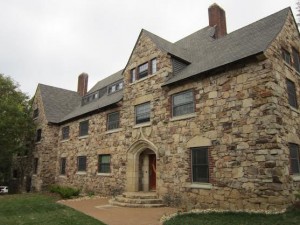
I lived right above the door at Cannon hall Sawanee built in 1926
I was not an athlete but I kept up. We had strength tests we had to pass. I did get the highest grade on the "squat jump" by doing more squat jumps in a measured period than anyone else. I had trouble doing the pushups and situps. I passed the requirement but did not excel. I did get a favorable comment from one of the physical training instructors. We each had to take a turn standing on the ten yard line of a football field and then had to scuffle with a gang of six or eight other young men who were part of our class. The object was to have the group drag the soloist across the goal line, ten yards away. I fought off the group longer than anyone else - it took them longer to drag me across. I did it by dodging and hitting them hard when they got close.
While at Sewanee, I was away from home and family for the first time. We has some "liberty" (they call it "shore leave" for officers and "liberty" for enlisted men - which I was at that time) and sometimes went home for the weekend. I also took a couple of trips to Chattanooga and stayed in a hotel along with other young men in V-12 uniform. We managed to meet WACS (Womens Auxiliary Corps ?)there. Enlisted people mostly. We'd buy a fifth of Canadian Club or Seagrams 7 and have a party. A well behaved fun loving group of young people. On a subsequent trip to Chattanooga, a fellow seaman and I bought a fifth and, instead of keeping in the brown paper wrapper, we put it in a beach bag and each held one handle with the bag between us. We were strolling down the sidewalk and I spied a WAC I had met and liked earlier. I let go of my handle to go speak to her, telling my companion to hold the bag. He also spied someone he knew at the same instant as I and also let go of the handle he was holding. The result was that the bag fell to the sidewalk and the bottle inside broke. The four of us sat down on the curb and commiserated with one another as the liquor drained into the gutter.
After a semester at Sewanee, those of us most advanced in school were pulled out and sent to Norfolk Navy Yard in Virginia. Surprisingly, Norfolk Navy Yard is across the bay in Portsmouth, Virginia. We were to await vacancies at rh Midshipmens schools in Chicago and New York City.
On the way to Norfolk/Portsmouth, we rode in a train. We had to sit up - no beds - for the trip which took a goodly time. On the way, it got very cold and the pipes in our coach froze - and so did we! Some of us ended up in the hospital after reaching Virginia.
There were many wooden barracks buildings on the base. The sailors awaiting school filled many of them. These were two story buildings with offices, bathrooms and stairways in the center and large barracks rooms on either side. These held double decker iron cots on which we slept. There were two rows of lockers, back to back, running down the middle of the barracks. There were rows of bunks on each side of the lockers and windows along the walls beyond the bunks. With hundreds of young men, there were always men who wanted fresh air, so some windows were open at night. This was winter, the ground was frozen and I was from Nashville where it seldom snowed! I wore a sweat suit to bed with wool socks on my feet and a wool cap on my head and extra blankets over me. Brrr!
There were all types of people there. In our general area, they were all college students in the V-12 program but they came from all over the Eastern seaboard. Some cursed, some didn't, some gambled and some didn't. A melange.
One night there was a commotion in our section of the barracks. There had been a big poker game and someone had lost heavily. After thinking everyone was asleep, he went to the locker of one of the big winners and took his wallet. The noise awoke someone who called out. That scared the robber who fled around the lockers to the other side and put the wallet under his mattress and jumped into the upper bunk which was his and feigned sleep. It happened that he had been seen and was identified as the man who ran around the lockers. He denied it and there began a search for the wallet. That didn't take long because the man who slept in the bunk below the robber saw it right over his head through the springs holding up the robbers mattress.
Needless to say, he was disgraced and put into the jail on the base awaiting trial. The sad part came the next day when his fiance arrived for a visit they had scheduled. He had stolen so he could entertain her properly. I understand that they were married later and he returned to Tennessee and became a prominent, well liked and respected person. For that reason I have omitted his name. Dr. George Will, famous writer and speaker, once said he thought we should forgive everything anyone does before they are twenty five years old. Perhaps so.
We spent time drilling and doing busy work. I was picked to be one of the officers and so I didn't have to make all of the drills. I was able to take the bus provided by the Navy and roam the entire naval base which was huge. I saw ships of all sorts in dry dock, moored, anchored. I saw submarines. I visited classes where men were trained to shoot machine guns at aircraft by the use of film of actual attacks by Japanese planes.
I had to take my turn on watch and on one occasion drew an outside guard post where I had to stand on ice in a snow fall for two hours without relief. I came down with a cold but recovered. We also had to take turns in the chow hall serving food, washing dishes or whatever. I drew dish washing which involved putting dirty dishes into a steam dishwasher and taking them out. Hot work and I was wet all the time.
While there we took liberty and went off base into Portsmouth and Norfolk. I had never seen such places. I had ridden through the red light district in Nashville but the block after block of women available for sailors and the block after block of tatoo parlors and peep shows was a shock to all of us more naive types.
The Episcopal church in Norfolk had a dinner for those of us from Sewanee. a real cut above what sailors could get on the streets.
While there I took trips to Williamsburg, Virginia and visited William and Mary College which is located there. The President of William and Mary was Dr. Pomfret who had thrown me out of Vanderbilt two years earlier. I visited him at his house in williamsburg. Of course Williamsburg itself is a big attraction. Rockefeller money had restored the town to an appearance it might have had in the 1700s. Beautiful. Excellent restaurants. I had scalloped oysters there which have never been matched elsewhere.
I met a girl there named Betty Roebuck. She and I became close. betty was a student at William and Mary and a very attractive and polished young lady she was. I don't think I have ever seen anyone else who could just float into a room she way she did. She didn't seem to walk she just glided along in a very smooth and ladylike manner. We had lots of fun. More about her later.
I also met a girl I liked named Ginny Darst. We also enjoyed each others company. She was in a different sorority at Wm & Mary than Betty. Different type. Both fine ladies.
Fortunately, I had gotten to know people well enough so that I was able to get a second ID card. The ID card was used as an admission ticket to the base and to all sorts of places. When you were on liberty you were given your ID card to let you out of the base and to get you back into the base. When you weren't on liberty, your ID card was taken up and held in the office. Having two cards was unheard of and meant I could go and come as I liked. I managed to move around the base enough to get to know some people and became a tour guide. They had personnel ride on some of the buses and tell people general things such as where the submarine base was. After my stint as an officer of our V-12 unit, I did that for a while.
Finally our turn to go to midshipmens school came. Some went to Columbia University in New York City, some to Northwestern University in Chicago. I went to Chicago. This was my third college.
Our new home was the former Tower Town Club which was a multi-story building on Michigan Avenue right by the old Water Tower. The difference between it and the barracks in Norfolk was amazing. We had rooms with eight to a room, large wooden lockers for our clothes, beds with mattresses with springs inside and nice clean sheets. Elegant, we thought. A world away from an enlisted man's life.
In the middle of the room were desks, one for each midshipman. Plenty of light and comfortable. Each floor had a large bathroom and shower area.
Our uniforms now were those of a midshipman - much better, we thought. We had heavy coats with skirts which extended below the knee, not the enlisted man's short peacoat, to wear in cold weather. We no longer wore bell bottoms, now we wore trousers.
Here we really began training in earnest. Naval officers were all over all day showing and teaching us what to do. We stripped our bedclothes off the bed to let them air when we arose and later, after breakfast, made the bed according to regulations: square corners, etc. Our clothes had to placed in the closet in a certain way and rolled "just so" to pass inspection. Our clothes had to be neat, clean and pass inspection every day.
We attended classes every day. Navigation, Seamanship. Gunnery, Naval Courtesy and Organization. We went through a short indoctrination session wherein we were introduced to all of these subjects and tested without it counting on our record. Then began the real school. We had time on weekends to go to Chicago and there were a few minutes every night when we could run across the street to the local stores and grab an apple or candy bar. We were dubbed "ninety day wonders" because the school lasted three months. It was a wonder we survived and some didn't. Fortunately, that ROTC training I had in high school and the training I had in V-12 were put to use. Not everyone had that training. Some young men came directly from V-7 to the school and had no military training.
That worked out well for me. I was among the six tallest men in my group (different from my years of being the smallest). When we marched outside we were in two columns. That put me third in line in one row. One of the first things we had to do upon exiting the building was to cross a bridge over Michigan Avenue and go down stairs on the other side. Then we had to cross a side street. Before doing that, the two men in front, one from each row would run ahead and block the traffic on the side street so we could cross it safely. That meant I was now number two man in our row. The man who was now number one had not had the training I had and didn't do a good job of marching - keeping step and cadence. The Ensign in charge of our group had the man in first position swap places with me so that I was now number one in one side. That exposed me to everyone because we marched in that formation for some distance with me leading the pack every time we left the building.
This worked to my favor because our Ensign White (Whitey to the already commissioned officers, Mr. White to us midshipmen) was very observant and outspoken. I remember having him stand and watch us march after which he came up to me and asked where I had learned to march so well. i did have the erect carriage and had drilled so much in marching that it was no trouble to keep a smooth cadence. If you've ever seen seasoned troops who have spent months drilling, you will recognize the way they march. It is an easy, rhythmic gait which appears unstoppable and inspires confidence in others that the marchers are very capable.
A minor thing you say? Yes, but sometimes it's the little things that count. They add up. "for want of a horseshoe nail a kingdom was lost".
That put me in his (Mr. White's) good graces. I also could give commands in a crisp and effective manner. He liked that. My room and belongings were always just as neat as they could be. So he gave me high marks for what they call "fitness to be an officer".
When my grades started to come in and I was one of the top students, academically, he nominated me to be a battalion officer -so I got a little gold braid to put on my sleeve which most others did not.
While in Chicago I met a family to which I took a liking. Tom Underwood was the man of the house. He had a wife and an attractive daughter who was away at college most of the time. They had an apartment near the Water Tower - which was the most expensive place in Chicago to live. He was a top lawyer. They belonged to the Saddle and Cycle Club a very upscale organization with facilities nearby. They had me over for dinner, took me to the club to play paddle tennis and have meals. They introduced me to a girl, Elizabeth Howell.
Betty Roebuck came to Illinois to visit a girl friend and they had me down for a week end. Betty and I hit it off well but she lived in Palm Beach and was in school in Virginia. Elizabeth was in Chicago. Elizabeth and I fell in love and, if she had not been a Roman Catholic or if I had been one, we might have married. We certainly were infatuated and said sincerely that we loved each other. Her father was a top executive in a large steel company in South Chicago and I regularly went to their mansion or Elizabeth came to my school so we could be together. Shortly before my four or five months in Chicago ended, her parents took her to Europe with them and that ended our warm but brief romance. Upon visiting Chicago after the war I called her and reached her mother. Elizabeth had married a banker and was happy with him and two lovely children in a city nearby. I felt good about that and sent her my best wishes.
As time passed, graduation loomed ahead and we were asked what we wanted to do. I volunteered for underwater demolition - frogman duty and the man who came to interview us wanted me even though I told him I came from Nashville and could barely swim because we just had almost no exposure.
Later, one of the officers, not Ensign White, but a Naval Lieutenant, Whitey's superior, talked to me and said there were two special openings available and wondered if I would be interested because he would recommend me for either of them if I wanted it. One was an administrative post with the Navy - an important one which offered special opportunity. The other was that Admiral King had asked that a midshipman graduate be assigned to him as an aide. King was the top naval officer in the US.
It was quite flattering and many people have told me I was a fool not to take the job with King. However, i wanted to be in an organization which had direct physical exposure to the enemy and I declined them both and went to Fort Pierce, Florida for training to join an underwater demolition team. Mom and my roommates knew all of this. Somehow the word reached Sewanee and an editorial was placed in The Sewanee Purple, the school newspaper, praising me.
I was commissioned on May 7, 1944 and despite having to take a lot of time out for love (Elizabeth, you know) I finished very high both scholastically and in "fitness".
Fort Pierce in WW II was a Naval Base (other military was there too) on an island off the East Coast of Florida. One of the barrier reef islands, it was full of mosquitos and sand flies. I believe it was about 40 miles north of Palm Beach.
No spit and polish here. This was he man stuff. Many tough and would- be-tough men belonged to UDT - some sadistic and perhaps deranged. One of those lived in the tent with me. He was always practicing throwing his knife.
We lived in buildings about the size of a big tent, four officers to a tent. The sides were wooden struts with screen across them to keep out whatever might want to enter. The top of the tent was also wood. We placed our cots - yes, cots, on stilts so that our bodies were above the wooden sides of the tent. We slept under mosquito nets - no matter how hard we tried, we couldn't keep them out of the tent. The cots were lifted be the stilts to a position about three feet from the wooden floor. That meant they were higher than the wooden wall which rose about three feet from the floor (the screens then rose about four more feet to the roof. We had a place to store our gear. We ate in a dining room across the road. The administrative offices and parade ground were over there. We got our drinking water from a lister bag on the parade ground.
Most of the officers were engineers who had been in construction work and knew something about explosives and their use.
We wore khaki colored tops which resembled pajama tops with long sleeves to protect us from the tropical sun which existed there and from whatever we might rub up against in the ocean. We wore leather sand shoes which were rough on the outside and could take a beating. We had metal battle helmets with our name and rank on them - the better for the enemy to pick out the officers and kill them first. We had a flotation belt which was inflatable and which was worn outside of our other clothes. CO2 cartridges were attached which could be activated to provide flotation. Officers had a 45 caliber automatic pistol and a carbine.
We trained on beaches. We had classes in explosives. What to use to blow up what. How to rig them to do the most damage . How to set them off. Precautions to take.
We also practiced on real beach obstacles. The Sea Bees (Construction Battalions) would build a series of obstacles on a beach and we'd go in and blow them up. Then they'd rebuild and we'd destroy again.
Obstacles were of many types. First, one might encounter scaffolding erected out of pipes anchored in the surf or just a little faster out. These would be visible but effectively prevented small boats from coming close to shore. We blew these up with rubber hose full of explosive. Next might be steel obstacles anchored in the sand with a point sticking up. These would go through the bottom of a vessel attempting to land. On the beach there might be various kinds of steel tripods, rails, etc. Behind all of these might be a large concrete wall reinforced with steel. All but the scaffolding were destroyed by canvas bags full of explosive. We'd arrange several bags of explosive around the obstacle and set it off.
We had rolls of waterproof wire which were attached to the explosive with a detonator at the end of the wire inserted in the explosive. We would attach the explosive to the target, attach the detonator and wire to the explosive , uncoil the wire, paddle with the wire on our seven man rubber raft out to our landing boat and set off the explosive. Lots of noise, lots of dirt and sand or water.
We swam. After a short time we began to swim a mile every day. We'd swim out past the surf and head North. When we passed the officer who was at the one mile distance, we could come ashore. As you read, I wasn't much of a swimmer. I had been to scout camp two years but the water in the river there barely came up to my waist. I had been to a public pool at Centennial Park in Nashville several times but made no effort to swim. At Peabody we had a pool and I spent many hours playing there but never concentrated on learning to swim. So I had never been in the ocean and didn't know much about swimming.
I went out with a friend before we started duty - just to get the feel of the ocean and almost drowned at first. But I persisted and soon was able to swim. The mile a day gave me opportunity to develop several different strokes. It's not a good idea to swim a mile using only one type of stroke. I learned to swim on either side, to do the breast stroke, the back stroke and the crawl. I felt comfortable. We had contests. My team won the one for stacking explosives against a concrete wall quickest. We came in second on the swim with a canvas bag of explosives. We did well on the obstacle course but one of our men had trouble getting over a wall and I had to help him.
I was proud of our team. I took them out in a boat for recreation some. I don't think any other officers did that.
We had to learn to drive big trucks in the sand. Fun.
The key man, though not the highest ranking, was LT. ? . I visited The UDT museum in Ft. Pierce and learned that he later became an admiral.
We were in Ft. Pierce when D-Day in Europe took place in June. We sat for weeks after completing training without assignment and began to get testy with each other. The commander had all of the officers sign their fitness reports in blank - against navy regs you know. Signing indicated you had read and understood your ratings. This wasn't true but we were ordered to sign them anyhow. I was one of the few who objected but received a rebuff.
Another notable incident occurred that fall. A hurricane came through. Ft. Pierce was a barrier reef island and so there was a big exodus to the mainland. UDT personnel were the ones selected to stay on the island after everyone else left. Did they think we could swim in a hurricane? Anyhow, the troops began marching down the road past our camp toward the bridge to the mainland. That kept up for many hours. We stayed put and made plans to hunker down.
Fortunately, the hurricane scare was over without the big hurricane expected. We did have a lot of wind and rain but not the high winds for which we prepared. Therefore we never left the island as did all of the others on the base.
Because of the war, Ft. Pierce had many strong and healthy young athletes. We had our own football team made of a number of All American players who had duty stations in Ft. Pierce temporarily. Names coming to mind are Marshall Goldberg, an All American back, from Pittsburgh I think. Bill Daley, All American back from Minnesota. Hamp Poole, All American end from Mississippi. Names of others escape me now but they were there and played football. The Ft. Pierce team was unbeatable during its short life.
After a seemingly long wait, I transferred out into another outfit at Ft. Pierce called Assault Beach Battalion. These are people who go into the beach at the beginning of an invasion and direct traffic for the navy. It grew out of the Navy's belief that it should have its own people on the beach in charge of directing ships into and out of the beach. We carried radio equipment and fighting equipment because we expected to be among the first waves ashore to do our job.
There were about 22 men to an assault beach platoon. A full Lt. in charge, a medical commissioned officer and another line officer (me) who was second in command behind the top man.
As you might guess, since we expected to hit the beach, we wore the same kind of outfits that UDT men did.
While at Ft. Pierce, I took flying lessons. I did my solo on a bright day after completing the required six hours of dual instruction. After riding with me while I took the plane around one time, the instructor got out and told me to go it alone.
I took off and circled the field. The landing approach I was to use called for me to cross the main highway and some telephone wire just after the highway and then come down on the field. They were burning the grass at one part of the field and when i came around to land the wind was such that the heat from the fire produced an updraft. I had to be high enough to cross the wires but by then I was in the updraft and the plane didn't want to come down. Fortunately I realized what was happening and turned on the power enough to overcome the lift and get low enough to land safely. When I got to the instructor he was elated but had been worried when he first realized what I had faced. He hadn't instructed me on what to do in that circumstance. Later, I practiced pylon eights which are no longer required for a license but are now. I also did my cross country flight across Lake Okeechobee.
Another fellow and I used to take Piper Cubs (tail draggers) up and do stunts and pretend we were dog fighting. One of the requirements was that one learn how to get out of a tailspin. One of the first thing s they teach a student is how to put the plane into a spin and how to get it out of one, Many hours of fun.
I went to Miami on occasion. It was a bit farther than Palm Beach. We'd ride the Atlantic Coast Line passenger trains down to Miami. One of the problems was that I had to be back on base by 6 Am the next day and the last passenger train left Miami too early in the evening. It went through Palm Beach at a decent hour for leaving if I saw Betty, but was not good for Miami. One had to start thinking of leaving almost upon arriving in Miami. The solution appeared. There was a late freight train out of Miami which went north and stopped in Palm Beach and Ft. Pierce in time for me to get a little sleep in my tent before morning muster. So I took to hopping on a freight car in Miami or Palm Beach and riding the rails home to Ft. Pierce.
It wasn't long before I was discovered by the man in charge of the freight train. He rode in the caboose. He wasn't nasty at all. In fact, he was very friendly. He said he had a son in the service and offered to let me ride in the caboose and sleep on the bed they had there. So, I began riding in the caboose from either Miami or Palm Beach to Ft. Pierce. I was even awakened gently upon arrival in Ft. Pierce.
One of the men whom I knew before going to Florida was Lewis Smith. He was in my tent at UDT and was swimming with me the first day I went in the ocean. We body surfed in the Atlantic in off hours.
One time I was having a great ride on a big wave when it broke and threw me. I landed on my head in the sand under the surf. I passed out for a fraction of a second. Close call. Perhaps landing on my head explains some of my insane ways.
Lew Smith was in love and his fiance came to Florida for a visit. he took her to Miami and they went to church on Sunday Morning. She had something to eat which didn't agree with her and, after the service she felt uncomfortable and told Lew she had to sit down. The only place available was the curb. So she sat there. Two older ladies coming out of the church saw them and shook their heads, saying something derogatory and suggesting she was drunk. Lew stood up straight as a rod and said "Madam, she is not drunk. she hasn't had a drink. She is sick" The older ladies melted immediately and helped get her to a good doctor and she recovered from whatever bug had gotten to her.
Near the end of my assignment in Ft. Pierce, I ran into Betty Roebuck again. Some of us were in our dress whites at a party in Palm Beach and a girl I found attractive and to whom I started to speak recognized me and said "You're the Ensign Betty Roebuck went all the way to Illinois to see". I thought Betty went to see her girl friend who lived there and just coincidentally saw me (men are so blind). She promptly got Betty and we began to date again. Her father was the sheriff of Palm Beach County and her family were very socially acceptable. In those days we had gas rationing. Betty had a gas station which would give her extra gas to which she wasn't entitled. We could ride around a lot with that. I told her she should be careful. He was probably giving it to her without her father's knowledge and there could be big embarrassment if it got out that the sheriff's daughter was getting illegal gas.
We had lots of fun. We used to swim in the ocean and in private pools. We'd walk and talk. The only privacy we could get was to go to the big hotel on the beach and climb in one of the cars parked there to do a little hugging and kissing. She was a fine, very attractive and intelligent lady. Our courting was cut short by my assignment to a ship.
Lt. Frank Carey was the officer in charge of our beach platoon, I was the second in command. Lt. Dr. De Stefano, a sports doctor was our medical officer. By sports doctor I mean he was connected to professional sports teams aa their doctor. We had about 20 enlisted men headed by Chief Bosun's Mate Parsill. Our group had a number of communications and equipment experts and considerable radio equipment. We also had some motor mechanics and coxswains to take care of boat problems. There were two medical aides to the doctor.
When I joined him, Frank Carey was considered to be the best beach platoon commander on the base. There were others who outranked him - even Lt. Commanders and one or two commanders but Frank was tops. We also had an outstanding crew. All of this led to adventures later.
We were shipped out of Ft. Pierce and sent to Norfolk Navy Yard to join our ship, The USS Charles Carroll. Carroll was a signer of the Declaration of Independence, from Virginia as I remember. The ship was designated APA #28. APA meant that the ship was an assault ship and carried personnel and arms. An AKA was also a large ship but it carried only material, not personnel.
The ship had been taken over by the US Navy while it was under construction as a luxury liner. It had features such as fine teakwood which a naval vessel normally wouldn't have. It also had special accommodations for VIP use. Special large staterooms suitable for an admiral or diplomat, separate dining facilities for VIPs, etc.
When we arrived, it was in drydock. After fighting in Africa and Europe, it had dragged anchor and run aground. An interesting sidelight is that such an accident seals the fate of two officers. The one on duty who "allowed" it to go aground and the captain of the ship.
Our captain, Elliott Strauss, was an Annapolis graduate. The son of an admiral, he held the rank of Captain in addition to being captain of the ship. A distinguished and polished gentleman who looked a lot like the former Prince of Wales did in his younger days. That is the Prince who gave up his throne to marry an American divorcee in the 1930s.
Naval courtesy and tradition calls for the Captain to have quarters near the bridge of the ship away from other officers. He eats alone and has his own mess boy and kitchen. He pays for his food.
The bridge is the place from which the ship is run. It is high up, enclosed, has the "wheel" in it, navigational equipment, communication devices and instruments. There may be a lower bridge and an upper bridge, meaning that the ship has two such wheelhouses. We had two enclosed bridges and a flying bridge on top of the uppermost and exposed to the weather.
The bridge has to have light but must remain dark at night so that the enemy can't see any light. Hostile submarines patrolled the seas. Lighting was provided by several means. The bridges all had several devices. There were special radar tubes which didn't destroy night vision but gave a picture of everything on the surface within the range of the radar. Radar was discovered/invented by the British in WW II and was a major advance in warfare. We also had Loran (Long Range Aid to Navigation) to assist in navigation. There would also be very dim lights inside the compass being used to guide the ship. This made it possible to read the compass so we knew in which direction the ship was going. We had an electrical gyro compass which gave us headings. The annunciator also had a dim light. This instrument was used to show the current direction (forward or reverse) and power being supplied to move the ship; slow, half speed, full, flank (meaning give me all you've got). This instrument was also used to signal the Engineer when a change in speed or direction was desired. Such a change caused bells to ring to attract attention. Many ship movies have that sound.
The bridge is under the command of the officer on duty as Watch Officer. At sea, he is on the bridge. In port, he is at the main gangway affording access to the ship. All officers train for watch duty. The less experienced act as junior watch officers under the command of a senior person. There would be several junior watch officers on duty at sea. At least one would be with the Watch Officer at all times. Others might be on that bridge or on another one of the bridges.
Others on the bridge would include an enlisted man manning the wheel which controls the rudder and steers the ship. There would be lookouts on every side, peering through binoculars.
The watch changed every four hours. The oncoming watch officer would arrive on the bridge about fifteen minutes before he took command and familiarize himself with all pertinent information. He'd have a "log" which told him what course and speed the ship was on as well as its destination and other important information. He would have a navigation chart to see where the ship was at that time and would check to be certain that all stations were properly manned and that his crew were ready to take over. At the proper time, he would discuss the situation with the watch officer preceding him on duty and the watch would formally change when he saluted the outgoing officer and said "I relieve you sir". After that, the ship was his responsibility.
All persons on watch wore the uniform of the day and watch officers wore sidearms - a belt with a holster and a loaded 45 caliber pistol and carried binoculars and a flashlight which had a special red covering to allow dim light but which wouldn't destroy night vision. We put on special goggles for about fifteen minutes before going on duty. We could wear them inside the ship where there was normal lighting but they didn't allow light to affect night vision. When we went into darkness outside, we could take off the goggles and see immediately as well as we would be able to see after being out for a half hour or more.
When the ship was on special alert, there would be a call to "General Quarters" at which time everyone on board went to his special station ready for battle. There would be a shrill whistle and announcement followed by a noisemaker which awakened all. The Captain would be on the bridge and would "take the con" meaning that he was taking the place of the Watch Officer. the Watch Officer stayed at hand because at any moment the Captain might want to go to the navigation room or the communications room and turn the con back to the other man.
I had two duties on board. I was the second in command of the beach platoon and a member of the First Lieutenants Department. There were a number of departments aboard our ship. Gunnery, Navigation, Communication, Supply, Medical, Engineering and others I have forgotten. The First Lieutenant had to take care of lots of things such as maintenance. We had deck divisions into which most of the crew were divided. Each had an area of responsibility aboard ship. While on board, my "General Quarters" post was in the after steering room. This was a very small space in the stern of the ship, several decks down, just above the rudder. From there we could manually move the rudder in the event power failed and it could not be steered from the bridge. We used telephone lines to communicate with the bridge. Yes, I know, you are saying: "If the power prevents signals from the wheel on the bridge from getting to the rudder, how could telephone signals get through?" Well, our telephones did not depend on power being on - they were voice powered. Second, they had separate lines to the bridge which gave an extra chance of getting through. Third, we had people directly outside our space who could use other means to communicate with the bridge if necessary. Finally, there is no guarantee in war that you won't be hurt or destroyed.
My sleeping quarters were on the main deck, just aft of the wardroom. There I had a nice built in bunk with a good mattress and cotton sheets and wool blankets. I shared space with two other Ensigns, Roy Rabb and Larry Jones. We each had a small desk on which to write and a chair on which to sit. There was ample closet space though cramped. Both of my roommates were officers in small boats - meaning they commanded several small boats and would lead them ashore during an invasion. For that purpose our ship carried a large number of LCVPs stacked on top of each other and cabled to the deck while we were underway. When we reached port these boats had to be put off so that we could open up the holds underneath them where equipment and material was stored.
We ate meals in the wardroom, served by negro messboys. In those days blacks normally had that kind of duty.
There was a group of officers who manned the LCVPs with crews and who were prepared to take them into the beach during an invasion, loaded with men and material. We also had LCMs which were larger than LCVPs and could carry tanks ashore. All of the boats had a flat, steel bow which served as a ramp. This provided some protection and could be dropped upon hitting the beach. This would allow men and equipment to move off of the boat onto the beach.
For armament we had a five inch gun, 3.5 inch guns, many 20mm guns and 50 caliber machine guns. All of these were stationed in fixed locations around the ship but could be turned and elevated to aim where desired. They had armor protecting the crews which manned them. We were thus equipped to give good showing against a submarine or small warship.
The Charles Carroll was dubbed "The Lucky Chuck" because she (ships are always treated as ladies even when they have men's names) had been through so many battles in Africa and Europe and come through unscathed. In our wardroom (the room where officers ate meals and relaxed) we had one wall covered with campaign ribbons and heroic medals won by ships personnel. We also had emblems of all the divisions which had traveled on board.
Our first voyage was to the Panama Canal. We spent a night in the town outside the canal waiting our turn to traverse the peninsula. We passed through the canal and spent the rest of the war in the Pacific Ocean. The canal itself is an engineering marvel. Imagine, lifting large ships out of one ocean up over hills and down the other side to another ocean.
Sometime along the way, our Executive Officer (the man second in command) who was an Annapolis graduate, was removed and we had a new Executive Officer. The former Exec had made a homosexual advance to another officer and this was reported to the Captain. In those days, homosexuality was not acceptable in the service. The replacement, Commander Thwing, was a banker from Seattle who had been active in the Naval Reserves before the war.
We went to San Francisco harbor, sailing under the Golden Gate Bridge and picked up supplies to go to Espiritu Santu in the South Pacific. On our way we stopped at Pearl Harbor.
Travel at sea was in a "darken ship" mode. No lights could be seen from outside. There were special double door arrangements which allowed one set of doors to be open while the other was closed. To go on deck, one passed through the first door, it closed and the other outside door could then open. All portholes and windows had special covers which allowed air to move in and out but not light. We generally travelled in convoy. Convoys would be made up of ships like ours carrying men and material, escorted by fighting ships such as destroyers, cruisers and such. Convoys changed direction every few minutes. This was coordinated by picking a pattern from a large book with many, varying patterns of behavior. All ships followed the prevailing pattern and turned at the same time as well as moving at the same speed. Impressive since the ships weren't any farther apart than they had to be for safety. Thus the crew had to be alert to avoid collision in addition to being on the lookout for enemy vessels. New zigzag patterns were selected frequently so that our movements couldn't
In the early part of 1945 we were in the South Pacific and preparing for the invasion of Okinawa. This was an island, part of the Ryukus, which were considered to be Japan itself. No American was known to have been there and photos taken by submarines didn't give too clear a picture. No foreign country had ever invaded Japan.
At a meeting aboard one of the command vessels, our beach platoon was picked to go ashore on the section of beach to be attacked by our group of ships. It was considered an honor to be chosen and we were happy about it. I had volunteered for duty involving direct contact with the enemy and this would be my chance. We were relieved of all other duty as necessary and prepared for the invasion.
We loaded troops and equipment (tanks, artillery, etc.) and proceeded in convoy toward Japan. We had some time ashore with the troops we were carrying and got to know some of them well. We pulled a trick on them which we had pulled on many others. We had a man named Gosewich who could run pretty well backward. Whenever we had someone in mind he would be parading around enough to cause comment about his running by the other party we were trying to trick. We'd let them draw us in and say we thought he could outrun a lot of people who ran forward. This was said in such a way as to bring out the manliness of the other side who couldn't believe such a tale. We let them draw us in and we'd let them have us bet with one condition. The two runners would start at the same place, run a certain marked distance to a finish line. Gosewich would have to run backwards and the other guy forward. By the time it came to the actual race, the others would be brimming with confidence and want to bet on the outcome. We "reluctantly" agreed if they would just do one thing. That was that their runner had to run around a small tree on the way to the finish line. They quickly agreed and the race was on. If you've never seen it done you would not believe how much going around that tree delays the runner. If the distance run is short enough, Gosewich would fall behind at first, then breeze into the finish line well ahead of his competitor. The reason he won is that the runner who circles the tree actually has to stop and go in the opposite direction for a short time before he can build up speed again in the correct direction. By that time, Gosewich has caught up and gone in front.
In such cases it is best if all of the money bet is put aside before the race. That way, the winners are surer to get it. The losers might balk after they learn they have been tricked.
We could always point out truthfully that it was they who suggested betting and that they agreed with the conditions. They were chagrined. Usually there was a good laugh and a vow that they would use that trick on someone else.
Ernie Pyle was aboard our ship as was the top officer of the group we were carrying, a Colonel. Ernie was the most famous newspaper correspondent during the war. He had gone through Africa and Europe with the troops and wrote about war as the common soldier saw it. Consequently, he spent his time with the enlisted soldiers, sailors and marines, not the officers. He was killed a few days after we put him ashore on Okinawa. i have an autographed picture of him.
The invasion of Okinawa started on Easter Sunday - April 1, 1945. That morning, before daylight, we were in our invasion gear and ready to load on the boats to carry us ashore. We had a hot meal - expecting that to be the last for a number of days. Then we assembled in our proper places from which to debark and checked our equipment. When the time came to load, we climbed over the side and went hand over hand down a heavy network of ropes to our boat with our carbines, etc. Some gear such as radios was hoisted aboard by winch. Frank Carey was in one boat and I in another with our platoon divided between the two boats..
Small boats after loading join other boats and they all circle at a certain point until it is their turn to head for shore. When that time comes, they form a line parallel to the beach and head for the shore in a "wave" - that is they stay in line. Another line or wave of boats would follow that and another, etc. until all were headed for shore.
USS Charles Carroll (APA-28) WW2 Amphibious Maneuvers, 4/28/1943 (full)
Our platoon was scheduled to be among the first Americans to go ashore - hence the need to train to fight and the name assault beach platoon as opposed to garrison beach platoon - a group which would come later and stay longer. They were not trained to fight as we were. It takes a while to prepare for the boats to head for shore after they are loaded. I spent my time talking to the enlisted men and checking on things. After a while there was nothing to do but wait. This can lead to seasickness in a small boat out in the ocean with waves and swells tossing the boats as they stall for time in their circling. I found that the two best prevention measures were to eat a piece of hard candy and sit down and try to sleep. I managed to do both while awaiting the signal for our wave to attack. I had not expected to sleep in a small boat in the ocean during the naval bombardment that was happening in front of me but I did.
Finally, the time came to go and the boats formed a line and opened their throttles full and headed in. There is always the sea and surf to contend with so that it is not like a sail on a lake. We approached our beach, Yellow Beach Three, which was on the West side of Okinawa. All of a sudden our boat touched bottom, the ramp went down and I went out followed by our platoon.
As widely reported, there was almost no resistance by the Japanese at first. Apparently they were surprised and did not oppose us in any determined way as we landed. We got our men and equipment ashore, Frank set up his command post and I was assigned to first test the waters off our beach to determine what obstacles there were, manmade or natural, so that we could determine where larger ships could come ashore, open their front and unload.
It was amazing seeing a line of large ocean going vessels beached with their bows opened and ramps coming out from them teeming with streams of tanks, trucks and material. The beach was perhaps 30-50 yards wide (ocean to land) and consisted of sand. Behind that was a 20-30 foot bluff and level ground beyond. The construction crews quickly used bulldozers and earthmovers to construct ramps from the beach to the land above the bluff and soon there was a steady stream of men and material off the beach toward the battle.
Marines on the Beaches at Okinawa 4 days after the April 1, 1945 invasion landing
When I had time I glanced at the fleet and men all about. This was the largest invasion fleet ever assembled and I could see a lot of it myself. The aircraft carriers were out off sight over the horizon but destroyers, cruisers and even battleships were right offshore in plain view. Of course the largest group of ships was full of the invasion troops and the things needed to support them. Our planes were continually flying overhead going inland or returning to their carrier.
When a battleship fires a twenty inch cannon it makes a loud noise and flames and smoke come out of the barrel. The shell would then fly over the beach toward a target inland. The sound of such a shell passing is sort of like hearing a freight train going whoof, whoof, whoof, whoof as it hurtles by the beach. The battleship West Virginia was just off our beach and lobbed plenty of large shells past us that day. Other ships. too fired at targets ashore.
One of the first things done when troops get ashore is to build airstrips for our planes to use. The planes are flown in and based there to add to the power of our forces. Okinawa was no different.
When the first day began to wane, we were pretty well set and I took time to go to the top of the bluff to survey the sight. What a magnificent panorama! I wished I had a camera to record it. There was the largest landing force the world had ever seen busily going about its business. Battleships, cruisers, destroyers, and dozens of picket ships and support craft as well as many large APAs and AKAs. I was standing there watching the planes return to their carriers over the horizon. By that time there were only scattered flight of stragglers because night was coming. I looked out to sea and could hear the engines of the planes coming from landward as they approached me. They sounded very powerful and capable. As i listened, I suddenly realized that I heard a different sound - sort of like hearing a "Model T" auto after hearing a Cadillac. Without turning, I realized that these were Japanese planes and turned to face them. Approaching me, as close to the ground as they could be, were three Kamikaze planes in formation. They flew right over my head and I felt I could have touched them if I could just reach a little higher. I got a glimpse of the pilot of one as he passed. If you don't remember, a kamikaze pilot is one who is trained to commit suicide by flying his plane, loaded with bombs, into an enemy target - usually a ship. They called it the "divine wind" and such suicide volunteers were great heroes and certain of a good life in the hereafter.
Once over the bluff the planes were in sight of the fleet. Each of the planes headed for a large ship. As they passed over the beach onto the water, a gunner on a ship recognized them and began firing tracer 50 caliber bullets at them. In the blink of an eye, another tracer line reached toward them from another ship, then several more and in five seconds or so the sky was filled with tracer fire aimed at those three planes.
The planes kept on their courses and each hit a ship, causing damage. Years later I met an officer from the West Virginia, who remembered the event and told me that the plane which hit it did considerable damage. I wondered if the men shooting 50 caliber machine guns and 20mm cannon at the planes didn't do more damage to other ships than the kamikaze pilots.
CVE ships buring and flaming planes falling from the skies in 194. Perhaps these are the Kamikazi attacks he witnessed from the shores of Okinawa
For sleeping, we dug foxholes in the sand on the beach. I took time to dig mine. It was dug in the shape of an "L' so that one could hide in either leg of the letter "L" if the other leg was exposed to attack. If both legs were exposed, well, it was war and one had to expect some discomfort.
The naval medical officer who was assigned to our platoon was transferred to ship's company prior to the invasion. This meant he would stay aboard to assist in the medical area as needed. Another, more junior medical officer, took his place and was busy attending wounded when the day wore on and had no chance to dig his own foxhole.
When he came to our area for some sleep, I gave him my foxhole and dug another one for myself. That was a stroke of fate which I don't understand today. My generosity saved my life because he and another man nearby were killed in their foxholes that night. If I had retained mine, I would have been the one killed.
We spent three days on the beach and, being an assault beach platoon instead of a garrison beach platoon, our duty was to help secure the beach and get things flowing inland. So we were relieved by a garrison beach platoon and went back aboard our ship. We had two of our twenty two killed on the beach - that's decimation. Hardly a light casualty list.
As soon as we were aboard, we sailed away with a large group of ships which had discharged their cargo. That was not the end of our Okinawa adventure. A typhoon had arisen and was bearing down on us. A typhoon is called a hurricane in this part of the country.
A storm at sea is a frightening thing. A typhoon is appalling.
The sea began to heave and the winds began to rise. Soon the waves were very large and after a while the ocean was like a washboard with one large wave after another.
It is impossible to stand on a ship in a high sea. A man is not strong enough to hold himself against the force exerted by the sea when it suddenly bangs against a ship. One retreats to his bunk and holds on unless he has watch duty at the moment. If he has duty he goes in slow and uncertain steps to the bridge holding on as fiercely as he can as he creeps along a gangway or climbs a ladder (stairway to landlubbers). The people on duty on the bridge have a tough job of standing but do so by leaning against a solid object and watching the sea so as to anticipate lurches by the ship.
an unknown Navy ship Fueling at Sea 1 day after Okinawa Invasion
The ship has to be headed into the sea to avoid being turned over. The bow tends to cut through the wave. As waves became larger, they exerted more force. At the height of the typhoon, the ship would be smaller than the waves. The scene would run as follows: The ship would ride up the side of a huge wave and reach the top. As one stood on the bridge looking ahead, the sea ahead dropped off abruptly and below, far below it seemed, was the bottom of the other side of the wave. As one looked over the precipice, the bottom was below and the bow of the ship would come out of the water as the ship reached the other side. Then slowly at first, the bow would begin to point downward and in a few seconds the ship would be sliding down the other side of the wave. As the ship reached the trough, the bow kept going downward as if to dive to the bottom of the sea. Then, almost too late, it seemed, and ever so slowly, the downward motion stopped and the bow began to rise. Now we were in the bottom of the trough. If one looked up, if seemed as if the next wave loomed overhead and would swamp the ship. Slowly, the buoyancy of the ship began to lift the vessel up the steep front side of the wave. Ultimately the ship would reached the top and the bow would come out of the water again just before the ship took the next dive down the back side of the wave.
This routine continued for hours. Many ships capsized and were lost at sea in that typhoon.
The physical and emotional strain was great. A high percent of the crew became seasick and were of little use. Those of us who stayed on our feet only did what was necessary.
As with all ordeals, this one ended. Happily, for our ship. We made it. Many didn't.
As the months passed. we did whatever was assigned, ferrying troops and material. Later, we learned that we were expected to make an invasion of Japan proper in the Fall. We began to ready for that. Those of us who expected to make the invasion didn't expect to survive it. We had lost two of twenty two on Okinawa, almost ten percent - high losses. We knew the Japanese were ferocious, tenacious and skilled fighters. We heard that they were training women and children to fight us when we came. We had seen their Kamikazes and seen them fight to virtually the last man on some islands. There was expectation of victory for our side but we expected to be in the front line when the battle began. As a beach platoon with invasion experience against the Japs, we accepted our fate and prepared to do our duty.
The invasion of Japan was scheduled for November 1, 1945. However, two atomic bombs were dropped on Japan early in August and they surrendered in September.
I disagreed with many things done by President Truman but delighted then that he dropped the bomb and have not changed my mind since then. I firmly believe I am alive today only because the bomb was dropped. Many hundreds of thousands of American and Japanese people lived because the surrender took place without prolonged fighting nor an invasion of Japan. With the end of the fighting there was still a lot to do. Men who had long service, wives, children, medals for meritorious service, etc. were given preference in separation from the service. That meant that the rest of us had to step in and take on greater responsibility. Captain Strauss was replaced by Captain Thwing. I was authorized to act as Officer of the Day (OOD) in port and later as OOD at sea. Frank Carey became Executive Officer. A little later, Frank was released and Lieutenant Wishmeyer was named Exec. I became Gunnery Officer and later also became Senior Watch and Division Officer. This meant I was the highest ranking line officer after the Executive Officer and was the top officer who stood regular watch. Still later, Commander Thwing was transferred off and a "regular navy" Captain became our Captain.
The Senior Watch and Division officer is responsible for assigning officers to watch duty arranging watch schedules, training and supervising watch officers. I was also gunnery officer and, although we didn't expect to use our guns, we had to be prepared for any eventuality.
As Senior Watch Officer, I "had the con" often because I had to take it in special situations.
As Officer of the Deck at sea, one is in charge of the ship in all respects. Of course the Captain and Exec outranked me and could step in at any time. That didn't happen unless we were entering port or leaving port at which time the Captain took the con although I was on the bridge as OOD. As OOD, the job often involved "keeping station" on other ships. This means keeping a set distance and direction from the other ship. To help with this we used a stadimeter which could tell us how far we were from the other ship. We used a compass and ring to check direction. We also could keep in line, direction wise, by watching the masts of the ship ahead. If we kept them lined up, we were directly behind the other ship.
To maintain station, as ships turn, required seamanship. The first ship turns and the second ship keeps on course until it reaches the point where the other ship turned. Then the second ship turns and brings itself in line with the first ship.
Sounds easy and becomes easy if one becomes good at it - which not everyone did. Fortunately, I became skilled at this. I recall that the technique involved waiting until the swirl caused by the turn of the other ship was broadside with the bridge of our ship. Then calling out "right eight degrees rudder" if the turn was to the right. then the skill came in deciding when to have the helmsman "meet her" which means throw the rudder over the other way to stop the turn. When our new captain came aboard and we were keeping station on a ship ahead of us, I had to turn the ship several times and was pleased to have the turn stop with the masts of the ship ahead lined up perfectly without any more maneuvers.
That made a very favorable impression on the new captain.
I had another notable seamanship event. One day we were cruising the Pacific and were ahead of schedule. I was still a junior officer. The captain decided to let all of the officers get practice "docking" the ship. We threw a large crate over the side to serve as a dock. The sea was smooth as glass.
The senior officers, in turn, tried to have the ship stop with the crate alongside the bridge. Everyone tended to overshoot, some by a long margin. This was not surprising, it is very difficult to stop a large vessel in the ocean. There is a lot of momentum at play when all of that steel is moving and there is relatively little resistance by the water to that movement. One also has to take into account the need to reverse engines to control the positioning of the ship when it stops. The ship may have only one screw propelling it and that causes the ship to turn one way or the other because part of the energy from the screw tends to move that part of the ship sideways. When the screw is reversed, the side thrust reverses.
Thus, large ships move up to a mooring point very slowly and take into account speed of the ship, strength and direction of the wind, currents (from tide or streams), the effect of the screws sideways thrust when engines are reversed and the space available to recover from error. When it came my turn, I carefully maneuvered the ship alongside the crate, slowed, then reversed the engines at just the right and the ship stopped with the crate beside the bridge. There was some applause and I was properly elated.
We spent much time ferrying troops home to the USA. Some had been away for two or three years. They were excited and eager to see the US. When land came into view, there would scarcely be a spot on deck on which to stand because they all were shoving each other and straining to see their homeland. When the ship passed under the Golden Gate Bridge there was always a big roar as men cheered and waved their arms in the air. Passing under it was always a thrill for me too - it never ceased even though I did it a number of times. I still tend to choke as I recall how the returning soldiers and sailors felt.
In the Pacific, there were few women for men to see and the ones who were there were Polynesian or Oriental. There might be a nurse or a WAVE if one was ashore at a place where one was present. That was rare unless one was in Pearl Harbor where they were plentiful.
We had been at sea for many moons when we returned to San Francisco. I recall going with other officers to a place where there was a band with a blonde singer. I thought I had never seen such a beautiful person. (I hadn't in several months). I believe it was Doris Day who sang with a "big band" then and later became one of the top movie stars..
Because of the quarters available on our ship, she was used to carry State Department personnel to the Far East after the war. That included women and so a nurse was brought aboard as part of our crew. She was a Lieutenant in the Navy and I was either an Ensign or a newly promoted Lieutenant, Junior Grade. By this time, I was the Senior Watch and Division Officer and had a nice, large outside cabin on an upper deck. There was a bathroom between my cabin and the next one. Both cabins had direct access to it.
The nurse was assigned the stateroom which shared the bath facility with me and we worked out a system of locking and unlocking the doors so that we knew if the other was in the bathroom. I locked the door on her side when I went into the bath and unlocked it when I left. she did a similar thing. It worked well most of the time. Sometimes she would forget to unlock my door when she left and I couldn't get to the bathroom. One time she forgot to lock my door and I went in and she was just stepping out of the shower. Quite an experience for a young man.
She was a fine young lady and jumped to shut the door. I retreated to my room. On board ship there are times when there is no duty to perform and there is time available for writing letters, playing cards, walking on deck, watching movies. We swapped movies with other ships whenever we got to port so that we regularly had a movie which we hadn't seen. Because movies were shown on a screen mounted on the rear of the ship, we couldn't see them at sea if we were where there might be an enemy submarine. They were shown in port every night and at sea when it was safe.
One of an officer's duties was to read the outgoing mail of enlisted men and censor it to protect secrets such as where we were or where we were headed. I was amazed at how brazenly men attempted to disclose such things even after being told that it might endanger someone's life if the information went astray.
Certain enlisted men handled the mail and took it ashore when we reached port or transferred it to a ship headed to the USA if we were headed in the other direction. The top man in this group was under the command of one of the three of us who roomed together when we first came on board. We censored his mail too.
We decided to make a special inspection one day and got a letter of his which he was going to mail without our review. He had placed in it much information which he was forbidden to reveal. While it was going to his home and would be useless information by the time anyone saw it, he was not allowed to put the information in his correspondence. We gave him a tongue lashing and placed him " on report" meaning he would have to go before the captain and might be punished.
It also was interesting to see how men communicated. Some were articulate and polished, some were not, could hardly spell their name and wrote crudely. They often liked to discuss sex or the lack of it and gave names to their body parts and those of their wives. You can imagine how they used these names in their letters.
Occasionally a sailor would be distraught because his wife hadn't seen him for such a long time that she had lost interest in him and wanted a divorce. Rarely, one would learn that his wife was pregnant although he had been away for over a year. Other tragedy struck sometimes and a child back home might be in an accident and injured or killed. All of these things gave officers difficulties to deal with in consoling their crew.
One oddity, I thought, was that one of the Chief Petty Officers, a career sailor had collected a notebook full of dirty jokes. It was a huge tome. Another practice, abhorrent to me was the habit of being tattooed. I don't recall many officers who were tattooed but it was fairly ordinary for enlisted men. Many of these had elaborate designs drawn on their bodies, sometimes covering a large area. This might be dragon or a tiger. Others might have their girlfriends name inscribed on their arm. Okay if one sticks with the same girl. I have seen some tattoos done so they could be manipulated by flexing muscles. For example, a hula dancer might move her hips as the sailor flexed his muscles.
The seafaring world is full of other traditions. If one crosses the Equator or the 180th Meridian, there is a great ceremony on board ship and one is inducted into a select society of those who have had that experience. I became an avid bridge player while at sea. We played for a twentieth of a cent per point and, while I lost at first, I became more adept and began to win. We also played games such as Gin Rummy. Sometimes we had a "flag officer" aboard. Someone with the rank of Commodore or above was entitled to fly a flag from the ship's mast showing that a flag officer was aboard and that this was his flagship. There would be special personnel who accompanied the flag officer. We had a Marine officer assigned on board who was part of a Commodore's staff. He was the best gin player i ever saw. I don't think anyone ever beat him. Unlike others, he would not let anyone sit behind him and observe how he played, so I don't know what technique he used.
We also played cribbage and I had many pleasant hours doing that.
Sunset and sunrise at sea are special times. Whether cloudy or clear, there is a magical quality to being able to see such an event in the vastness of the sea with no trees, or land to obstruct one's view. It is both dramatic and serene. It is as if one were in a magnificent cathedral with spectacular changes of scenery occurring as the sunlight plays on the clouds and sea as it brightens or dims with sunrise or sunset.
Clear nights are spectacular at sea. With no other light the stars and moon really shine. The sound of the waves lapping against the ship and the sight of Orion or the Southern Cross are absorbing and make one ponder the meaning and marvel of life.
On one trip while carrying State Department personnel to the Far East we stopped at Tientsin and Tsingtao. We were not far from the Russian border and there was a settlement of Russians who had fled to China to escape the communists. These were white people. While we were there, there happened to be a dance held by these Russians. My Captain had me invited to attend. It was a beautiful sight, seeing these young ladies in their evening dresses. They looked just like the girls might have looked in the states. I wonder what their fate was after the communists took over China.
I recall sailing past Korea and seeing the mountains on its soil. I wondered if we would be fighting the Russians. It was a thought which was with us for many years of the cold war.
Our ship visited many Pacific islands and ports. Shanghai, Eniewetok?, Ulithi, Guadalcanal, several Philippine ports, Honolulu, Nagoya, Kobe, Colon, Seattle, Long Beach, San Diego, San Francisco to name some I recollect.
After the war, we visited Japanese ports. Seeing the destruction caused by air strikes and our ships was impressive. Toward the end of the war our battleships could approach the coast of Japan and bombard targets ashore. Ships hulks were in harbors which hadn't yet been cleared when we sailed in and those obstacles had to be avoided.
While in Kobe we were offered Japanese rifles as souvenirs. I took two home. I had also collected an Obi, a vase and a wooden dish on Okinawa. I still have these.
While in Nagoya, another officer (Lieutenant Winkler)and I went ashore together. He was the Supply Officer and I was the Gunnery Officer and Senior Watch and Division Officer. We did not smoke. Cigarettes were a treasure ashore. We were entitled to buy two cartons of cigarettes as a ration.
While ashore, we were offered money by a storekeeper for our share of cigarettes. We decided to come back that night and sell them to him. This was against the rules but was done regularly by others so we mischievously thought we would do it.
Unfortunately for us, there was an armed marine hiding behind a screen when we arrived and offered our cigarettes. He pulled his gun and arrested us for black market selling. We were guilty but there was no big money involved and the marines superior later apologized, saying that they were after a large ring of black marketeers who were operating through that store and thought we were part of the ring.
That didn't help us because we were already booked. He said he would have stopped the procedure if he had been in the office when we were brought in. As a result, our Captain had us formally confined to quarters for a few days and wrote out a reprimand. He too, apologized, saying that what we did was mischief more than crime. He related an experience of his when he was a young officer. He had a bag in his hands with liquor in it on a naval base. The bottle was broken and liquor was leaking out as he walked across the base to hid quarters. On the way, he passed superior officers and shore patrol people who could have stopped him and called attention to what was obviously liquor dripping through the bag. If he had been caught his career would have been ruined and he would have received no more promotions.
It may have assuaged our feelings but none of that mattered. We were guilty and convicted of breaking the law.
We spent much time during the ten months after the war was over bringing our soldiers home. I select ten months because the peace treaty was signed on September 12, 1945 and I was discharged from active duty on July 26, 1946 - ten months or so later.
While I don't know the names, I do recall taking key State Department people to China. I have often wondered if they were among the group who helped the communists take over China.
One of the women with the State Department tried to strike up a shipboard romance with me en route to China. I wasn't attracted to her and urged another young officer to pay attention to her. He did and they had a fun trip.
When in the States we might call at any of several ports. We always had an official "home port" (ours changed occasionally. We had San Francisco, Seattle, Long Beach and San Diego as home port at one time or another) but might call at any port.
We put in at Long Beach several times. I got to know people there and often rented cars to ride around. My favorite was a white pre-war Packard Coupe. I met a young widow in Long Beach named Carmalita Fasola and shared many pleasant hours with her and often teamed up with Lt. Wishmeyer, our Exec, to double date.
I visited many sights on the West Coast: Catalina Island, Big Bear Lake, Lake Arrowhead, Hollywood and the big cities.
Time came finally to end my active military career. the Navy was offering spot promotions to officers who would agree to stay in the service. War time duty would count double when retirement was figured - my three years active duty would become six years in calculating benefits. I considered staying but not for long. I wasn't really of a mind to become a career naval officer.
If I had accepted a promotion and stayed, the Korean War and subsequent troubles might have made it relatively easy to rise in rank. Some people I knew did so. I have no regrets. I made the right decision in this case.
When separation came, I left my ship, had my things shipped home to Nashville and flew out of Los Angeles and didn't return until the 1960s when I was asked to fly out for a job interview.
With few exceptions, I didn't hear from anyone in the service nor did I contact them after leaving. Friendships were accepted as temporary acquaintanceships and new ones were expected to appear.
There were a few exceptions. I wrote a friend named Dan Ross several times. I heard from Carmalita for a while. I contacted Frank Carey and CPO Parsill when I visited Chicago in 1946. I visited Tom Underwood in Chicago in 1946. I tried to reach Elizabeth Howell then and talked with her mother. I ran into one of the men I had met in Norfolk in 1943 at the Republican National Convention in Philadelphia in 1948. I looked up Lt. DiForio in New York State in the late 1950s Later, I saw the names of some people I had met in the service - mostly football stars. One was a fellow named Bailey from Virginia and another All American from Mississippi.
I mention the lack of contact to make note of the fact that contacts were close and lasted a while but were not permanent. That wads the way it was with many other servicemen. We saw our duty and did it. We didn't expect any lasting personal contact or gain from it. Upon return from the service I was placed on terminal leave which meant I was paid for the unused leave to which I was entitled.
I moved into home in Nashville. We were back in Elliston Place with Grandad Crockett. Mom, Dad, Crockett, Bob and I were there. Mary Lee had her own place.
I entered Vanderbilt in the Fall and graduated in June, 1947. The GI Bill of Rights provide money for tuition and a living allowance of $75.00 per month. Many veterans of WW II were able to attend college because of this assistance.
My grades were very good and I attended class. i did develop a manner of study which allowed me to memorize vast amounts of information in a short time. That came into good use during that year in several ways. One example I recall involved a course in which I did not have the notes necessary to have a full grasp of the course but knew a young lady who did. We studied together for the two major tests and knowledge I gleaned from her notes yielded me an "A" in the course. She complained in a teasing fashion that she only got a "B" from the same study material.
I got back into extra-curricular affairs. I became Business Manager of the Hustler again - purportedly the only person ever to repeat. I became President of the Junior Bar Association again. I was very active in my fraternity -SAE- and was nominated to be President. I spent many hours mowing the grass, painting rooms, etc. at the frat house. I was very active in the "rush" of new Freshmen which we conducted that fall. I spent time with the freshman urging them to attend class, get good grades and broaden themselves by extracurricular activities and dating.
A fraternity brother and I became contestants in the contract bridge contest at Vanderbilt and we won the championship. I devised a "card system" to be used at football games whereby students in the football stands hold up cards to make a graphic picture which can be seen across the way. I designed the cards (two colors: Gold and Black), bought them, designed the stadium layout for several figures to be shown and led the card section in using the cards during the football games that fall. As a result of that work I was elected President of JA-Vuu, the school pep organization which organized parades, bonfires, etc.
That Fall, I was "tapped" for ODK, the top leadership honor society on campus, and helped establish procedures for that group to judge who should be selected in future years.
We broke a taboo that year and picked a Jewish boy to be a member for the first time. No Jewish person had ever been invited to be a member of ODK prior to that. He later went on to be elected Bachelor of Ugliness in his Senior year - the highest honor accorded to a male student at Vandy.
This might be a good time to insert a note about the then prevailing attitude toward Jews. Everyone I knew was horrified at Hitler's treatment of them. Yet there was a prevalent attitude which viewed them as pushy, loud, more likely to take advantage of others and to have lower moral standards than Christians. Perhaps this came partially from books such as those written by Dickens who openly showed prejudice against them. After WW II the question arose as to what would become of the many Jewish refugees who had no place to go. The Western nations did not wish to increase their Jewish population. Two prominent congressmen sponsored the McCarran Walters Act which aimed at limiting their immigration to the USA. Finally, the idea spread that they could return to the Biblical Israel. Unfortunately, the Arabs were already there and didn't want them. It took force of arms to put them there and has required force of arms to maintain them there. The USA still sends about $3 billion per year to Israel to support their economy in addition to being their principal military supporter. Jews were not admitted to most social clubs. Many hotels would not allow them to stay overnight. A "Selected Clientele" sign on the reception desk meant that Jews and Negroes should go elsewhere. They had separate fraternities at college. They had their own golf and country club - they wouldn't be admitted to those with Christian memberships. My father worked for Werthan Bag Corporation which was owned by Jews. (GFW note: Miss Daisy of the Film "Driving Miss Daisy" was the Aunt of the Werthans who owned Werthan Bag company in Nashville ) Many were in retail businesses or show business. Yet they did not rise to the top in other businesses or banks with which I was acquainted. They were viewed as usually very smart but of a different social set - a bit lower. Often they changed their name to sound more Christian - especially if they were in the public eye.
A joke about that practice: "What's your name?" "Smith" "What was it before you changed it?"
Americans have made sincere efforts to do away with prejudice. Yet, people still have serious reservations about anyone different from themselves. We all tend to prefer someone just like us. This leads to unfair bias against others.
I think those of us who voted Sam Baloff into ODK believed he deserved to be a memeber and we weren't going to let prejudice stand in the way of our consciences. SAE was active in every aspect of campus life. Crockett was elected Editor of The Hustler in the Spring (to serve the following year). He was nominated to be President of SAE but declined because he would be too tied up with the paper. One other thing: I participated in the intramural wrestling tournament that winter and beat a fellow who was bigger and stronger than I. I just wasn't going to give up. Afterward, I paid a price. I had to lie down and rest. Each time I tried to stand up, I got a headache. It took a while to get over that before I could get up and go home. Interesting fact: the young man I beat was John P. W. Brown, a cousin who lived in Chattanooga.
When I returned home from the war I dated a number of lovely ladies: Malinda Wells (the one who broke my heart earlier but who became my sweetheart on two occasions over the years), Kitty Brooks (Miss Vanderbilt and who was very bright and had the prettiest eyes), Martha Wood (who became president of Kappa Alpha Theta and won many honors), Jane Lee (A wonderful, capable person who also won many honors at Vandy and who went with me as my date to the ODK Ball at which I was accorded the traditional honor of a kiss which I used effectively enough to cause a lot of teasing), Mary Coble, a Freshman Kappa Alpha Theta who became my sweetheart after Christmas that year. We had a love affair that lasted until I had been away at graduate school for most of a year. She became involved with the man she eventually married and I became involved with a wonderful lady named Dottie Dunn. Many people told me I should marry Dottie (more later about her).
College life in those days centered around fraternity and sorority activities. We ate lunch at the frat house, held "Tea Dances" after football and basketball games at the frat house, had special parties honoring specific sororities and did things with fraternity brothers.
SAE was a top fraternity socially, financially, scholastically and athletically. When I first entered Vandy the best Fraternities were SAE, Phi Delta Theta and Beta Theta Pi. Delta Kappa Epsilon and Sigma Chi were a little behind them and others trailed off in prominence.
After graduation from Vandy, I was accepted into Vandy's Graduate School and attended there for the Summer of 1947 while awaiting my entrance into Wharton. In keeping with my practice of revealing the bad as well as the good, I should report that I received an "F" in Constitutional Law. This was because I never wrote the term paper required. I had an "A" for the course work and tests but didn't take the time to write the paper. This was a pattern of mine - not writing the paper nor doing some outside work such as preparing workbooks for accounting classes. This fault has more than one aspect. Partially it was procrastination, partially it was that I undertook many activities and didn't always juggle my time well. Later in life, I had to take a psychological test as part of qualifying for a job and one of the findings reported was that I was likely to take on more than I could reasonably handle. That seems to be true. Another, perhaps minor, factor was the fact that I couldn't type and my work had to be handwritten. Few could read my writing - even I couldn't always decipher the hieroglyphics I put to paper. Of course I should point out that many famous people had the problem of poor handwriting. Napoleon was reported to write so poorly that his writings were sometimes confused for maps.
During my senior year, Dr. Eberling taught me Statistics and Insurance. I got "A" in all classes he taught and he gave few of those. His classes required repeated detailed outside work which had to be presented in formal written form precisely done, including text and graphics. I guess the need to "do it immediately" prevented procrastination which caused me trouble in other instances. He interested me in attending graduate school and extolled the virtues of The Wharton School of Finance and Commerce in Philadelphia. It was a part of the University of Pennsylvania.
I applied to enter the MBA courses at Michigan, Stanford, Harvard and Wharton (they were known then as the four premiere MBA schools) and could have gone to any of them. I chose Wharton, partially because of Dr. Eberling, partly because they offered me advanced standing and said I could earn my MBA degree in one year because of the courses and grades I had. I wanted to obtain my MBA and enter law school. The one year MBA program appealed. I accepted Wharton's offer and entered in the Fall of 1947.
My major was Accounting. That deserves comment. I had contacted a number of prominent business executives in Nashville and asked them what subject they wished they and others knew more about. To a man they said "Accounting". That seemed to me to be a good clue as to what might be useful after graduation. That's why I chose accounting. It was not because of any special attraction. Many people who learned of my accounting background are surprised and said that I don't seem to them to have the personality of an accountant. They meant that as a compliment and I took it as such. The choice has had advantages and disadvantages.
I went to Wharton in the Fall of 1947. I had to traipse about looking for a place to stay. I found one at 217 South DeKalb Street near the campus. that street had been eliminated with campus expansion. i had a room on the second floor rear with a bay window which looked out into a small garden and the building behind. I shared a bath with others who rented rooms there. My recollection is that I paid $7.00 per week to Mr. Tagland who knocked on the door every Saturday morning and collected the next week's rent. Bed linen and towels were included in the rent and the landlord made the bed and cleaned the room for tenants. I ate meals at the SAE house often. There was a Horn and Hardart Automat nearby and I enjoyed putting nickles, dimes and quarters into the machines and getting out a chicken pot pie or other delectable.
I wanted to earn extra money and the school recommended me to The New School of Music to be a bookkeeper on a part time basis. I posted Accounts Receivable for them and earned an hourly rate.
When the next semester started, I was asked to teach two Accounting classes at Wharton to undergraduates. This was the first of many teaching experiences I was to have.
This was good and bad. Good experience, good on the resume (helped me get several jobs to say I taught at Wharton) and good on the pocketbook. It was bad on my time. I had a thesis to write and little time to do it.
I met an executive at the Pennsylvania Railroad and he showed me a "flash report" he had devised to give executives a quick evaluation of the results for a period of time without waiting for the accounting reports which would take several weeks. I planned to write a paper about that and started work on it but my thesis supervisor changed his mind and said he didn't think the subject was weighty enough to count for a thesis. He said I could write my thesis on another subject and submit it after I completed my course work and left school - that others had done it.
Thus I left Wharton without completing my thesis and without my MBA degree. A big mistake for which I have paid many times in lost job, opportunities.
Mary Coble's family knew a Philadelphia family named Wike. Mrs. Wike was from the South, Columbia, Tennessee, I think. I believe she may have been a relative of Mrs. Coble or else a friend. Mr. Wike owned a company which manufactured closures - bottle caps. They had a large, beautiful house in Wynnewood, PA - on the Main Line. The Main Line refers to the fact that it was on the main line of the Pennsylvania Railroad and the Main Line was THE place to live in the Philadelphia suburbs. The Wike's were very nice to me, having me out to dinner or for weekends frequently. They often included me in their "family night" which was every Thursday. All family members did something together that night of every week. Thus I was introduced to Philly.
We often had dinner at the Union League Club, one of the most prestigious. Here I saw photographs and paintings of yankee civil war heroes, their medals, flags and captured Confederate flags. When one moved to Philly, one had to get used to the water. This meant one had to spend a good bit of the first two weeks in the bathroom until one's body built resistance to the germs in the water there. If one visited for a day or weekend, he would be advised not to drink the water.
Mary came up to visit on Thanksgiving and I spent time with her in Nashville during Christmas that year. We still had a passion for one another but, by that time, I had become involved with someone else and so had she. Our love affair ended that Winter.
One cause was Dottie Dunne. Before I went to Philly, Hallie Webster (Bob Webster's daughter) told me the names of two former schoolmates of hers who lived in Philly. One was Ella Widener. Ella's family was very rich and had a large museum named for them. When Ella made her debut it was written up in Life magazine, then a prominent weekly magazine. Much was made of the fact that her father spent $100,000 on her debut party - a very large sum then. I called Ella, who took the precaution of checking me out with Hallie and otherwise. We arranged a date and she insisted on picking me up. Her chauffeur/ body guard drove her to my rooming house and we had a date. i later met her mother, who was an alcoholic and seemed in a funk when I met her. They lived in a mansion on a large estate on the Main Line.
Ella and one of her friends had fun one night throwing something at a police station because they had been stopped by a patrolman for some traffic offense. That made the papers. The other friend of Hallie's was Dottie Dunne. I arranged to meet her at the Narbeth RR station. Yes, Narbeth was on the Main Line.
We described what we would wear and I saw her as the train pulled into the station. She wore a Glen Plaid suit and looked very stylish - which she was. Dottie was a model and her picture could be seen around Philly. The best thing about Dottie was her personality. She was a lady and very outgoing in her manner. Intelligent and thoughtful. Enthusiasm abounded in her.
We fell in love after a short time. I spent most weekends at her family's place after Thanksgiving that year. Her father, Ralph Dunne, owned a coal distributing company. He could calculate when one of his customers would need coal by the amount of cold weather experienced and called them to obtain an order just before the ran out of fuel. He was a distinguished looking man who smoked cigars and made speeches around the country to Rotary Clubs of which he was an active member and a national director. He told jokes but none off color. He told me of an occasion when a speaker was about to tell an off color joke and who asked "Are there any ladies present?" implying that he wouldn't tell the joke if there were any present. Mr. Dunne stood up and said "No, but there are gentlemen present". This squelched the speaker and he didn't tell the joke.
Mr. and Mrs. Dunne were bridge players and Dottie and I spent many hours playing bridge with them. I took test papers from my students to her house to grade them. We also went to parties at the SAE house at Penn and double dated with her next door neighbor. We went in her family car.
That love affair lasted two years or so - sometime after I had moved to New York. I believe we would have married if Dottie hadn't smoked. That seems trivial when considering all of the fine qualities Dottie had. But it was important to me.
Bryn Mawr was a top girl's college in those days and some Nashville girls attended. It was on the Main Line and, early in the school year, I visited the campus and met some of them.
I recall the way we learned the names of the RR stops on the Main Line. "Fifty Two Old Maids Never Without Assistance Have Babies." These words stood for the stations on the main line - all on the way to Bryn Mawr. Fifty Second Street was the first stop, then Overbrook, Narbeth, Wynnewood, Ardmore, Haverford and Brynn Mawr. The first letter of each station was the first letter of one of the words in the saying. It helped.
Some important street names in Philly I learned by a rhyme: Chestnut, Walnut, Spruce and Pine; Market, Arch, Race and Vine. This gave the sequence in which the streets were encountered if one started at what was called the Chinese Wall. The Wall was the RR line running through part of downtown (it was elevated and laid on a stone wall). Streets crossing the RR had to go through the wall via underpasses.
SAE was a top fraternity at Penn. Many outstanding young men. I enjoyed meeting and knowing them. One was Skippy Minisi who was an All American running back that year. When I left Wharton I gave them a plaque on which names of outstanding students were to be engraved. I wonder if it's still around.
During the year, many companies came to Wharton to interview and hire graduates. I was interviewed by a number and had a hard time deciding what I wanted to do. Would I go to law school as planned? Would I take a job? If so, what kind?
I was asked to visit MIT and spent a weekend there. They talked of having me teach there. I interviewed with a number of big companies who wanted salesmen, management trainees for factories, etc. One which stood out in my mind was Otis Elevator Company.
Otis had sent an executive to recruit salespeople and I talked with him. He also was looking for someone for their financial operations in New York City. I went to New York and met the Financial Vice President, Bruce Wallace, as well as the company President, Leroy Petersen. They made me a written offer outlining a five year training program which would put me in a position for a top job. No one else had ever been given such an offer. The most others got was a one year management training program. I got that plus four more years of planned exposure to all parts of the company. A super offer.
I also was asked by the Third National Bank President, Frank Farris, to join them. Generel Shoe Corporation Financial Vice President, William Blackie, offered me my choice of two jobs. One a direct movement to a specific job, the otherr a position in their executive training program. Interestingly, the personnel Vice President was Mr. Spickard, who was the father of Amelia Spickard, Brother Bob's wife to be. Of course Bobby and Amelia didn't know each other then.
The offer from Otis paid more than others: $300.00 per month. It offered me the chance to go to New York and be in a training program with the top company in its field.
After deliberation, I took the Otis offer. This entailed moving to the New York City area when the next training class began in a few months but I was given my choice of living in New York or Philadelphia until class started. I opted for Philly and Dottie.
My interim job was tied to the Philadelphia Zone Office. Otis divided the US into ten or twelve zones for sales, erection and service. As you may expect there was a Zone Manager and under him there was a Zone Sales Manager, A Zone Construction Manager and a Zone Service Manager. There was also a Zone Accountant. There were outlying offices in principal cities like Washington and Baltimore. I was assigned to the Service Manager for the city of Philadelphia. He had me go out with crews working on elevators and escalators. That way I became somewhat familiar with the products and services offered by Otis. The only problem was that I was not allowed to actually do any work. The union rules forbade me to even carry the toolbox or hand anyone a wrench.
At the annual dinner for the Philadelphia Zone, the Zone manager gave out awards to outstanding salesmen, etc. At the end of the meeting he said "There is one more award." He called me up and awarded me a hat. That was a clear indication that rising young men at Otis were expected to wear hats. I did.
Dottie and I saw a lot of each other and were near marriage. She was ready but I wasn't. We looked at houses and spent much time together.
I also met a Bill Mckittrick from Tennessee. Bill was an intern at the University of Pennsylvania Hospital. He and I double dated. Dottie and I, some other girl with Bill. An interesting sidelight: Interns wore white jackets and could go to the nearby arena and get in free. There were regularly scheduled events such as boxing matches and Bill and I attended these in our medical jackets.
It happened to be an election year (1948) and both national parties were having their national conventions in Philadelphia that year. Senator B. Carroll Reese, Chairman of the Republican Party, was from Tennessee and I was fortunate to get an appointment as a page at that convention (thanks to Mr. Frank Farris, president of Third National Bank). The Chief Page, Joe Bartlett, was a Republican aide in Washington who years later worked for congress in an administrative position.
Dwight Eisenhower had turned down an offer from President Truman to run for president as a Democrat with Truman's backing. He also had turned down offers from Republicans. He said, in effect, that there were plenty of capable candidates available and they didn't need him. I recently heard an Eisenhower student say that the worst day in Ike's life came the day Truman defeated Dewey after Ike had turned down both parties. He had thought, as had most others, that Dewey and the Republicans were a sure thing in 1948.
One lesson learned is that the candidate has to run hard and answer charges made by his opponent. Dewey tried to run a clean campaign, above the smear politics in which Truman engaged. It didn't work.
Before the conventions, I volunteered to work for the Republican Party and, after the convention, was assigned by Frank C. P. McGlynn to sell Dewey-Warren Dollar Certificates. Before the convention, I worked at the Philadelphia headquarters and met and talked with people who came in for literature. We had literature from all Republican Candidates as well as general literature favoring the Republicans. FBob Kunzig was president of the Young Republicans then and was from Philly. I met him and he later headed the SBA, I believe.
Later, some small amount of money disappeared from the desk in the campaign office and we never did figure out who took it. I was as suspect as anyone else because I had to handle the money too. Poor control is rampant in these endeavors. I learned to either stay away from being jointly accountable for money or to install good controls over funds.
The convention was exciting. Prior to it, the delegates poured into town and were invited to affairs held in honor of various candidates. Parades and publicity stunts were pulled off. There were serious people and kooks. One Kook was named Countryman. His slogan was "Countryman for his Countrymen". I don't think he had any delegates. A local man backed Harold Stassen who was a WW II veteram and who had been a "boy governor" of Minnesota before the war. Tom Dewey and Robert Taft were the principal candidates and there was a big fight for delegates. The whole thing was much fun.
I went to a debutante dance and one of the debutantes had a dress that had sewn on the front of it the words "Stassen for President". There were still veterans of the civil war who came to the Grand Old Party convention and were honored. They were yankees, of course. They were doddering but how could they still be alive?
I was on the platform from which speeches were made when a Senator from Pennsylvania announced he was supporting Dewey. There was much cheering and booing. That seemed to swing it to Dewey and he became the nominee and selected Earl Warren, Governor of California, to be his running mate.
Before the election, our class in New York City was begun. Otis had reserved me a room in a house in New Jersey near the Hudson River. I stayed there a week before learning that there was a club named The University of Pennsylvania Club of New York and that they had living facilities in New York City for men. I applied, was accepted and moved into 106 West Fifty Sixth Street just west of Sixth Avenue and in the heart of the shopping and entertainment district.
The Otis course was thorough. We were addressed by every executive of Otis in the New York Area and told of their operations and problems. They stayed and answered questions. I was one of the most outspoken in attempting to learn what made Otis successful.
They all had handouts which gave much detail and could be kept for reference. We also had to work at engineering drawing tables and actually draw blueprints for a number of elevator and escalator installations. We were tested on our knowledge periodically.
When the course was completed we were given a dinner at the University Club in New York City. Mr. Petersen spoke and congratulated us as well as urging us to become the future leaders of Otis. It turned out that only two or three of the twenty five or so of the graduates stayed more than five years. Better pay and faster promotion took them away.
My assignment first was to the factory in Harrison, New Jersey where Otis made elevator cabs, rails for the elevator shaft and some miscellaneous parts. To get there I boarded the subway on 7th Avenue (5 cents then), rode downtown to the Hudson Tubes. Th etube trains were so called because they went under the Hudson river in a tunnel or tube. I took a Hudson Tube train to Harrison and walked several blocks to the factory. This took about an hour from the time I left the club. I could leave at 7 AM and be there at 8 AM.
I started as a timekeeper. Here I learned the rudiments of Otis' incentive system and how people made more money by doing more, acceptable work. It tied in directly with the accounting system which was a big advantage. It was a ticket system, wherein, each person turned in time tickets for work done and the timekeepers had to calculate the time allowed to do that work in minutes and the time taken in minutes. Workers could see the allotted time on their work order. At the end of the day we had to account for 480 minutes of time for each person (eight hours).
After some time in this job I was made a Time Study Man. This person studies the work to be done by watching an operator do it and writing down the operations which are required by the operator: Pick up piece, move to jig, insert in jig, have machine punch hole, remove piece, file edges smooth, place in bucket.
The Time Study Man has a stopwatch and keeps track of the time of each operation and the overall time taken. After timing the performance for several sequences, he selectys appropriate times and rates the job as to difficulty and the man as to skill. The rating is applied to the time selected by formula and this results in a standard time in which the job is to be done. If a person does it faster he makes more money so long as the work passes inspection. If he is slower, he makes less money. Good incentive systems provide for almost everybody to make some incentive money, not just those who do better than average.
Otis' incentive system had been installed by a group of enginners many years earlier. Bruce Wallace, Otis' Financial VP, had been the engineer who led the installation of the system.
It was fascinating to see men work when they knew they were being timed. They could look as though they were working diligently and still be stalling because they wanted as big an allowance to do the job as possible. Of course management wanted to hold down costs to be competitive which called for as low a standard as pacticable.
I have seen men object that a standard was too tight and work for days without "making standard" then realize that mangement wouldn't change the standard. Then they started making money as they could have been all along.
After some months at this I started a tour of departments in the plant by which I sat at each desk and learned what each person did and why. Payroll, production planning, engineering, scheduling, inspection, etc.
I got invaluable insight into how factories succeed and how Otis' system worked. Later Otis undertook a basic review of the budget system and established new budgets. I was still at Harrison and became the "point man" in that operation for Harrison. I developed a budget manual which I was told a few years ago was still in use. We separated fixed and variable costs and had a very sophisticated reporting and accounting system based on shop time standards.
While there in Harrison, it came to the time of year to take physical inventory each year. I was placed in charge of auditing the inventory taking procedures and given a team to lead in the process in each of those years.
This, again, taught me much because I, in effect was telling the factory what to count and had to understand how they kept track of work in process and other matters.
For recreation, I sometimes went into Newark, New Jersey which was just across the Passaic River from Harrison. There, an attraction for us young men was the strip show. All of the big name strip tease dancers came to Newark: Gypsy Rose Lee, et al. My favorite was Rose La Rose. There would be several vaudeville acts but the big draw was the stripper. Rose La Rose might appear twice in a night. One time she'd undress. The next she'd dress on stage.
Ultimately, I was reassigned to do an audit of some government work at another factory in Yonkers, New York. That led to a number of recommendations by me. One of the problems with Otis was that they did not pay well. My starting pay was better than others I heard of but I received $300.00 per year raises which didn't help much. One day I talked to the top Accounting Officer, Al King, who was a good friend and asked him about my pay. He said he had to be sure it didn't get so high that I couldn't become a Zone Accountant. That tells it. My pay was held back so I wouldn't earn too much to be a Zone Accountant which they expected me to become. So the long training period had its drawbacks.
Then I developed a complex system to evaluate the impact of change orders on contracts in process. This became known as the Defense Order Change System and was adopted for multimillion dollar defense orders. Otis made tank drives, rangefinders, reworked airplane engines and other special products during the Korean War.
My next assignment came as student in the New York Zone, probably sometime in 1953. Here I sat at each desk in the Accounting Department and learned what they did. I made several suggestions which were adopted.
While living in New York I had great fun. My residence location was ideal. I could quickly get to Rockefeller Center, Central Park, the Theater District, the library, museums, etc. There were plenty of bachelors like me living there. We did lots of things, dated lots of attractive women and lived a great life. Mom was afraid that I'd die in a chair at the club.
The club was owned by The Phi Gamma Delta Fraternity and shared facilities with Penn and two other universities. We had dances in the large lounge on the second floor, meals in the dining room on the first floor, drinks in the bar on the first floor or the one in the basement where there was also an exercise room and barbells.
There was also a library on the second floor with a goodly assortment of books and chairs and tables.
A card room was on an intermediate level off of the second floor. There were handball courts and lounge seating on the roof.
The club had sleeping rooms above the second floor up to about ten floors. I had a private room but chose to save money by sharing a bath.
All of this kind of spoiled me. I got to the point where I wouldn't date anyone who lived north of a certain street nor one who lived below another street.
I spent time playing contract bridge on many evenings for one tenth or one twentieth of a cent per point. This is where I polished my game. Then one day I learned that Penn had a team in New York that played duplicate bridge in contests against other Ivy League schools. I was asked to be a member and enjoyed learning to play duplicate.
The scoring was by rubber points not match points. Whichever team had more points at the end of the evening was the winner.
Ultimately I became Captain of the Penn team and that year we won the championship of our league. I still have the plaque. Yeah!
I also was active in the Penn Club. Ultimately I became president of the club. That year we had a new University President, Dr. Harnwell, and our club organized a reception for him at a large hotel followed by a dinner with Club Board members and Reception officials at the club. Elmer Humphrey, President of U S Rubber Company, accepted my invitation to be Chairman of teh Reception Committee. He, his wife, the University President and his wife and the rest of us had a lovely dinner after a outstandingly successful reception.
I had occasion to meet Dr. Harnwell's daughter and dated her a few times. I represented Vanderbilt at his inauguration. I recall having dinner at his house (I had a date with his daughter that night and they had invited me for dinner) during the presidential campaign of 1952. His son in law was adamantly against Eisenhower and I was for him. We discussed the campaign a bit but found no common ground.
I was active in politics in New York City. I spoke from the top of sound trucks in New York in 1952. There hadn't been a Republican president since 1932. Many New Yorkers were rabid fans of the Democrats. I recall standing on top of a truck on the upper East Side and having a woman, who had no teeth, shout: "Repooblicans, Phooey". Tomatoes were ocassionally hurled but people generally were polite.
My first speeches were poor. I couldn't remember what I wanted to say. I tried memorizing passages and I'd forget how to bridge between them. Finally, I got so I could make a sensible speech and hold people's attention. Practice, practice, practice.
I have many pleasant memories of that campaign. Many sound truck talks. Many rallies. I saw Ike at some of them and saw him in parades.
The last week of the 1952 campaign I stood on top of a truck at 42nd and Park Avenue just outside Grand Central Station, urging people to vote Republican and getting roaring support. There were thousands of people blocking the street listening to my spiel. Happily, Ike won. Like many other young volunteers, I felt I had done my part in helping.
There were lots of very attractive single women in the city and plenty ready to come to town if invited. I met some lovely ladies and had lots of fun. Some were in show biz, some were in biz biz, some were just having fun.
One weekend Dottie Dunne came up. We had been dating pretty regiularly but I had not been very attentive in the past few months. we still were great friends and had a deep passion for each other. After dinner we went for a walk in Central Park. YES! one could safely walk in the park in those days in the evening hours. We stopped and talked a while and she the told me that she had been seeing my friend Bill Kittrell and that he had asked her to marry him. I asked what reply she gave. She said "I said 'Yes".
We went dancing and for a late supper before I took her to her hotel. The next day I took her to her train and we said goodbye. I'll never forget the look in her eyes as the train pulled out. I have wondered what she would have done if I'd asked her to change her mind and marry me. I wasn't ready to marry and yet I did love her dearly. I wrote her a letter telling her that I had truly loved her and wished her happiness. i got a very sweet reply.
I never heard from her again. I didn't go to the wedding but sent a present.
Dottie Dunne was the second most important sweetheart I had. It sounds shallow but I think her smoking kept me from proposing marriage on several occasions.
One girl I knew in New York took me on a Nova Scotian Motor Sailer in Long Island Sound. The boat was kept at the Larchmont Yacht Club in, where else, Larchmont, New York.
I also met Tillie Faulkner (Aunt Trudy's sister) and her family while in New York. They invited me out for a visit and Ken Faulkner had me man the tiller in a sailboat race. He told me what to do and when to do it and we won! I can truthfully say that I have won every sailing race in which I have competed (one).
I met my wife-to-be as a result of belonging to the Anchor and Saber Club - composed of men who had been officers in WW II. Somehow, attractive young women also belonged. "Perry" Fitch, nee Mary Pierson Fitch, belonged and we met at one of the beach perties given by the club practically every weekend at Jones Beach on Long Island. There we could bathe in the Atlantic Ocean and lie on a beautiful beach. One day, after playing volley ball with Perry and others, I went to lie down and cover my face to avoid sun burn. Some time later there was another person under the towel with me. Yes it was she.
I had no objection. She was very good looking and had a great figure - how could I resist? She also was the best natured person I have known. She was friendly had a ready smile and laughed with everyone. Always in the midst of the action and ready to start more. I was dating two or three other girls at the time but fairly soon began to date just Perry. We walked up and down New York streets, went to movies, rode the subway, the Staten Island Ferry, went to concerts in Central Park and became virtually inseparable.
She and several other ladies rented a house on the Jersey beach at Sea Girt. I was a frequent weekender there. Wonderful time.
Then I was assigned as Assistant Zone Accountant in the Philadelphia Zone. Thus I was number two man in the Accounting Department under the Zone Accountant, Bill Keane - a peach of a fellow.
I had to move back to Philadelphia and after pounding the streets for a few days found an efficiency apartment at 2012 Spruce Street, just off Rittenhouse Square. The house had been the home of the Rockefellers but had been converted to a rooming house of sorts. My place was the original dining Room -very large and had a small kitchen and bath plus a back porch.
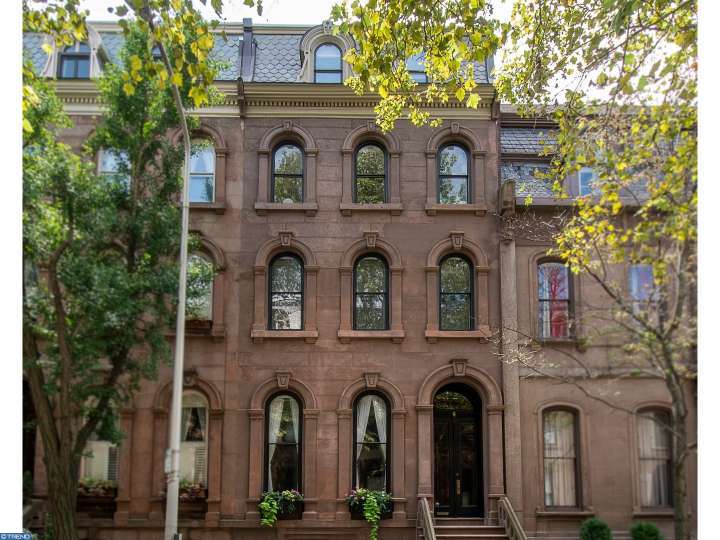
2012 Spruce St near Rittenhouse Sq (now for sale for $3,690,000)
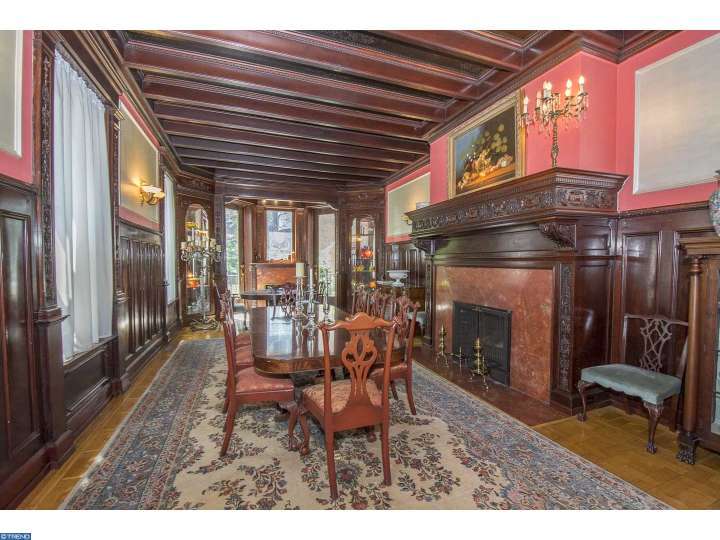
2012 Spruce St near Rittenhouse Sq dining room now
I bought something to sleep on - a bed - and a lounge chair to put on the porch. Little else.
On the job, I spent my time learning all that could be learned about each job in the Department and then set about making improvements. Bill Keane was enthused and when I presented the suggested budget for salaries for the next year he said "There should be a nice raise for you, Bill."
It turned out that Al King vetoed it (again) because he had a promotion in mind for me which would entail a raise. Such logic.
Off the job I mainly courted Perry, who still lived in New York. I had expected that we would break up when I left New York but we didn't.
We visited every weekend. Either I went to New York or she came to Philly. During the week we talked on the phone.
This continued for a while. Then Crockett came to visit and he and Perry and I had fun. I mention that because he immediately called Mom and said "If you want to meet the girl he's going to marry, you'd better come up". They did. We had a great time and Mom and Dad left for Nashville on Saturday. Perry was down for the weekend and she and I walked on Sunday and ended in Rittenhouse Square as I had planned. I sat down with her on a bench in the park as I planned. It was there that I proposed to her. Her eyes really lit up and she said "Yes". We called her Mother and began to make plans for a Fall wedding.
The promotion did come through. Lang Shulz, lead auditor and trouble shooter for Al King had been temporarily assigned to a new position as Factory Accountant for The Production Division - meaning all manufacturing facilities. He wanted me to be The Assistant Production Division Accountant with the idea that I would become the Accountant in a year or so.
Lang was a good friend. He had been my boss when I did audits earlier and we got along well. Over the years when I'd lived in New York he'd have me out to his place as a guest. Many times he and I played golf together. I'd get a train to Long Island where he lived. We'd then drive to a public course, register to play and return to his place where his wife would give us breakfast. After talking a while, we'd drive to the course in time for our scheduled tee time.
Mr. Wallace called me to New York to offer me the job - which I accepted.
I moved back to the Penn Club and took Brother Bob with me. He had just graduated from Vanderbilt. We got a double room with a bath and he took his singing lessons and I worked at the Otis factory in Yonkers, New York. The plant was large and located on the Hudson River. I rode the subway to Grand Central Station and then The New York Central RR to Yonkers.
This is a good time to insert something about Bob. He had attende Eakin School, then Palmer and finally Duncan. Duncan was aprivate boys school. There Bob was President of his fraternity, Delta Sigma, and for three years was president of his class. He was a member of the Honor Society. He won an Elgin watch in a speech contest on the day of graduation. Bob sang at church and was the soloist with a Nashvile orchestra led by Bill Yandell. He was on TV while at Vandy and sang on the Shell Oil program. In a tryout for a program in Nashville, he won out over Pat Boone.
He ran the card system (which I had originated) while at Vandy. He was president of the Men's Glee Club and President of the A Capella Choir. He was elected Eminent Recorder (Secretary) of SAE for two years and the Eminent Archon (President) as a senior. He was in the National guard and placed on active duty as a medical technician from April '51 until Aug '52. He served in Memphis, Tn and later at Shaw Air Force base near Sumter, SC. Originally scheduled to graduate in 1953, the Koean War delayed his graduation until 1955. Ultimately, the wedding day came for Perry and me. On the previous evening, there was a nice rehearsal dinner given by Mom and Dad. Afterward we all went to see a new British actress who was thought to have promise. Her name was Julie Andrews. She was the star in the stageplay "The Boy Friend' which we all enjoyed. We were married in St. Bartholomews Episcopal Church on Park Avenue on September 10, 1955. A gorgeous place and a stellar location on New York's most prestigious avenue. As the cab took us to the wedding (Crockett was my Best Man) I could see the beautifully decorated canopy in front of the church. Once inside, arrangements were all made. We just had to wait for the ceremony.
Then it started. Bob sang. Crockett and I were told to go into the church and then Perry appeared at the other end of the aisle. What a gorgeous picture she made! All brides are radiant, I suppose, but Perry looked stupendous. in her gown and veil. She came down the aisle on her father's arm and in almost no time the ceremony was over. I had bought her a diamond band for a wedding ring and she jumped a little with delight when she saw it. But best of all was the way she looked at me when it was time to kiss. We were married!
As we turned and walked down the aisle we waved at our parents and friends. As we neared the door of the church we could see outside. My family had arranged to have a horse drawn carriage meet us at the door instead of the limousine which had been hired. When she saw it, Perry said "Oh Goodie". We rode up and down Park Avenue for a while and of course everyone we passed was full of smiles and shouted well wishes. The weather was more than kind it was beautiful.
The ride ended at the Park Lane Hotel where we had the reception.
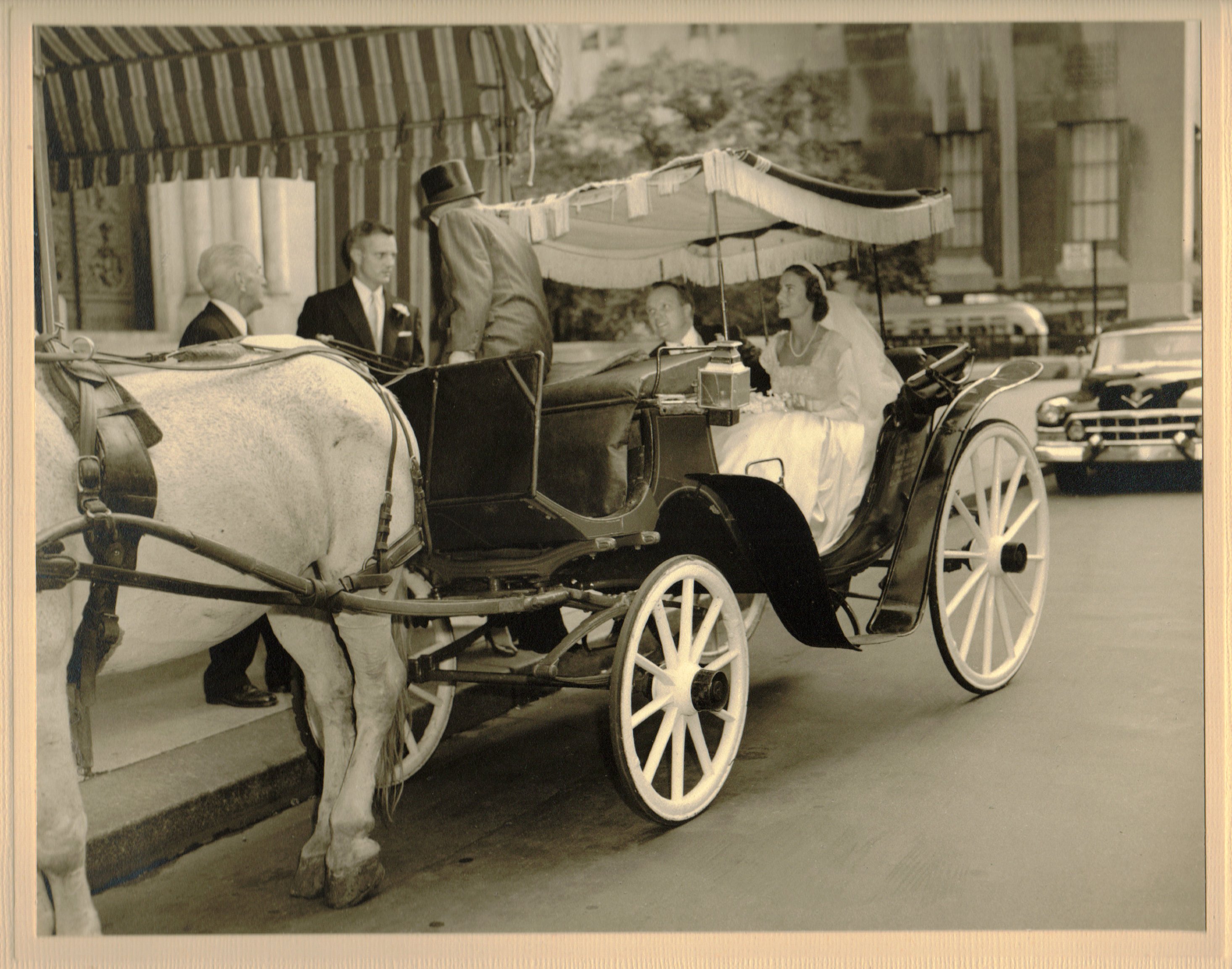
Carriage from the Wedding Arriving at the Parklane Hotel in New York City 1955 William T Watson and Mary Pierson Fitch
There was the usual toasting, feeding and eating of cake. Then we changed clothes and said our goodbyes and thanks to everyone and took a cab to the Waldorf Hotel where we spent our first night together.
We had a fairly early flight scheduled the next morning. We arose, ate, called our parents and took a cab to the airport. We spent the next two weeks at Cloister in Sea Island. Wonderfull place. Wonderful wife, wonderful time.
We spent about ten days there along with other honeymooners. Vice President Nixon was scheduled to come down while we were ther but couldn't.
There is no question about it - marrying Perry Fitch was the best thing that ever happened to me. Nothing else is even on the horizon.
On the way home we stopped in Nashville. We bought our first car there: a Plymouth convertible. It was sitting on the turntable in the showroom and suited us. We took out a three year loan with payments of $75.00 per month.
We returned to New York and our jobs. I drove to Yonkers and she worked in Manhattan. Perry was earning more than I was. She was a fashion executive and looked the part. Very stylish as well as good looking.
We moved into her apartment on East 82nd Street for about a week. Then her father took a job at a boy's school in Pawling, New York and her parents offered us the apartment they had under lease if we took over payments. We moved to ??? West 115th Street. The building had a doorman and an elevator. Her parents left most of the furniture for us. We had living Room, dining Room, kitchen, bedrooms, bath. Very roomy. Tenth floor with a bit of a view of the Hudson River. We also took over the garage rental that Perry's parents had. They had valet service which provided that we just called and the car was delivered. On returning, we'd pick up the valet and he'd drop us off.
We stayed there until Perry became pregnant. Then we looked for a place out of the city and located an apartment on North Broadway in Yonkers, NY - near my office. No garage nor valet service.
Our first child was born in New York Hospital on June 5, 1956. Mary Pierson Watson was a little larger than average. Her Mom had fed her a lot of steaks and potatoes while she was pregnant. She was expected to be a boy by the doctor. He said "You have a fine boy, er, girl." as she came out.
There was no mistaking who her father was. If one looked at her in the basinnette, the resemblance to me was astounding.
One amusing point. When the doctor and Perry were talking about the expected birthdate of the baby, it appeared that the birthdate would be before June 10. Perry said "That can't be, we were married on the 10th of September. It won't be nine months until June 10th". She didn't know that the cycle is usualy 180 days, not exactly nine months. We were suckered into the "natural" childbirth movement which subjects the mother to pain she need not experience. I held her hand when she was experiencing labor pains and she practically broke my hand with her grip.
We had a healthy baby and went home to Yonkers after a few days. Perry had quit her job shortly before Mary came, so she was at home to take care of the baby and herself. I was just a few blocks away at Otis.
We were visiting her parents in Pawling and Mary was playing in the yard when she smashed her hand and one of her fingers was actually mashed flat. We called the doctor, who came by. By that time May's finger had snapped back into position and she was playing in the yard. The doctor walked up and said "Is this the little girl with the terribly smashed finger?" Of course it was. He said that, at that age, children have something like a green twig on a tree. It can be crushed but will recover.
Her father passed away that year. He got to see his grandchild and we have a picture of them together. He had a sudden heart attack and was gone. Perry's Mom moved to Yonkers and took an apartment of her own. We saw a lot of her and she was a real blessing to us in helping with the baby and otherwise.
My work at Otis went on. Otis had taken a contract with Brunswick to make their automatic pinsetter machines. This was a big contract because bowling was popular and every bowling alley had pin boys who had to pick up the bowling ball, return it to the bowler, pick up the pins and reset them. This was expensive and it was hard to get reliable pin boys.
We numbered the first pinsetter to be #19 - they didn't want anyone to think they had the first one. They were a hit! Sold like hotcakes and we had to continually raise production rates.
At that time IBM punched cards were used for payroll and other activities. I combined the punched card departments of Harrison and Yonkers in Yonkers. It was difficult to keep employees and I looked for a way to save money. I learned of a new stored program computer being developed by IBM called the 650. After considerable investigation I ordered one and assembled a team to program it. It used punched cards but had a program stored in the computer which picked up information from the cards and developed payroll information. I researched the available equipment and found that we could buy a burster which separated the documents from each other and also pulled off the portion of the computer paper which contained the holes for guiding the paper through the printer and burster. One giant leap forward was the actual printing and signing of checks by machine. I had trouble getting approval from the Treasurer of Otis to have a machine sign checks but we devised a signature plate which could be taken out of the machine and we placed this under the control of an auditor along with the checks. It was quite a thing in those days to see the checks coming out rapidly and being separated and signed by the machine as it stacked them.
IBM wanted to feature me in an ad they were going to run on successful applications of the 650 but we didn't receive approval from Otis to do it. I think Otis was afraid that any publicity for an individual might lead to a job offer from another company.
As nature will have it, Perry began to expect another child and we felt that the apartment was not the place for two little children. There was really no place for them to play.
We searched for a house. Perry and I whenI was available and she and her mother at other times. We found one in Ossining which we liked. It had a beautiful view of teh Hudson and was near a friend of Perry's. We couldn't swing the financing and had to let it go.
One day we came upon a house in North Tarrytown, NY which was owned by a widow who wanted to sell. The house didn't look good, needed painting inside and out and the yard was run down.
It was in a fine section of town called Philipse Manor. Schools and churches were good. The house was within walking distance of a commuter station on the Pennsylvania Railroad - which also stopped in Yonkers The area was on the Hudson River. There was a beach on the river owned by the residents and folks had sailboats there as well as barbeque grills.
Perry's Mom lent us the down payment and we moved into 107 Harwood Avenue. It was an unusual house. It was constructed of steel and concrete - no wood. The owner had been afraid of fire and woulf have nothing flammable used in construction.
It was two story. Entrance hall, living room and screen porch to the right. Dining room to the left with kitchen behind. Theentrance hall ran alongside steps to the upstairs and ended in the kitchen. There was a nice bootharrangement in the kitchen and window to see outdoors.
Upstairs ther was a bathroom at the head of the stairs and bedrooms. The master bedroom was above the living room and had a small hath off of it with a shower stall.
There was a pull-down stair to the attic. The basement could be reached by stairs from the kitchen or from a door to the outside.
We had little but our furniture 9though plenty of that) and needed things like a lawn mower dish washer and clothes washer. I got a push mower and spent many hours mowing with it while my neighbors used power mowers. We had a washing machine in the basement and it was busy washing diapers, especially after our second child was born.
I strung wire back and forth across the basement from wall to wall to hold wet diapers and dry them. If one walked through the basement, one would be hit in the face by rows of diapers hanging from the wires. Ignorant as we were, we didn't realize that Mary wasn't getting enough solid food. We thought she was just cranky and cried all the time. Fortunately, brother Crockett came for a visit and diagnosed the situation. He taught us how to make proper food and feed it to a baby. He'd sit in a straight chair, put Mary in his lap with her face up toward him and with her legs on either side of him. He'd hold the food dish in one hand and the spoon in the other. Soon he was virtually pouring the food down her throat. In no time, Perry and I were doing the same and Mary was sleeping through the night, happy as could be.
Our second child, William Taylor Watson IV, was born on October 2, 1956 - a little over a year after his sister's birth. He was born at the Yonkers General Hospital. Son and Mom did well.
Mom always said that the Watson men just had to hang their pants on the bedpost and their wives were pregnant. Some of our friends had trouble having babies. We were grateful that it was so easy for us.
Mary had been weaned from the bottle before Bill came but immediately went back to the bottle when she saw him with one.
We were advocates of Dr. Spock. We read his book and were amazed at how he could tell in advance what would happen. Very helpful.
Perry was not only a wondeerful wife, she was an angel of a mother. She spent time purring over her little ones saying bright and cheerful things - singing little songs, playing with them, reading to them.
Our children were fortunate to have such a devoted and intelligent mother.
I had lots of fun with the kids. We had a rocking chair and I spent many hours rocking little ones to sleep as I sang to them.
We played in the yard. Our backyard was amle and flat. We put in a sandbox and swings set. We also devised a leash and post arrangement fro Mary - like the ones used with puppies. This let Mary roam a lot but kept her close by. Mom could run in the house and not worry that Mary would go far.
While there I planted flowers in the back yard. We had beautiful cut flowers: Asters, etc.
The weather can be cold there. We had snow regularly. One year the snow was as high as the hood on the car. After the top layer froze, we could dig tunnels under the snow. Snowmen, snowball fights. Sled riding. What fun!
I commuted to Otis on the train and left Perry the car. We had a garage. One day Perry got Mary in the car in the garage and began to back the car. Unfortunately, she hadn't yet opened the garage door. Oh well.
For a while, Perry's Mom lived with us but she decided that we'd all be better off if she had a separate place and found one in Yonkers. We still saw her regularly.
I became active in the Beach club and became the Beach Vice President. This meant I had to see that the beach was cleaned up and ready for opening day. I hired a life guard, bought floats and rope to mark the swimming area and did whatever was necessary to keep the beach operating.
My time began to be taken up in politics when the 1956 elections came around. I was selected as Vice Chairman of tha Central committee for the Yonkers for Eisenhower campaign. My position in Otis put me in contact with lots of people who were outspokenly in favor of Ike. This is interesting beause we had an office union as well as a plant union and the union supported Democrats. Yet lots of union members supported Republicans.
Therefore I could round up a good sized group of people any evening when work had to be done. Someone would call and tell me that a large number of envelopes had to be addressed and I could getit done quickly.
There I met Bob Barry, who headed Ike's campaign in Yonkers and Mrs. J. Kendrick Noble who was next in line on the Ike team in Yonkers. He, She and I became friends and she sort of took me under her wing. Her son, Ken, and his wife became friends of Perry and me.
Somewhere along this time, Lang went to the New York office and I became the top financial man for the largest division of Otis. My title was Accounting Manager. I reported to the Production Vice President, Leroy Whitton.
At thaat time, I was also the highest ranking person in Otis of my generation and I had the advantage of being experienced in the sales end of the business (not as a salesman but I understood the business) and had spent years as a troubleshooter for the executive offices.
Still, my pay was below what others made whom I met. I had started out competitively financially but raises had not matched what others in other companies received. Otis didn't like for people to get too prominent. I asked to be allowed to join the Controller's Institute (now the Financial Executives Institute) but was turned down by Otis executives who said that was intended for top Controllers only. I knew others who belonged and who didn't have the responsibilty nor accomplishments I had.
In 1958, Ralph Gwynn, who had been congressman for Westchester and other nearby areas for years, announced that he might retire. Bob Barry leapt at the opportunity and said that, if Ralph did retire, he would run for that seat.
Bob asked me to be join THeodore Kendl, a prominent New York attorney, as CoChairmen of his election committee. We both agreed and the committe had two heads. Not good usually, but Ted was mainly a figurehead to get influential people. Iwas the working head. Bob barry didn't really need a committe chairman. He was so active and capable that he could do it all himself.
Bob was an attractive person who had worked in politics for a number of others and was well known. He obtained letters from many prominent people including President Eisenhower and Governor Dewey lauding his ability and performance. He had a lovely wife, Ann and two fine looking children. He was wealthy and was not hampered by having to go to a job every day.
The only drawback was that Ralph hadn't yet decided to withdraw and the Republican Party hadn't decided who would be the nominee if he did withdraw.
In the background was the fact that Malcolm Wilson, a popular Republican was "in line" to follow Raplh. The seat was supposed to go to Malcolm if he wanted it. Malcolm was a leader in the New York legislature and became Lieutenant Governor.
When Ralph decided to leave the congress, the Republican leader of Yonkers and the Republican leader of Westchester County selected the Mayor of Yonkers to run for the office as the Republican nominee. He was elderly, popular and would occupy the seat for a few years until Malcolm was ready to take it.
We were ready for this. We also were ready to run if Ralph Gwynn had decided to stay in office.
To understand the situation, the two bigwigs decided everything for the Republicans. No one had opposed the Republican leaders and defeated them in forty years.
We organized Putnam County - got the Republican party leader there to endorse Bob. We organized other areas and got endorsements from many leaders. One of my business associates, Russell Coapman, was head of the Republican Party in Dobbs Ferry.
We put out two papers to registered Republicans. Both were on "slick" paper, very high quality and told of Bob's ability and experience. They were laden with endorsements and pictures of Bo with bigwigs. They sold the candidate.
I obtained billboard ads in prominent places in the district and had buses carry posters in full view - inside and out- showing a picture of Bob and our slogan. We went to various Republican events and were given the cold shoulder at many because we were not "Regular Republicans" meaning we didn't accept teh decision of the leaders as to who should be congressman.
Bob always wanted me to accompany him on his rounds. He thought it looked better if the candidate didn't have to go alone. It got so people couldn't tell us apart and I was often spoken to as Mr. Barry.
One day, Perry and I accompanied Bob to a republican picnic in Yonkers. Bill was in the stroller and mary was alongside. Governor Rockefeller was there and picked Bill up and kissed him. (Politicians are always said to kiss babies - this one did). Bob and I were moving around talking to peopel and the head of the Republicans, a woma, came over and asked us to leave. She said this was a party for regular Reublicans and we were not welcome.
We couldn't have asked for more help. The next days papers all had a picture of her and Bob. We left but if we had needed a boost this would be it. The election followed immediately. I put up postersa at every commuter RR station in our district urging people to vote for Bob.
When the results were in, Bob had won! we had a big celebration at his house. The boss Republicans had never lost a primary in forty years.
The Republican nomination in Westchester was tantamount to election. As Bob said, we coulkd go to Bermuda and be elected. of couse we didn't. We carried on a good campaign and won. Bob went to Washington.